
A Rare Opportunity!
SALE!
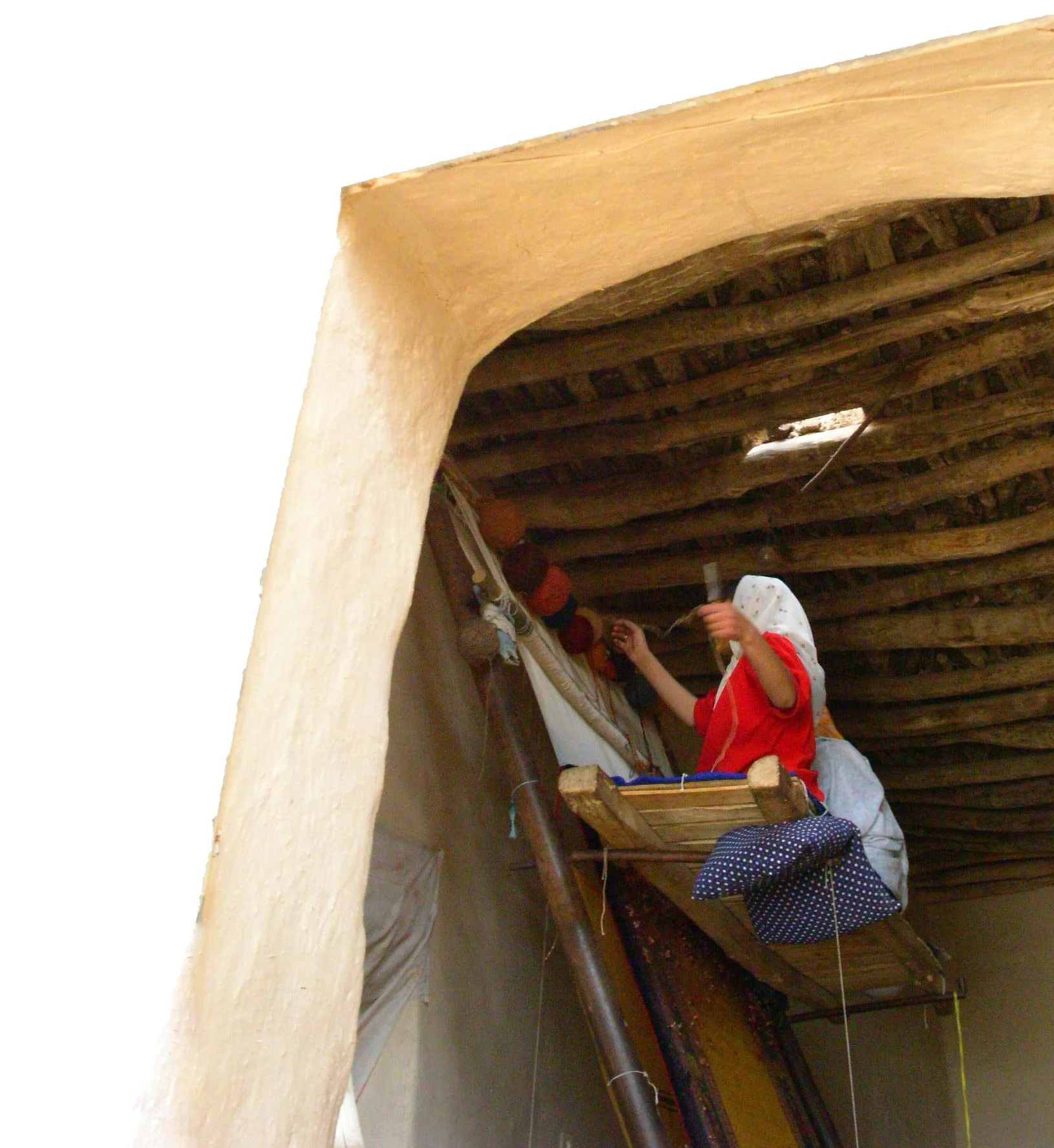
For decades, we have carefully collected exceptional Persian rugs, selecting each piece with knowledge, care, and love.As we make room for our new exclusive collections, we are releasing a limited number of these remarkable rugs at genuine sale prices.Those who know us know that we rarely offer discounts.Limited pieces. Genuine savings. Once sold, they are gone.Don't miss it!Shipping can be arranged at a very reasonable cost.

This beautiful rug is a celebration of texture, simplicity, and the quiet beauty of natural materials. Handwoven by the Lori tribes of southwestern Iran, it reflects a weaving tradition shaped by centuries of nomadic life among the valleys of the Zagros Mountains and the plains stretching towards the Persian Gulf.
The wool comes from the weavers' own sheep, handspun and left undyed to preserve its natural character. The gentle ivory field is animated by delicate streaks of grey, brown, and charcoal, creating a subtle rhythm reminiscent of windswept grasslands, flowing water, or the grain of weathered timber. The beauty of the rug emerges entirely from the natural variation of the wool, without the use of dyes.
Its restrained palette and richly textured surface give the piece a distinctly contemporary presence while remaining deeply connected to its tribal origins. Minimal yet expressive, it rewards closer observation, revealing layers of movement and nuance that change with the light and the viewer's perspective.
Elegant in its simplicity, this rug introduces texture, depth, and visual interest without overwhelming a space. Its natural palette allows it to sit comfortably within both modern and classic interiors, complementing rather than competing with its surroundings.
Authentic Reduction.
Don't Miss Out.


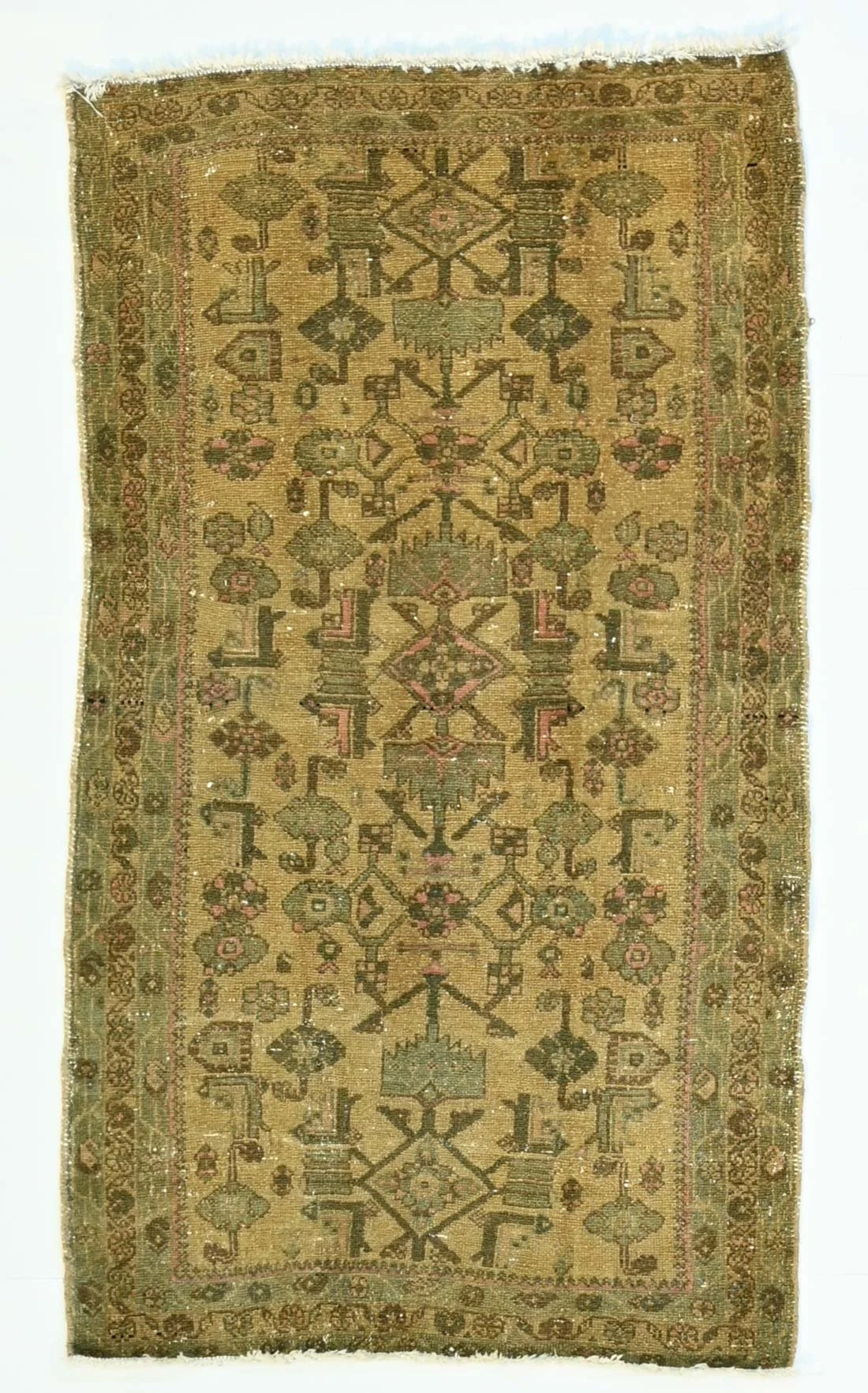
There are hundreds of villages scattered around the regions of Qazvin, Zanjan, and Hamedan, each preserving its own weaving traditions, patterns, and colour palettes. Many of the rugs woven in these villages came to be known as Musel rugs, most probably because the city of Mosul in Iraq was once an important trading hub where such pieces were highly appreciated and widely traded among the Arab nomads and Bedouins of Iraq and Arabia.
This particular Musel rug, most probably woven around the 1950s, carries a very different kind of beauty. Years of use, exposure to sunlight, and the passage of time have softened both its colours and its surface. The pile has gently worn down, creating a texture that cannot truly be reproduced artificially.
What remains is a quieter beauty.
The once vibrant colours have settled into subtle earthy tones, giving the rug a calm and understated presence. Rather than dominating a room, it melts naturally into its surroundings, enriching the interior space with warmth, atmosphere, and depth.
Such pieces have a unique charm because age itself has become part of their design. Time has collaborated with the weaver, softening edges, muting contrasts, and creating a harmony that only decades of living can produce.
It is this honesty of wear and this quiet maturity that make rugs like this deeply appealing. They do not shout for attention, yet the longer one lives with them, the more their beauty reveals itself.

The village of Shul, situated in Fars province not far from Persepolis, is associated with settled Qashqai communities whose way of life stood between nomadic pastoralism and village settlement. Many of these communities maintained permanent villages while preserving strong tribal ties and elements of their migratory heritage. Their cultural landscape was closely connected to the heartland of ancient Persia and the region surrounding Persepolis.
The rugs woven in Shul are often admired for their simplicity. Unlike many Persian carpets that rely on elaborate colours and intricate ornamentation, Shul weavings frequently employ natural undyed wool, limited palettes, and highly restrained compositions. Their beauty lies not in complexity but in confidence, allowing form, texture, and symbolism to take centre stage.
This remarkable Gabbeh is a fine example. Four large medallions are arranged along a central axis, creating a calm and balanced composition. At first glance the design appears minimal, yet a closer look reveals some of the most intriguing motifs found in village weaving traditions. Within each medallion, stylised human-like figures seem to be seated around a central flower, as if participating in a gathering whose meaning has long been forgotten.
The flower itself is particularly fascinating. Its form recalls the stylised lotus that appears repeatedly in the reliefs of nearby Persepolis, one of the most enduring symbols of the Achaemenid world. Whether this resemblance is intentional, inherited through generations of visual memory, or simply coincidental is impossible to know. Like many motifs in tribal weaving, the original meaning may have faded long ago while the form itself continued to survive through tradition.
Such mysteries are part of the enduring charm of village rugs. The weaver may have been copying motifs inherited from earlier generations without knowing their original significance, or perhaps she attached meanings of her own. Whatever the case, the presence of these figures surrounding a lotus-like flower invites speculation and imagination.
Woven in natural shades of ivory and brown, this rug demonstrates how simplicity can be profoundly expressive. It stands as a quiet reminder that some of the oldest visual memories of a civilisation may survive not in monuments or written records, but in the humble weavings of village women who preserved ancient forms through centuries of repetition.

The Kurds of Kelardasht are believed to be descendants of Kurdish tribes who were moved from western Iran to Khorasan by Shah Abbas the Great in the early seventeenth century to defend the northeastern frontiers of the Safavid Empire against Uzbek and Turkmen incursions. Over time, some of these communities migrated again and settled on the northern slopes of the Alborz Mountains around the beautiful valley of Kelardasht.
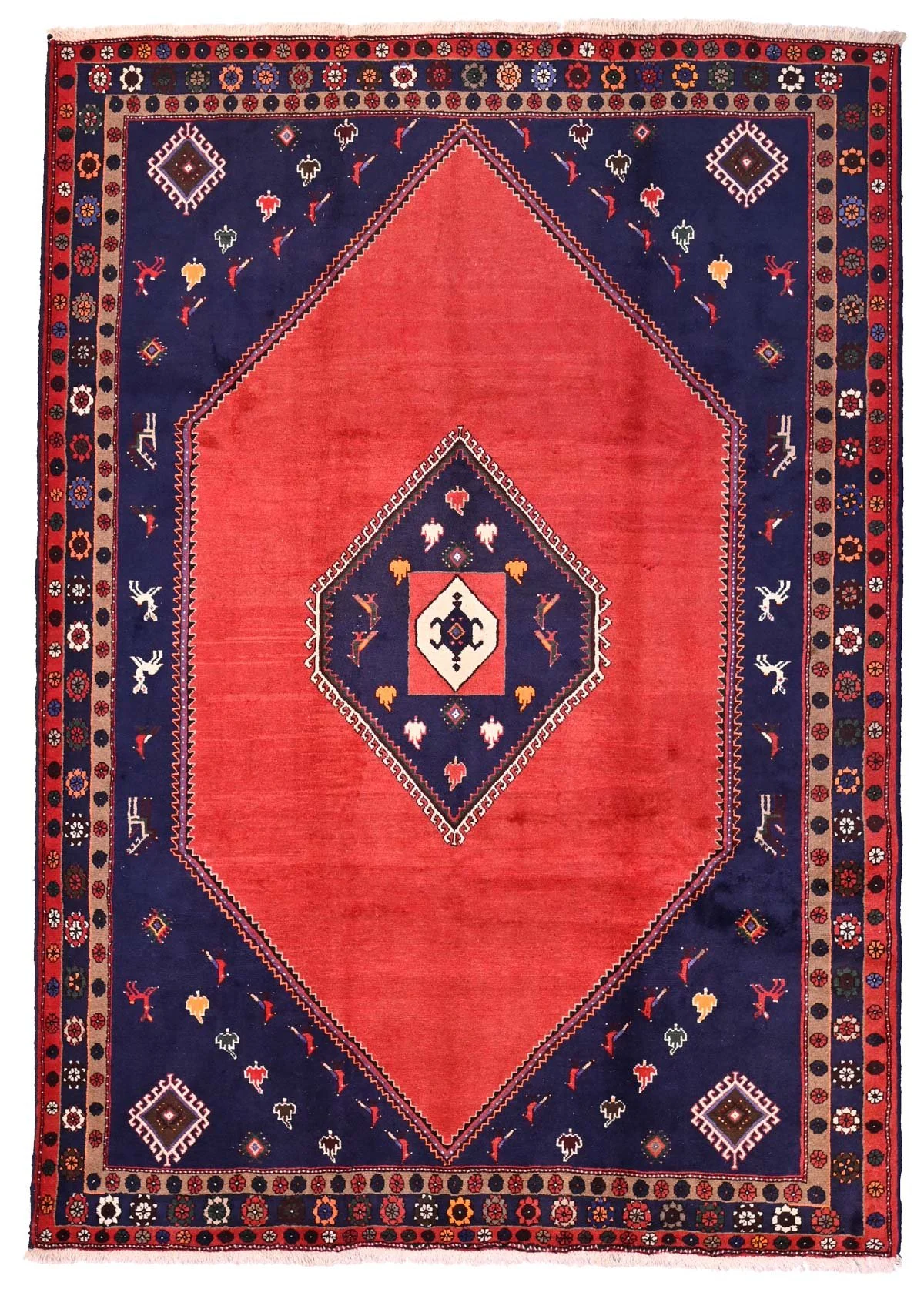
Living among forests and mountains, they developed a weaving tradition distinctly their own. While retaining elements of their Kurdish heritage, their carpets gradually diverged from those woven by their cousins in Khorasan and western Iran. The open fields, bold geometric medallions, stylised animals, and spacious compositions have become characteristic features of Kelardasht rugs.
Unlike many village carpets crowded with ornament, these weavings often celebrate simplicity. The large open field of this rug allows the powerful contrast between the glowing madder red and deep indigo blue to dominate the composition. Small stylised birds, animals, and protective symbols scattered throughout the field reflect the natural world surrounding the weavers and connect the rug to centuries of tribal symbolism.
Traditionally, weaving was a family activity. Large looms were often mounted against the exterior walls of wooden houses, allowing several members of the family to work together on larger pieces such as this one. The result is a carpet that combines tribal spontaneity with impressive scale and presence.
Woven of wool on a cotton foundation, this rug possesses the durability for which Kelardasht carpets are admired. The excellent wool, strong colours, and confident simplicity of the design give it a timeless quality. It is a rug that can easily last for generations while bringing warmth, character, and a sense of authenticity to any interior.
More than a decorative object, it is a reflection of a people, their history, and their adaptation to a new landscape. The mountains, forests, memories, and traditions of Kelardasht are all woven into its bold and beautiful design.
Significant transformations occur in the weavings of nomads when they settle in villages. Among the most conspicuous changes is the size of their carpets, which often become considerably larger and more conventional compared to nomadic rugs.
This transformation can be attributed to the shift in their weaving equipment. Nomads typically use small, portable, rudimentary looms consisting of two wooden poles firmly positioned horizontally on the ground, supported by stones and spikes where weavers sit to create their rugs. In contrast, when they settle in villages, they adopt larger looms that are permanently framed within their homes.
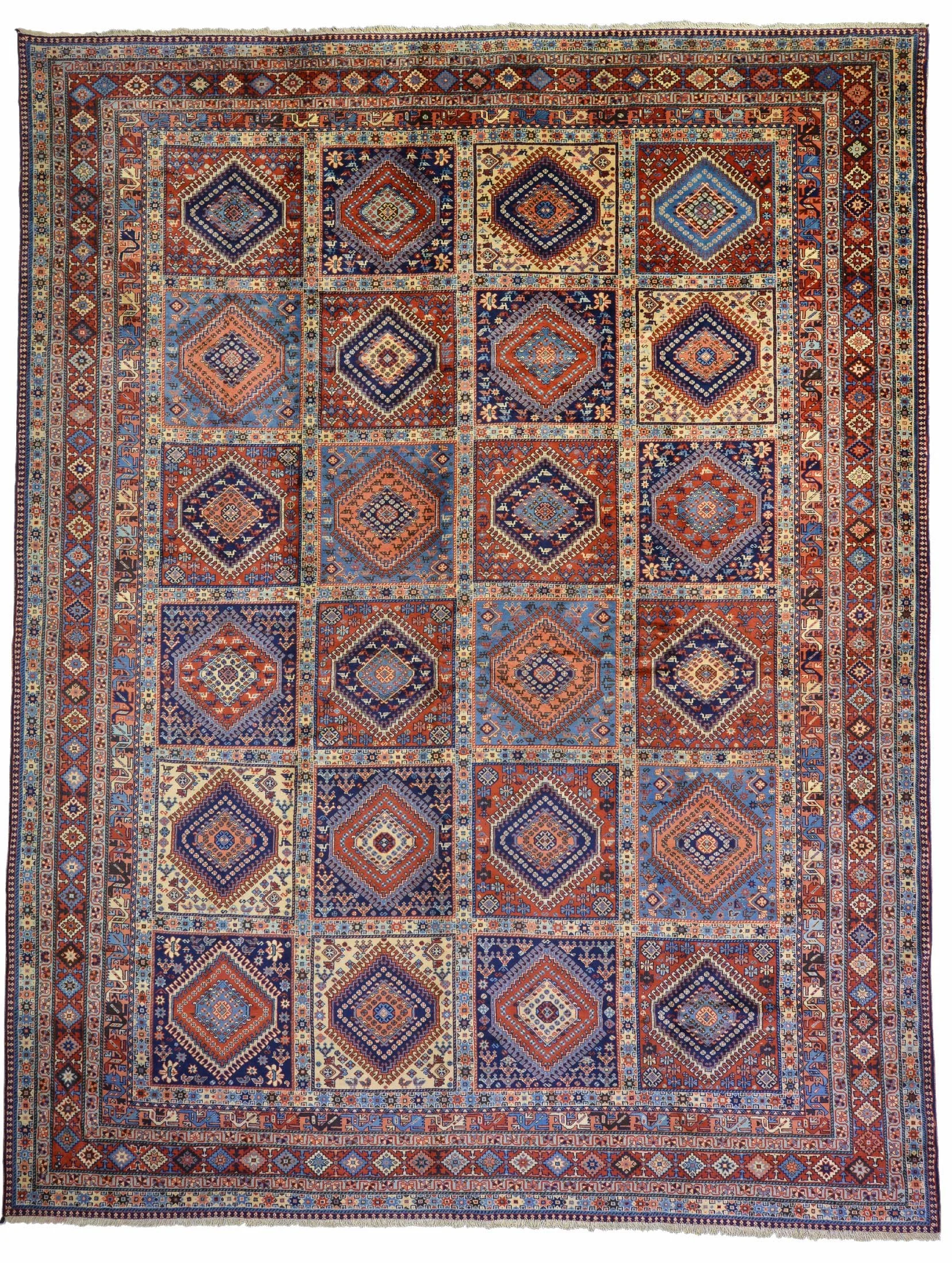
The Persian Yalameh rug here is one such rug, which is the creation of the Yalameh tribes, now settlers in northern Fars province's villages.
They reflect their ancestral symbols, with archetypical significance in their larger and far more orderly designs than those of their nomadic sisters.
Despite the mentioned differences, these people still use a fantastic quality of wool that they acquire from their nomadic relatives who roam the area during spring and summer, contributing to their carpets' amazing texture and lustre.
A super-large tribal rug!

Many village weavers are influenced by the rich legacy of their mothers and grandmothers, faithfully adhering to the family's or village's established patterns and colours. Marvels happen when a weaver decides to follow her own path and develop her own style and design. That is when traditions, folklore, myths, wishes, and dreams begin to dance to the tune of her mind, materialising as the most intriguing and beautiful carpets, such as this gorgeous Bidganeh rug. This piece presents an unusual interpretation of the 'Tree of Life' design, a motif with a history dating back over 3,000 years. Zoroastrian sources mention the tree as The Tree of All Seeds, while the great Persian philosopher of the 12th century, Sohravardi, calls it Tuba, both recognising it as the mother of all vegetation in the world.
Wool on a cotton base
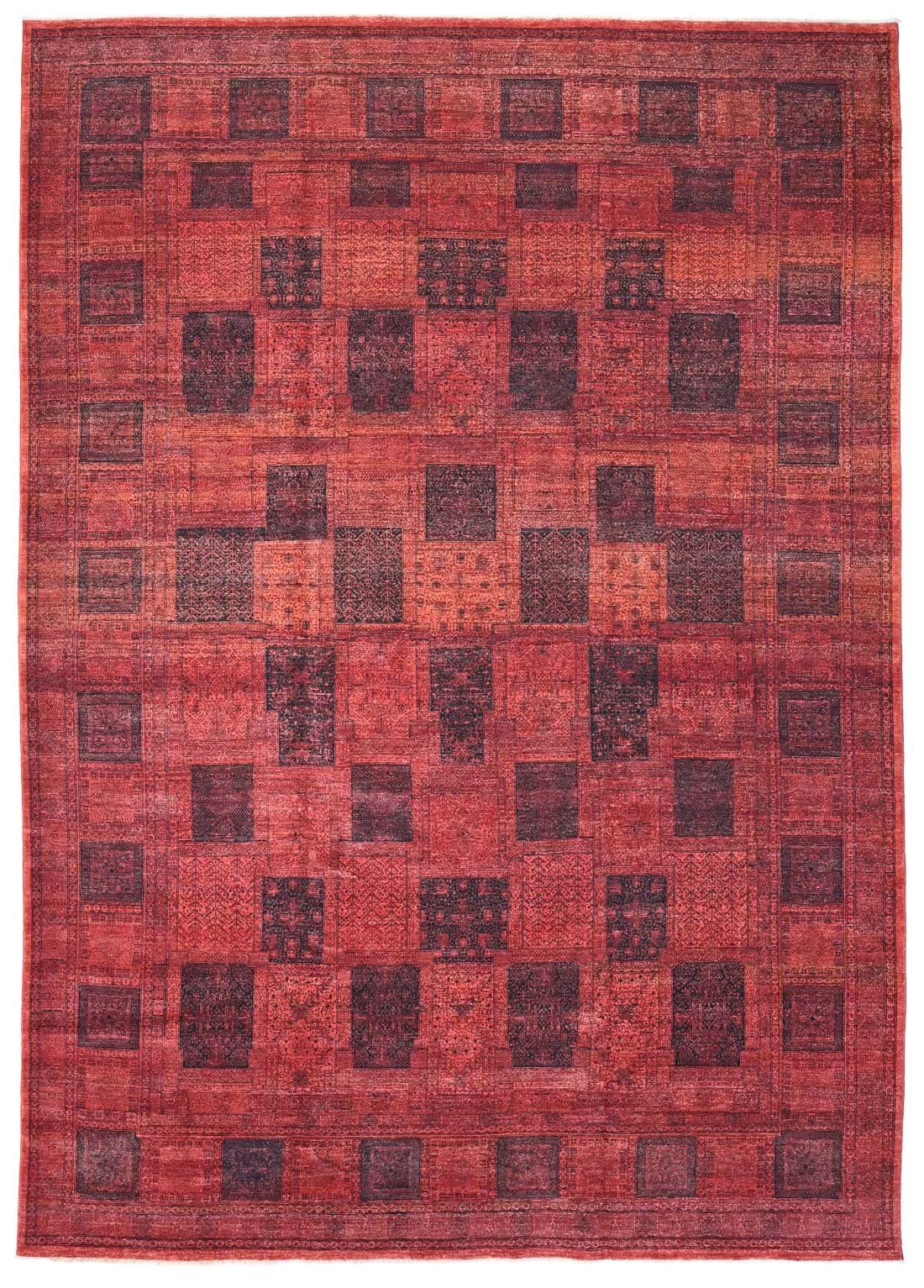
Weaving in India began to flourish in the 16th century under the Mughal court, when Emperor Akbar established imperial workshops and invited Persian artists and craftsmen, including carpet weavers, to India. Over the centuries, Indian weavers developed their own distinctive taste while remaining deeply influenced by Persian traditions. The industry continued to grow and evolve, producing some of the finest carpets outside Persia.
In the late 20th century, following the disruption of the carpet trade after the Iranian Revolution, parts of the industry adapted increasingly to Western demand and large-scale production. As a result, many carpets became more commercial in nature. Yet among the weavers, designers, and producers there have always been those who remained committed to the older traditions, striving to preserve the qualities that made the great Persian carpets so highly regarded: fine materials, careful craftsmanship, and enduring beauty.
This carpet is one such example. Woven in a distinctive design using high-quality wool imported from Iran and dyed with natural materials, it stands apart as an artistic creation rather than a purely commercial product. The subtle variations in colour, the pleasant texture of the hand-spun wool, and the balanced composition give it a character that reveals itself more with time.
Like the finest traditional carpets, it is made to age gracefully. With use, it will develop an even richer patina and greater character, while retaining its strength and beauty for generations. Elegant yet understated, it is a carpet capable of bringing both sophistication and warmth to a room.
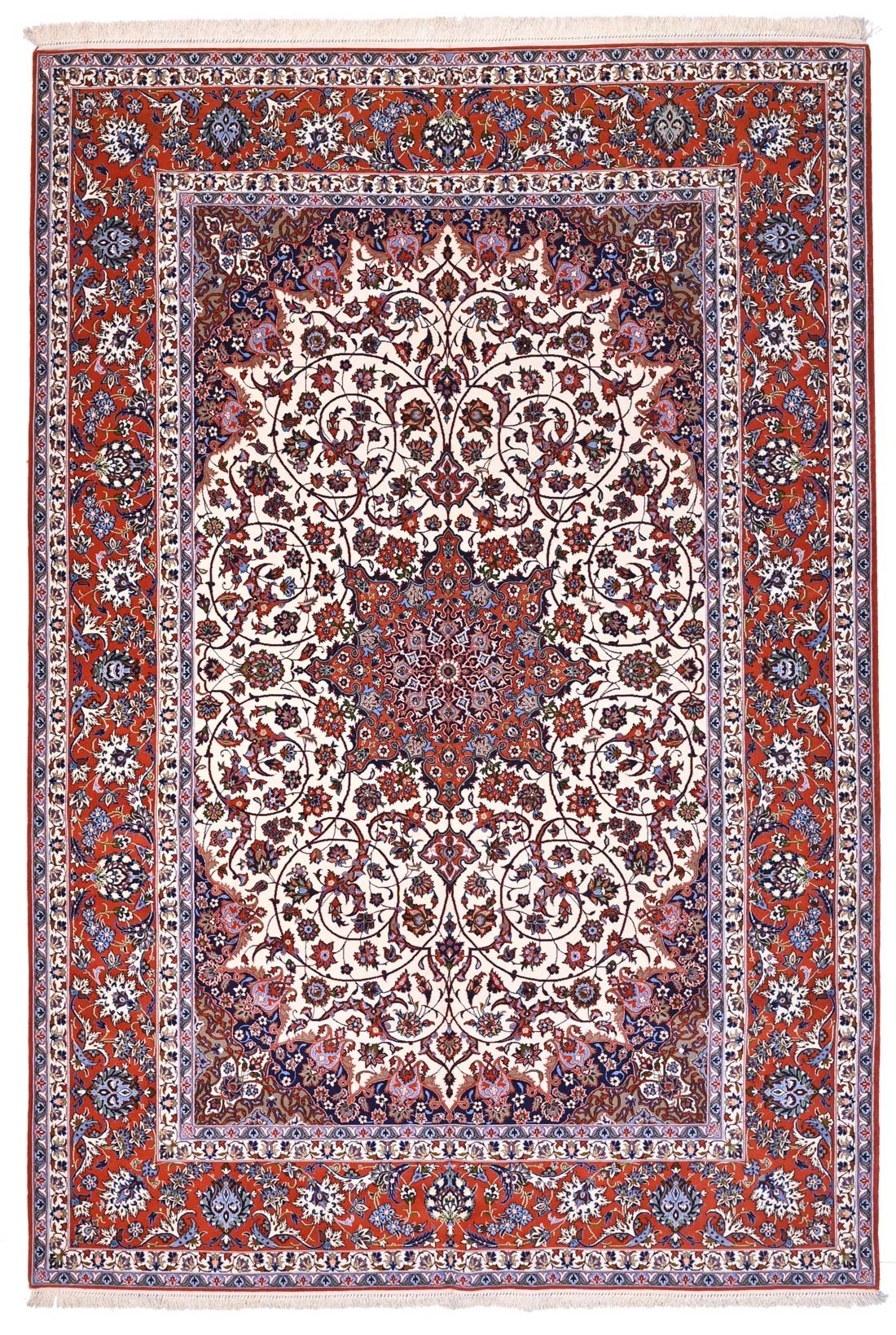
Isfahan, the crown jewel of Persian art and culture, is renowned for its magnificent palaces, intricate tile work, and timeless architectural wonders, a legacy born during the opulent Safavid era of the 16th and 17th centuries. Under the enlightened reign of kings like Shah Abbas I, art and craftsmanship flourished like never before. Among the most enduring achievements of this golden age are the breathtaking carpets that continue to inspire awe centuries later.
This exceptional piece is a masterfully woven, contemporary homage to that storied past. Inspired by a design originally commissioned by Shah Abbas himself, hence the revered "Shah Abbasi" motif, the carpet embodies the refinement and prestige of classical Persian artistry.
Meticulously handcrafted with over three million knots on a foundation of fine silk, this creation took more than a year to complete. Every detail reflects an extraordinary level of skill, passion, and heritage, making it not just a floor covering, but a true work of art.
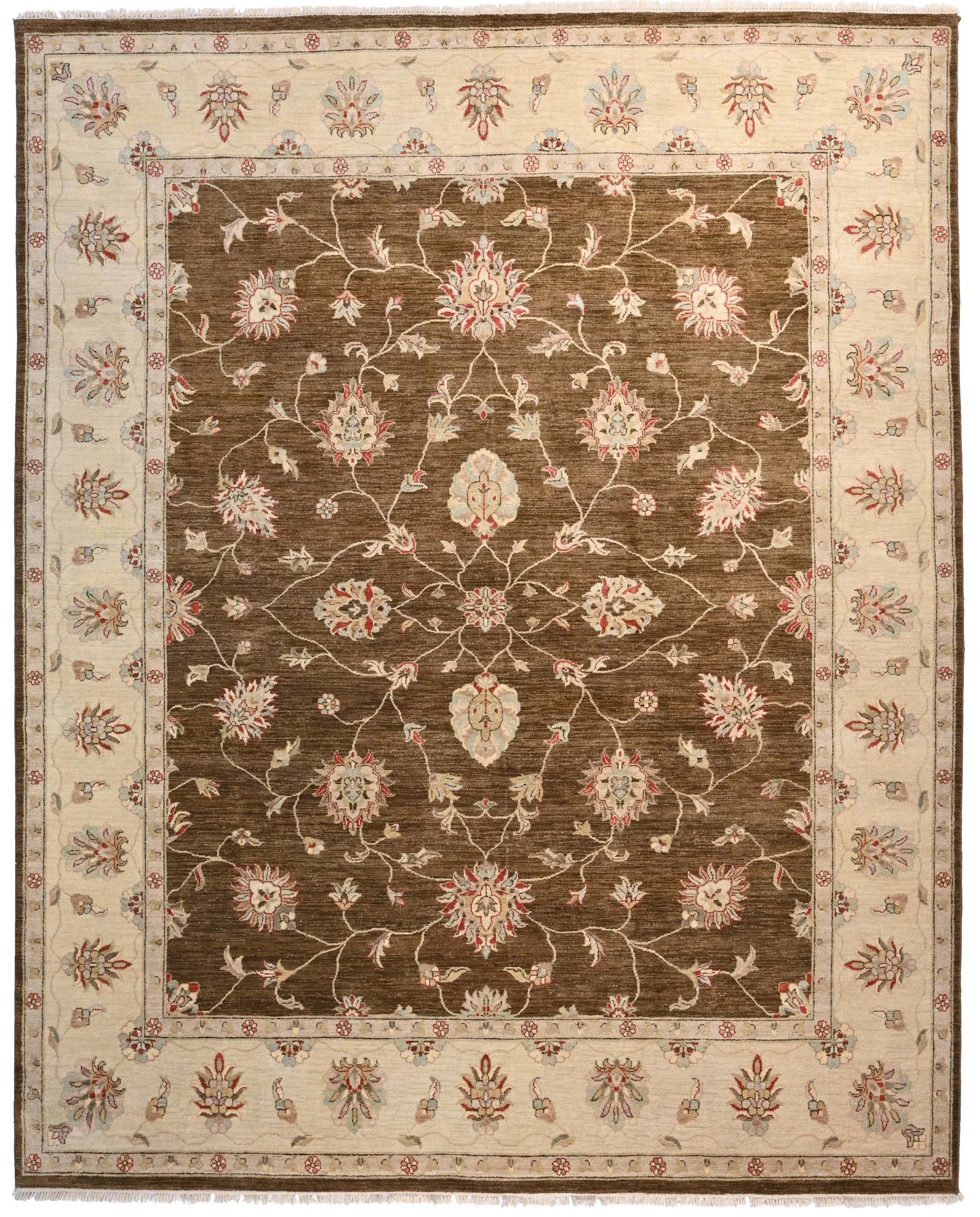
This rug is woven in the region of Varanasi in northern India, an area with a long and distinguished carpet-weaving tradition. Its design is inspired by the celebrated Ziegler carpets of the late nineteenth century, rugs originally commissioned for Western markets and woven with larger floral motifs, softer palettes, and more open compositions than most classical Persian carpets. Their elegance and versatility made them highly desirable then, and they remain just as relevant in contemporary interiors today.
The rich chocolate-brown field of this example provides a beautiful backdrop for the delicate floral design. Large palmettes, flowers, and scrolling vines spread gracefully across the surface, creating a sense of balance and calm. The restrained palette allows the pattern to breathe, while the contrast between the warm brown field and the soft ivory border gives the rug both presence and refinement.
Part of the charm of such pieces lies in the materials. The wool is hand-spun and dyed using artisanal methods, resulting in the subtle variations in tone known as abrash. These gentle shifts of colour bring life to the surface and create a richness that cannot be replicated by industrial production. Combined with the texture of the hand-spun wool, they give the rug warmth, depth, and character.
Elegant yet understated, this carpet relies not on complexity but on the harmony of colour, texture, and proportion. Its timeless design and soft, natural palette make it equally at home in both traditional and contemporary settings, where it can quietly and effortlessly enrich a space.

The cypress motif is one of the most ancient and enduring symbols found in tribal rugs. It is a motif that has travelled through generations of weavers, carried not through written instruction, but through memory and tradition. The Serv appears as early as the reliefs of Persepolis, dating back to around 500 BC, and continues through Persian literature such as the Shahnameh of Ferdowsi, as well as earlier Zoroastrian texts.
In Persian literature dating back over a thousand years, particularly in the Shahnameh of Ferdowsi, there is a reference to Zoroaster bringing two cypress trees from heaven. One of these was planted in the city of Kashmar in northeast Iran, where he began his invitation to Zoroastrian belief. According to the story, the tree grew into a magnificent symbol, later associated with a fire temple. Centuries afterwards, during the Abbasid period, it is said that the caliph ordered the tree to be cut and brought to Baghdad.
Stories like these remain in cultural memory and gradually find their way into visual expression. Motifs such as the cypress become more than decorative elements; they become carriers of memory, belief, and identity.
This rug is a fine example of that tradition. Woven by Lori Bakhtiari, nomads of Central Iran, it presents a beautifully stylised cypress tree, surrounded by complementary ornamental elements. The composition is balanced and confident, enhanced by a rich and harmonious colour palette.
Dating to the early 20th century, this piece combines excellent quality wool, natural dyes, and a refined sense of design. It remains in very good condition and stands as a strong example of how ancient symbolism continues to live through tribal weaving traditions.
P103
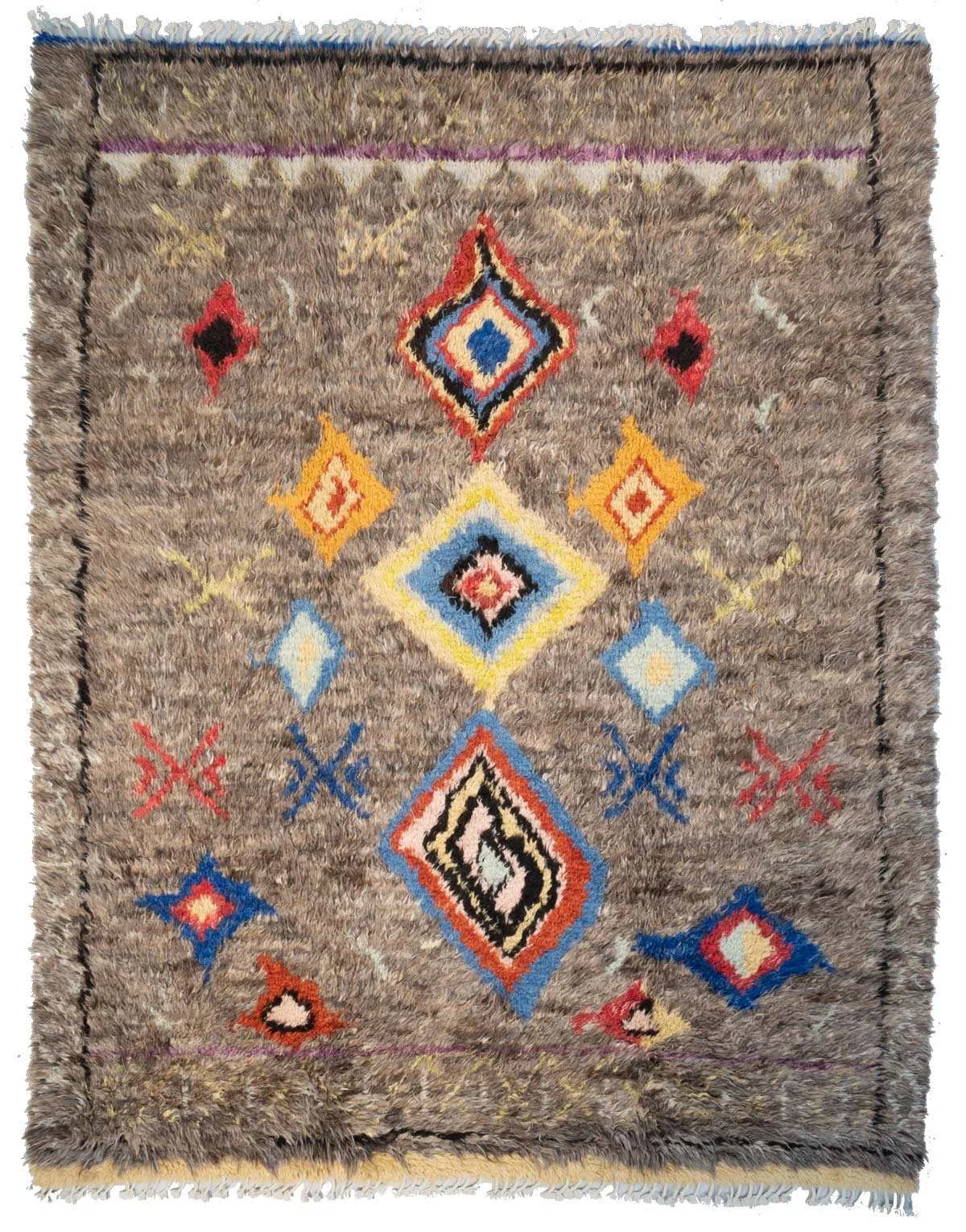

Some designs remain mysterious. They are woven for generations, each weaver inheriting the form from those before her. Perhaps the original meaning is partly lost in time, yet such motifs continue to intrigue the curious mind.
This remarkable piece is a Barjid from a village near Mount Sabalan in Azerbaijan. Its main design appears as an old motif resembling a bird with open wings. Naturally, birds have long been associated with flight, ascendance, and freedom, so it would not be surprising if this motif once carried the wish to rise, to reach higher states, perhaps even spiritual heights.
This interpretation feels especially meaningful in a region where Sufi traditions have had a strong presence. In Sufi language, birds are often used as figures of speech for the soul, spiritual journey, and ascendance. One is reminded of Attar’s Conference of the Birds, where birds become symbols of souls in search of truth.
The rug, therefore, is not merely an aesthetic object. Its beauty is more than surface decoration. It carries traces of culture, belief, myth, and old stories, all translated into wool by a weaver who may have inherited the form without necessarily knowing its full ancient meaning.
With its strong colours, bold geometry, and repeated wing-like forms, this rug has a powerful presence. It is a piece that can invite both visual pleasure and deeper contemplation, the kind of rug that keeps speaking quietly the longer one lives with it.
P103
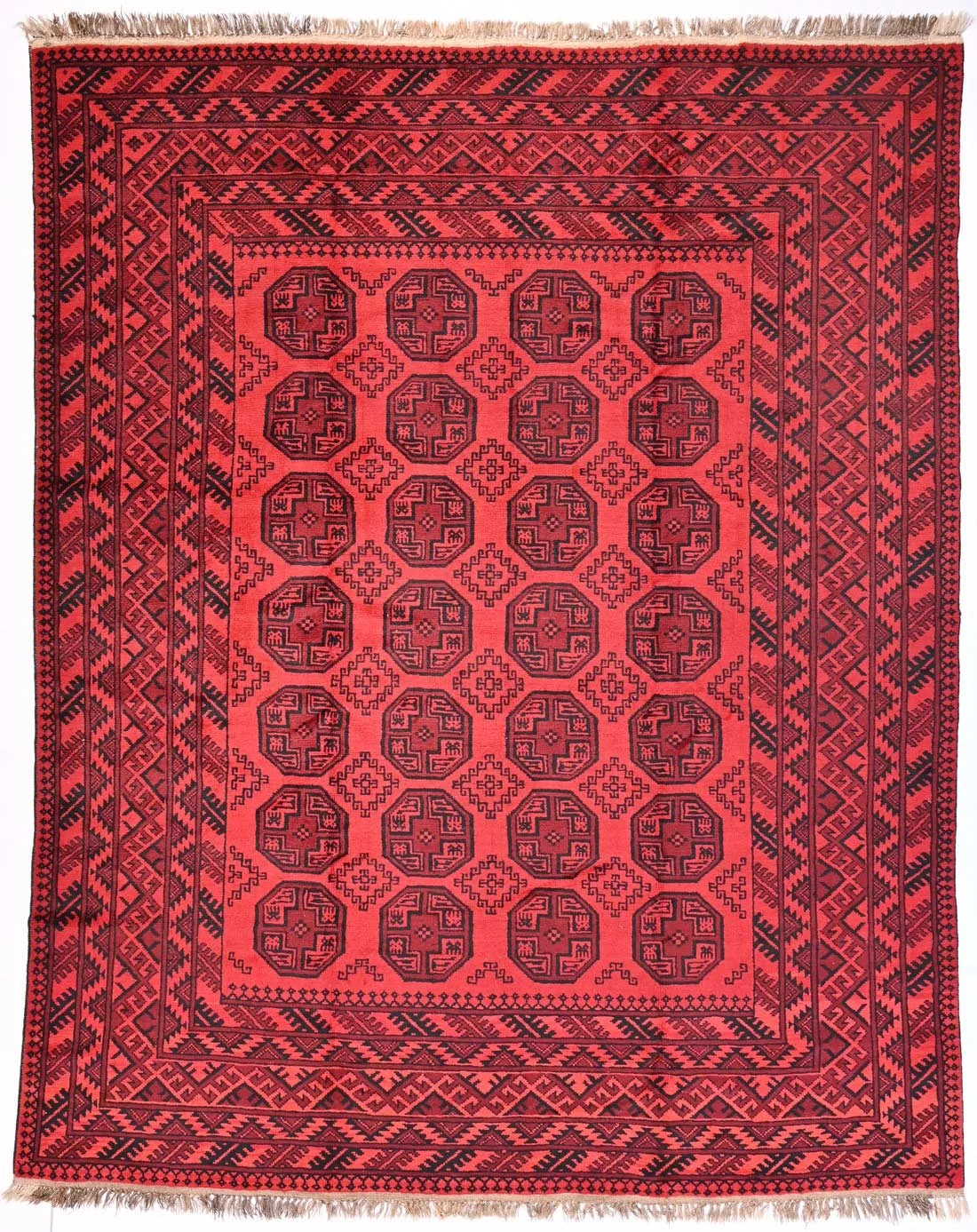
Carpets such as this are woven in and around the city of Andkhoy in northern Afghanistan, close to the borders of Turkmenistan and Uzbekistan. The region has long been home to large Turkmen and Uzbek communities, and their weaving traditions remain deeply embedded in the carpets produced there today.
The pattern seen here is composed of repeated guls, the tribal emblems that have become the most recognisable motifs of Turkmen weaving. In local Persian dialects these motifs are often called filpa, literally meaning "elephant foot," a reference to their octagonal shape. Each tribe historically developed its own variation of the gul, using it almost as a woven identity or signature.
The beauty of such rugs lies in their simplicity and confidence. Rather than elaborate floral patterns, the design relies on rhythm, repetition, and harmony. The rich red field, contrasted with deep brown and black motifs, creates a powerful visual presence while maintaining remarkable balance and order.
Woven from wool, these rugs were traditionally made for everyday use by tribal and village families. Their dense construction and practical design have made them famous for durability, often allowing them to serve several generations while retaining their beauty. The natural lustre of the wool and the depth of the colours only improve with age.
Timeless and unmistakable, Andkhoy rugs represent one of the purest expressions of Central Asian weaving culture. Their bold geometry, rich colours, and tribal character have remained fashionable for generations and continue to complement both traditional and contemporary interiors with equal ease.
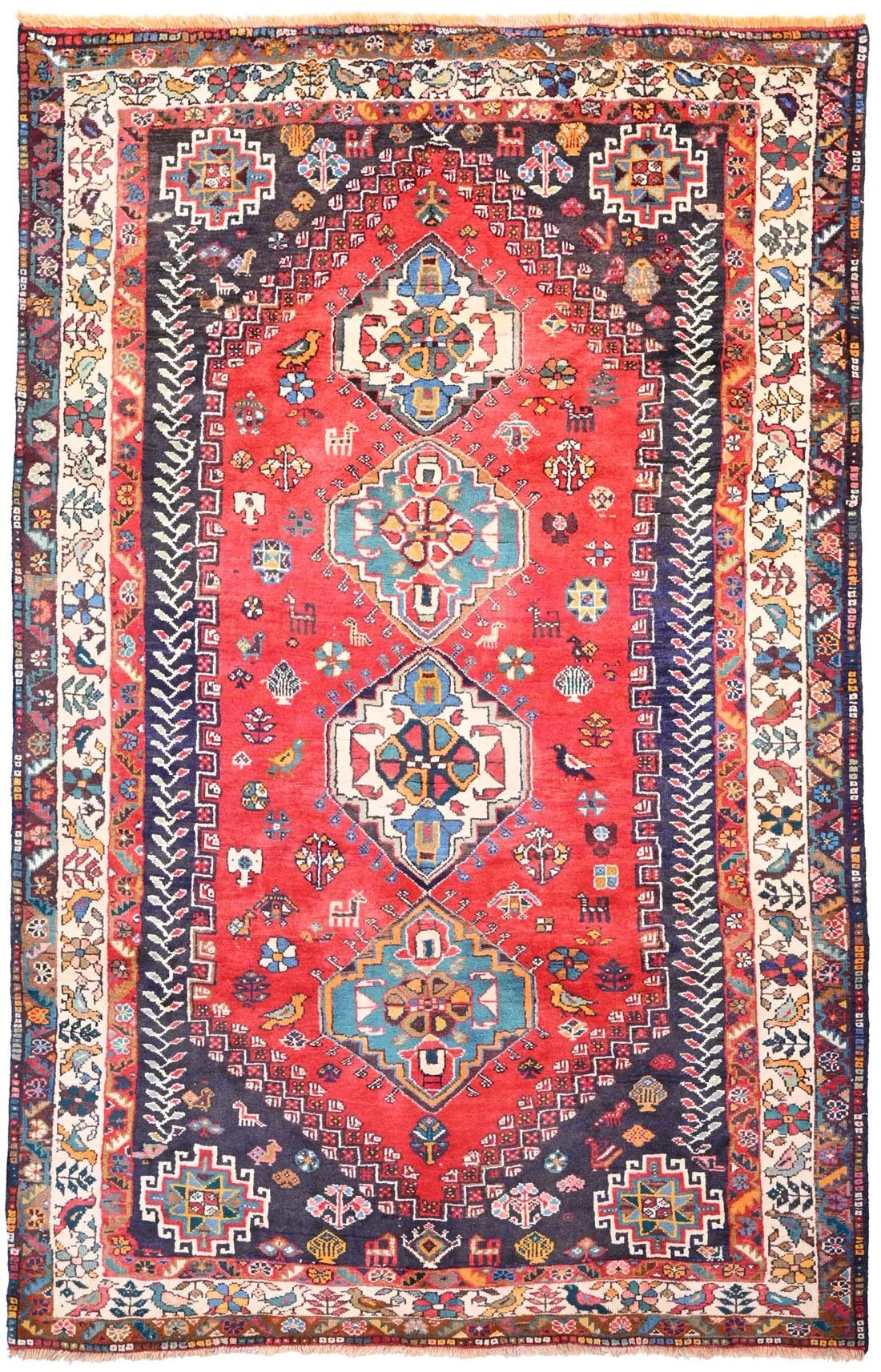
Every nomadic rug is a reflection of the people who made it. Woven by the Qashqai nomads of southwestern Iran, this piece carries the colours, memories, and spirit of a life lived close to nature. Birds, flowers, trees, and ancient symbols fill the field, forming a visual language passed from generation to generation through memory rather than written design.
The rug was woven entirely by hand using the wool of the weavers' own flocks. Its thick pile, wool foundation, and vibrant colours are characteristic of the finest Qashqai weavings. The exuberance of the palette and the joyful abundance of motifs suggest the hand of a young weaver, translating her world into wool, knot by knot.
Like many authentic nomadic rugs, it contains small asymmetries and charming irregularities. Far from flaws, these are reminders that the rug was not produced to the dictates of a graph or the demands of the market, but woven in continuation of a millennia-old tradition and way of life. They give the piece character, warmth, and authenticity.
Rich in colour, texture, and symbolism, this is more than a floor covering. It is a glimpse into a world where beauty was found in the simplest things: a bird in flight, a flower in bloom, or the changing colours of the seasons. It is a celebration of the creativity of the women who preserved these traditions and transformed the memories of their lives into enduring works of art.
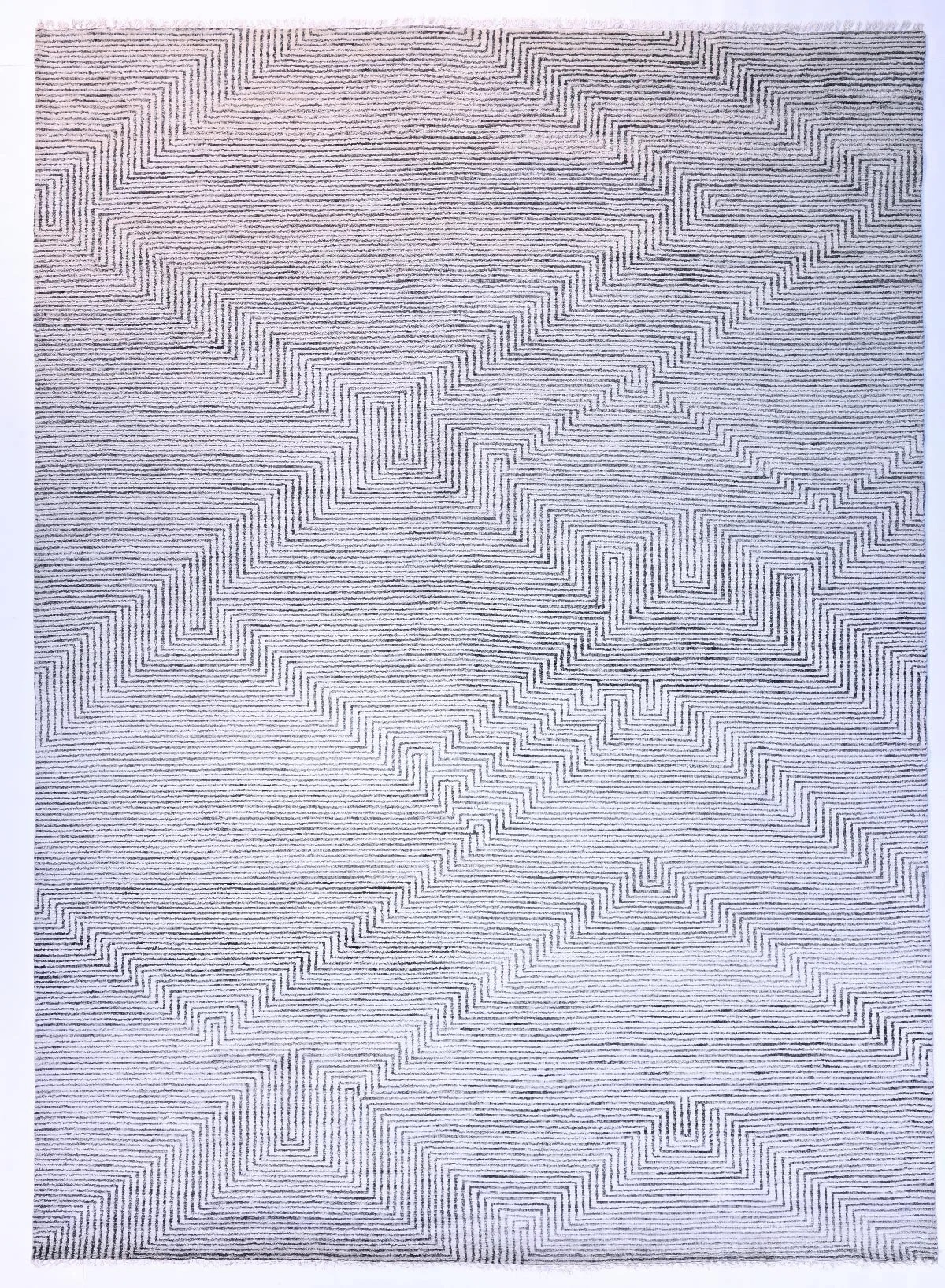
Beauty is not always found in complexity. Sometimes it emerges from restraint, from the careful balance of texture, material, and proportion. This carpet is an exploration of that idea.
Hand-knotted in India using high-quality wool, it embraces a minimalist language where texture becomes the principal form of expression. The design is reduced to a subtle geometric rhythm that gently moves across the surface like a quiet landscape, inviting the eye to wander without demanding attention.
What gives this rug its distinctive character is its coarse weave and generous knotting. The larger knots create a rich tactile surface that is as rewarding to touch as it is to look at. The slight variations in the wool and the interplay between light and shadow across the pile produce a depth that changes throughout the day.
The restrained palette further enhances this effect. Rather than relying on strong colours or elaborate ornamentation, the rug draws its beauty from texture, proportion, and material. It is a carpet that reveals itself gradually, rewarding close observation and physical interaction.
Contemporary in appearance yet rooted in the ancient craft of hand-knotting, this piece is designed for those who appreciate simplicity with substance. It can sit comfortably in a modern interior while bringing warmth, softness, and a quiet sense of luxury to the space.
A rug not only to be seen, but also to be felt.
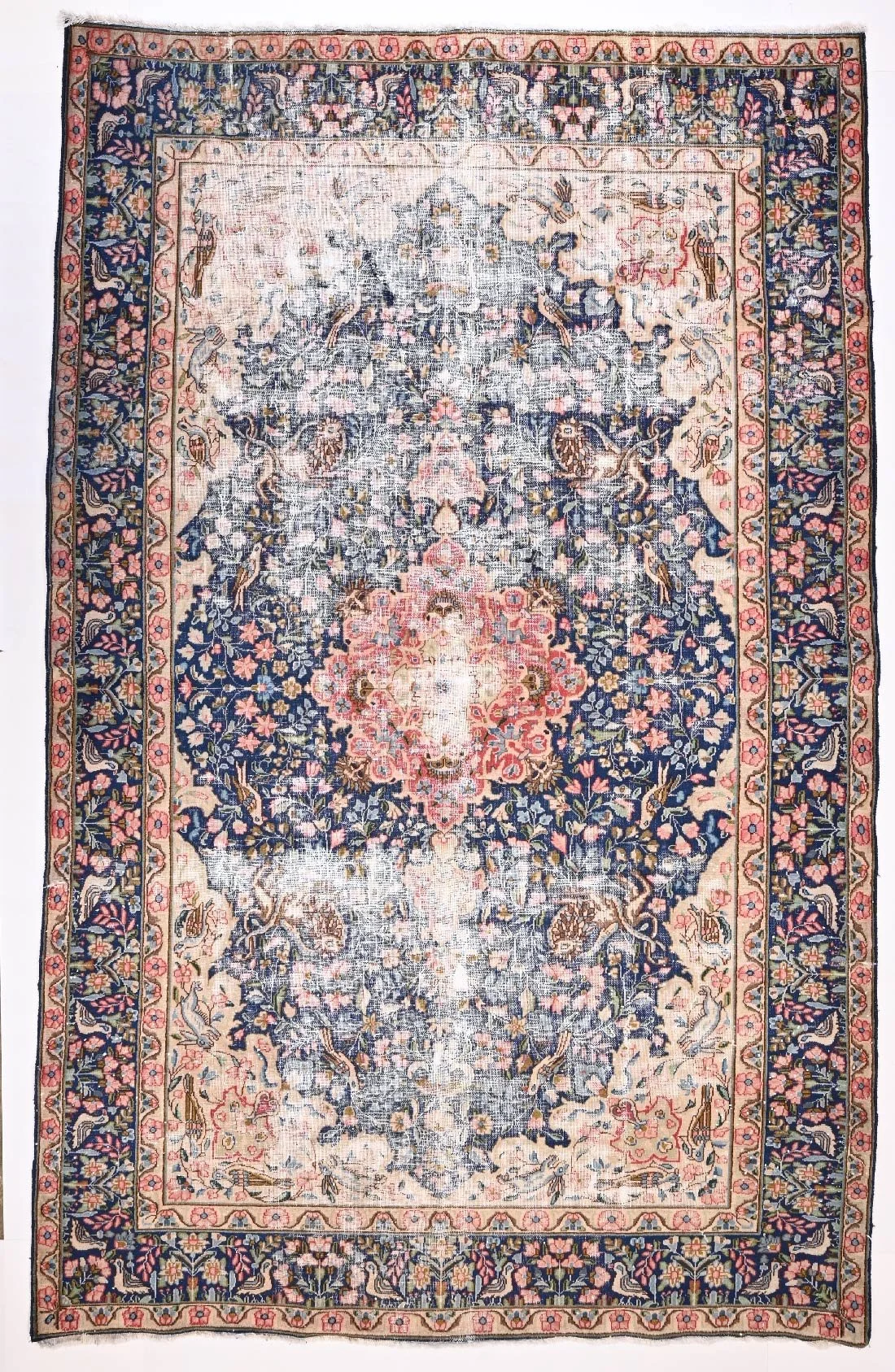
The city of Kirman in southeastern Iran is one of the great carpet-weaving centres of Persia. (Kirman flourished as an important commercial and cultural centre under the Safavids and remained one of the principal cities of Iran, renowned for its crafts, textiles, and trade routes linking central Iran to the Persian Gulf and the East.
This beautiful Kirman carpet, woven in the second half of the twentieth century, demonstrates another kind of beauty—the beauty that only time can create. Decades of use have worn the pile unevenly, revealing the foundation in places and partially erasing the pattern. The result is a remarkable patina and texture that no new carpet can imitate.
As the design emerges and disappears through the softened surface, fascinating details reveal themselves: lions confronting serpents, birds hidden among flowers, and eight angelic figures appearing to support the central medallion. The fading of the pattern only adds to the mystery, inviting the viewer to look closer and discover something new each time.
Rich in texture, history, and atmosphere, this is far more than a decorative object. It is a carpet transformed by time into a unique work of art, capable of bringing elegance, depth, and endless conversation to the room it inhabits.
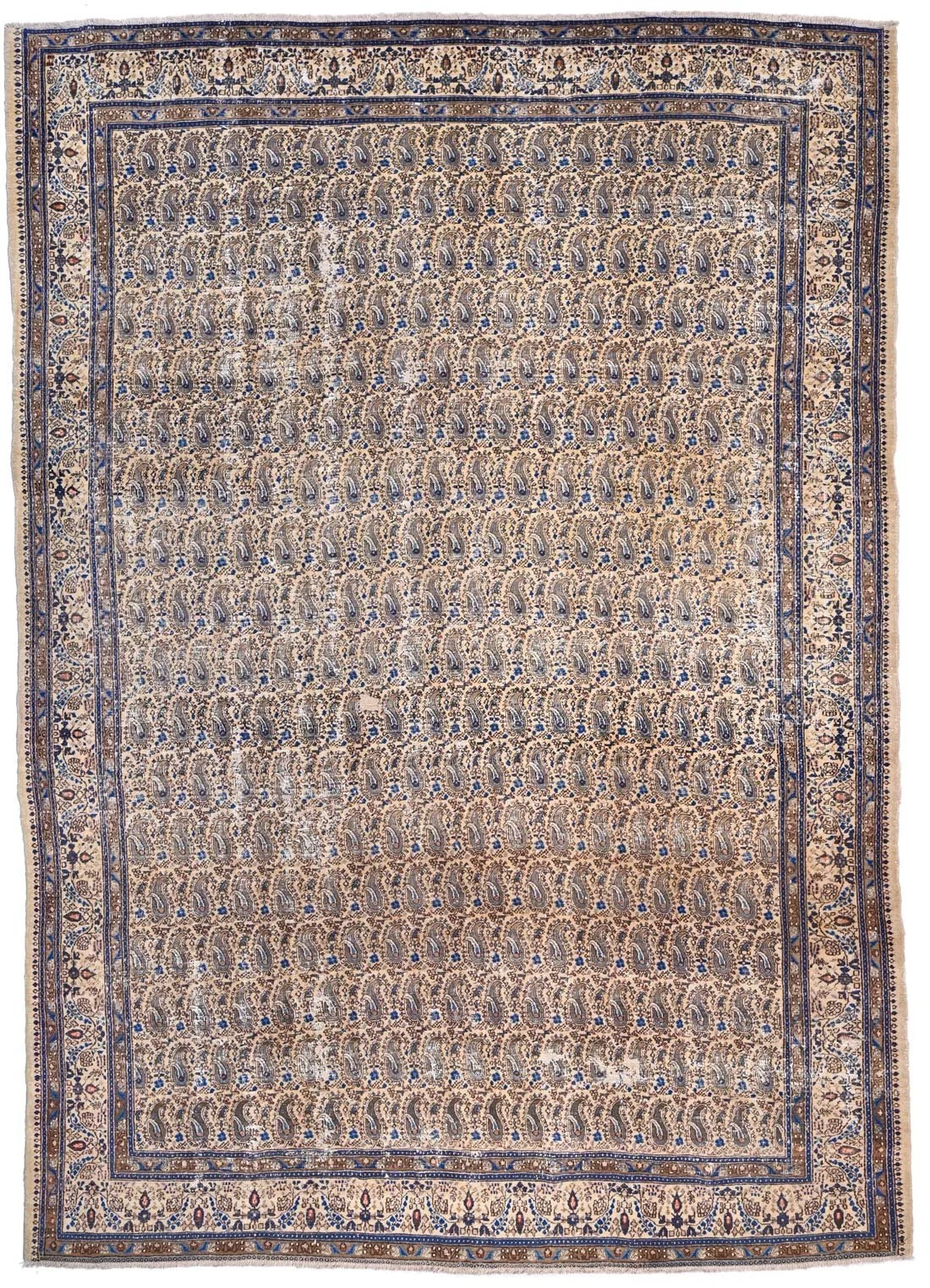
Some rugs seem to absorb time rather than suffer from it. This antique Khorassan carpet is one such piece. More than a century old, it remains remarkably alive, carrying a quiet presence and a mesmerising charm that has only deepened through the decades. The colours have matured, the pile has softened, and the texture has acquired a richness that cannot be manufactured. It is the poetry of time woven into wool.
The field is filled with one of the most enduring symbols of Persian culture: the cypress. Repeated hundreds of times across the surface, these stylised cypress motifs create a rhythmic and almost meditative effect. In Persian poetry, the cypress is often a metaphor for the tall, graceful, and youthful beloved. It also occupies a special place in ancient Iranian mythology, where sacred cypress trees are associated with Zoroaster and the spiritual traditions of pre-Islamic Persia. The motif appears throughout Persian art and can even be traced to the visual language of ancient Persia and the reliefs of Persepolis.
What makes this rug particularly appealing today is the harmony between its age and its design. Despite its classical origins, the all-over pattern, subtle palette, and extraordinary texture allow it to sit effortlessly in contemporary interiors. The passage of time has softened every element, creating a depth and character that many modern furnishings strive to imitate but rarely achieve.
Like many great antique rugs, this piece offers more than decoration. It carries memories of a vanished world, of skilled hands, natural materials, and a slower pace of life. It invites contemplation and conversation, rewarding those who spend time with it. The longer one looks, the more it reveals.
Still structurally sound after more than a hundred years, this carpet is likely to continue its journey for decades to come. It stands as a testament to the durability of traditional craftsmanship and to the enduring beauty of objects that age with dignity.
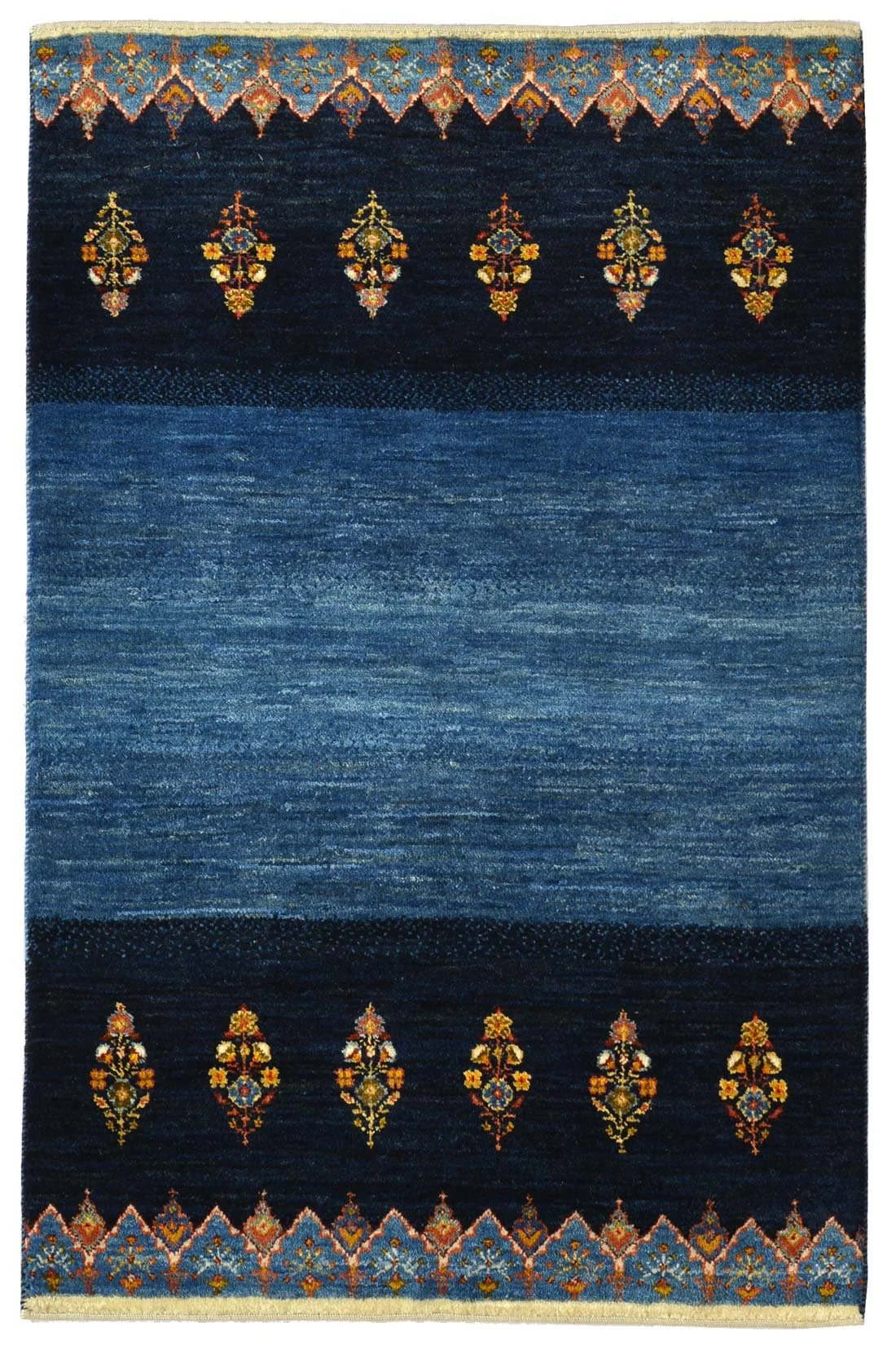
Gabbeh rugs woven by the Qashqai nomads of southwestern Iran are celebrated for their colour, texture, and quiet charm. From shearing the sheep and spinning the wool to dyeing the yarn and weaving the rug, almost every stage of production was traditionally carried out within the family.
The wool comes from the nomads' own flocks and is hand-spun and naturally dyed, often with indigo. This slow, artisanal process preserves the strength, softness, and natural lustre of the fibre, creating a texture that industrial production can rarely match.
Woven from memory rather than drawings, Gabbehs are reflections of the weavers' world. A flower, a tree, a mountain, a cloud, or the deep blue of the sky may become inspiration. In this piece, the expansive blue field evokes distant horizons, while the delicate floral motifs appear like treasured memories floating in space.
Simple, honest, and deeply personal, this rug is more than decoration. It is a reflection of nature through the eyes of its weaver, carrying the spirit of a slower and perhaps happier world into the modern home.
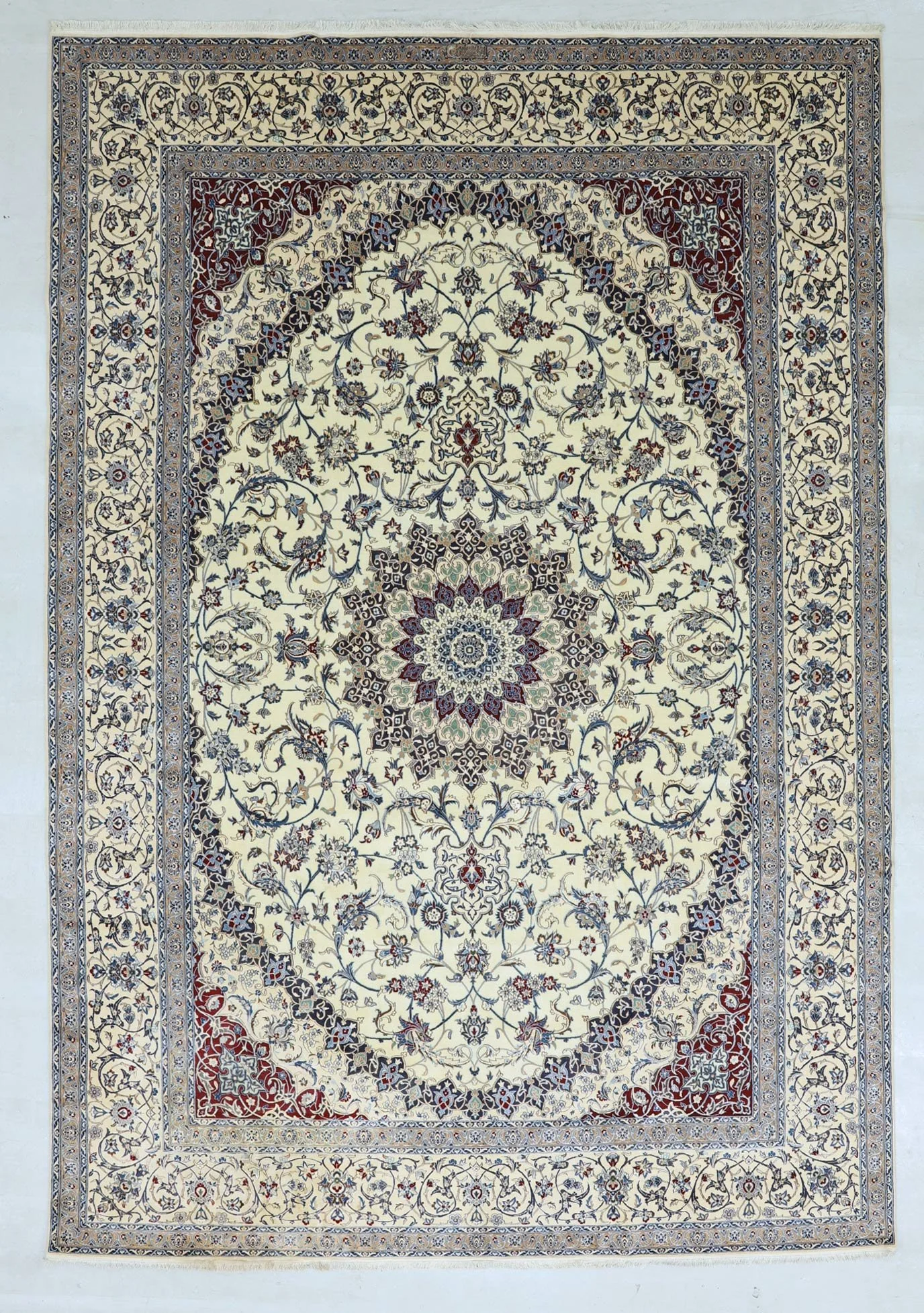
The signature woven into this carpet reads Iran, Habibian, Nain, a name that occupies a special place in the history of Persian carpet weaving. Nain, a small desert town on the edge of central Iran, only became a major carpet-producing centre in the early twentieth century. Before that, it was renowned for producing fine textiles, particularly the woollen aba cloaks worn throughout Iran. When industrially produced fabrics and changing fashions diminished this trade, local masters redirected their knowledge of spinning, dyeing, and design towards carpet weaving. The result was the birth of one of the most refined weaving traditions in Persia.
Among the pioneers of this transformation was the Habibian family. Their workshop established the standards by which fine Nain carpets are judged today, combining extraordinary precision with designs inspired by the masterpieces of Safavid Isfahan. The colours they employed—soft ivory, deep blues, beige, and burgundy—echo the palette of the textiles that had once made the town famous.
This carpet is a beautiful example of that tradition. The elegant Shah Abbasi design unfolds across a luminous ivory field, filled with delicate vines, blossoms, arabesques, and palmettes arranged around a finely drawn medallion. The drawing is remarkably precise, yet the composition remains graceful and effortless, allowing the eye to wander through a garden of flowers and foliage without ever feeling overwhelmed.
What truly distinguishes a fine Nain carpet is the discipline and skill required to execute such a design. Thousands upon thousands of knots are placed with extraordinary accuracy to create curves, flowers, and details that approach the refinement of miniature painting. The short pile and fine weave allow every element of the design to appear crisp and clear.
The wool used in carpets of this quality is carefully selected for its softness and lustre. As light moves across the surface, the pile reflects it differently from various angles, creating subtle changes in tone and giving the carpet a gentle radiance that enhances the beauty of the design.
More than a decorative object, this carpet represents the successful revival of an ancient artistic tradition. It carries within it the heritage of Nain's textile masters, the influence of the great Safavid designers, and the skill of generations of weavers who transformed a small desert town into one of the world's most respected centres of carpet production. Elegant, timeless, and remarkably refined, it is a carpet that rewards close inspection and remains a source of pleasure for decades.
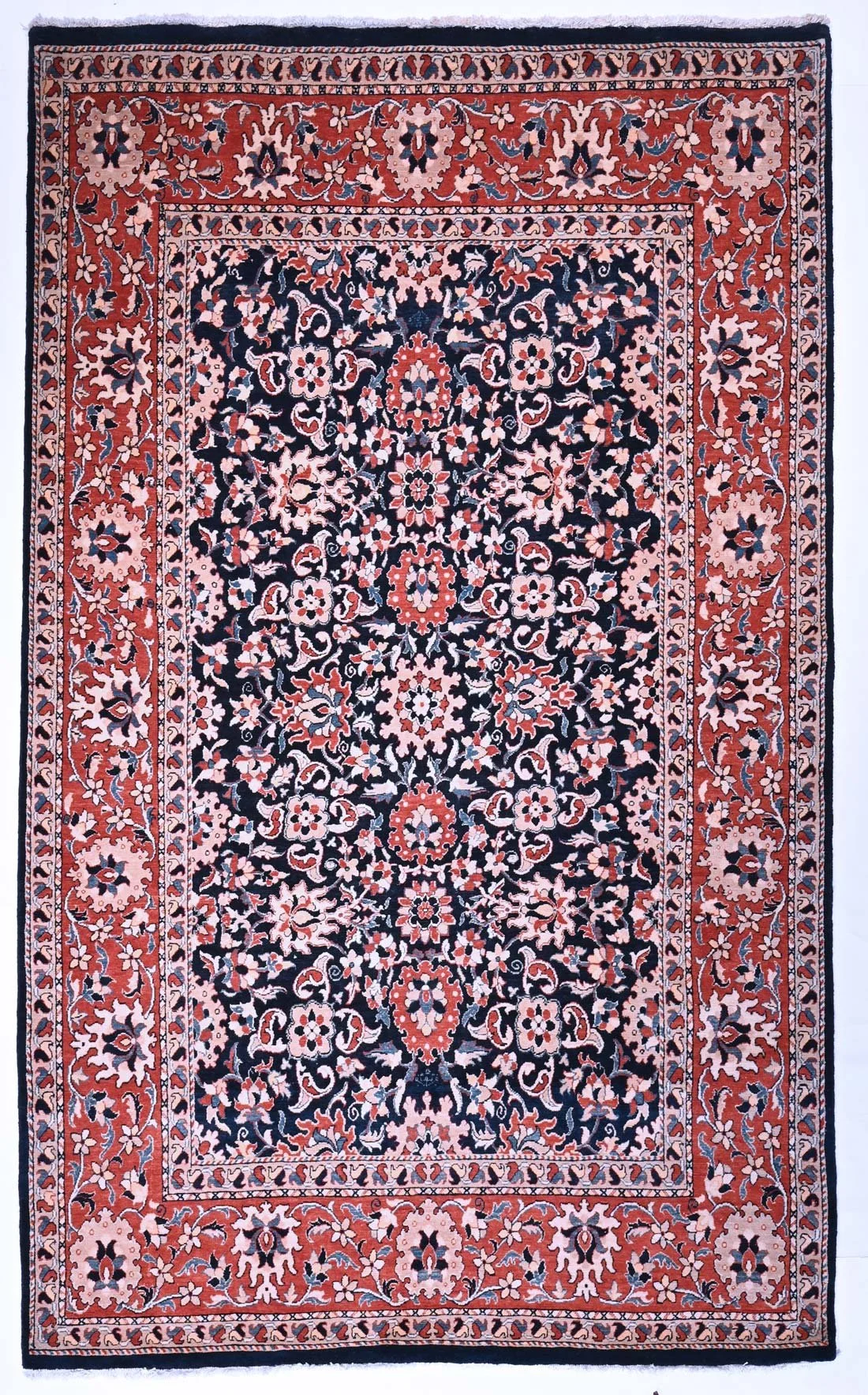
Creating a rug comparable in quality to the finest antique pieces is a challenge. Every element must be right: the weaving technique, the quality of the wool, the spinning of the yarn, and the dyeing process. Only when all these come together can a rug uphold the reputation of Persian carpets, like the one you see here.
This rug was woven by the Afshar tribes of Kerman using traditional skills passed down through generations. The Afshars, originally a Turkic tribal group, settled in different parts of Iran over the centuries, with an important community in the Kerman region. Their weaving tradition combines the strength and character of tribal rugs with influences from the refined floral designs of Persian city carpets.
To recreate the quality admired in older weavings, exceptional hand-spun wool was prepared and dyed using natural materials. The slow process of spinning and dyeing preserves the character of the fibre, allowing the wool to keep its natural lustre, softness, and resilience.
The design of this piece beautifully demonstrates the meeting point between tribal craftsmanship and classical Persian aesthetics. The deep indigo field creates a dramatic background for the flowing floral pattern, while the warm madder tones of the border bring balance and harmony. The colours have a depth and variation that only naturally dyed hand-spun wool can achieve, giving the rug a living surface that changes with light.
The result is a rug with the richness, texture, and soul often associated with antique pieces, yet created for contemporary living. It is a continuation of a centuries-old tradition, proof that when knowledge, patience, and the finest materials come together, carpets of exceptional beauty can still be woven today.
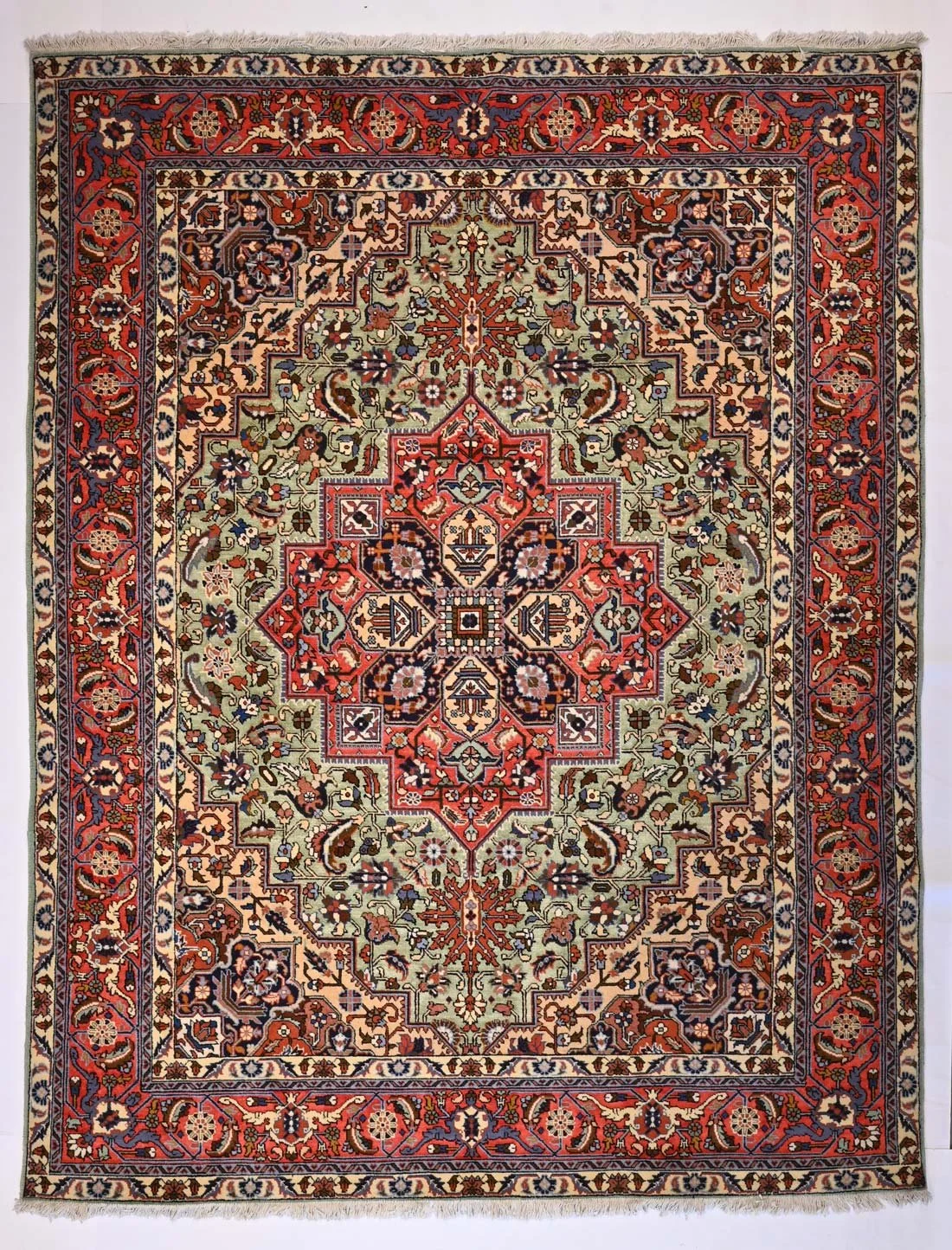
The town of Ardabil in northwest Iran has been one of the major carpet-producing centres of Persia for centuries. It possesses a rich weaving culture and a remarkable variety of designs, largely due to the Shahsavan tribes who live around the city and the Shahsavan population of the town itself, who have inherited a wealth of patterns and motifs from their ancestors.
Ardabil lies close to the Caucasus, particularly present-day Armenia and Azerbaijan, and its carpets reflect centuries of cultural exchange across these borders. The result is a distinctive weaving tradition that combines Persian refinement with tribal vigour and Caucasian geometry.
Traditionally, Ardabil weavers produced wool carpets on wool or cotton foundations. Yet for a brief and unusual period in the early years of the 21st century, roughly between 2000 and 2007, a collapse in the silk market made silk yarn unexpectedly affordable. Taking advantage of this rare opportunity, some weavers began incorporating silk into carpets that otherwise retained their village and tribal character.
The experiment was short-lived. As silk prices recovered and rose beyond their previous levels, the practice became economically impractical and quickly disappeared. Carpets such as this one therefore belong to a very limited chapter in the history of Ardabil weaving—a chapter unlikely ever to be repeated.
The rug shown here is woven in a geometric pattern related to the designs of neighbouring Heriz, centred around a bold medallion. What makes it particularly fascinating is the use of silk in the green field and the salmon-coloured border. Silk reflects light differently from wool and lies flatter within the pile. As a result, the wool rises slightly higher while the silk areas shimmer softly, creating subtle variations in texture and appearance that change with the light.
The combination of tribal design, village weaving traditions, and the unexpected use of silk makes this a truly unusual piece. Its rich colours, striking geometry, and constantly shifting surface give it a presence that is difficult to ignore.
Adding further to its appeal is its uncommon size of 250 × 200 cm. Its almost square proportions make it particularly versatile and well suited to many interiors.
Rare, distinctive, and born from a unique moment in history, this is a carpet that naturally becomes a subject of conversation and a piece one could genuinely be proud to own.

A Village Rug from Aghja Ghaya, Zanjan Province — ContemporaryHand-spun wool, natural dyes. Wool on cotton foundation.
The village of Aghja Ghaya in Zanjan Province has a long weaving tradition. The women here are skilled, and their wool, hand-spun, naturally dyed, is among the finest you will find anywhere in Iran.
This piece is something different. About twenty years ago, we began working closely with the weavers of this village, bringing them quality materials and encouraging them to explore beyond the conventional. This rug is the result of one such collaboration, a design we conceived together, departing entirely from the village's classic patterns in favour of something more spare, more contemporary, and perhaps more quietly daring.
Three geometric compositions float on a vast ivory field, framed by a deep, warm red border. The palette, saffron, rust, slate blue, navy, is the same as it has always been in this village. The wool and the dyes are entirely natural and entirely traditional. Only the vision has changed.
It is the kind of piece that sits just as comfortably in a contemporary interior as it does in a traditional one. And it is one of a kind.

This is a fascinating piece that we had woven in the village of Aghja Ghghaya in Zanjan province. The idea was quite simple, but meaningful, to go back to the roots.
We collected antique weavings from the area, pieces originally made by the ancestors of the same villagers, and asked the weavers to recreate those designs by following the same designs while adding their own twist. At the same time, we provided them with high-quality wool and yarn dyed with natural vegetable dyes, as well as appropriate looms and materials.
So in a way, the design comes from their heritage, while the materials and overall process were carefully guided by us. The weavers followed what they had inherited, remembering the motifs and symbols, but naturally added their own small personal touches along the way.
The result is a piece like this that feels both authentic and fresh.
The main motif here is the pomegranate, a very old and meaningful symbol. In Persian mythology, it is said to be a fruit brought from heaven by Zarathustra, and it has long been associated with abundance and fertility. It also carries importance in Islamic tradition, as it is one of the fruits mentioned in the Quran. So it is a symbol that has travelled through time, always carrying a sense of life and richness.
In this rug, the motif is woven in a very balanced and pleasing colour combination, making it easy to place in an interior space while still holding depth and character.
The quality of the wool and the vegetable dyes is such that the rug will only improve with time. With use, it will soften, develop character, and gain a beautiful patina. It is the kind of piece that will age gracefully and, over the years, become something even more special.
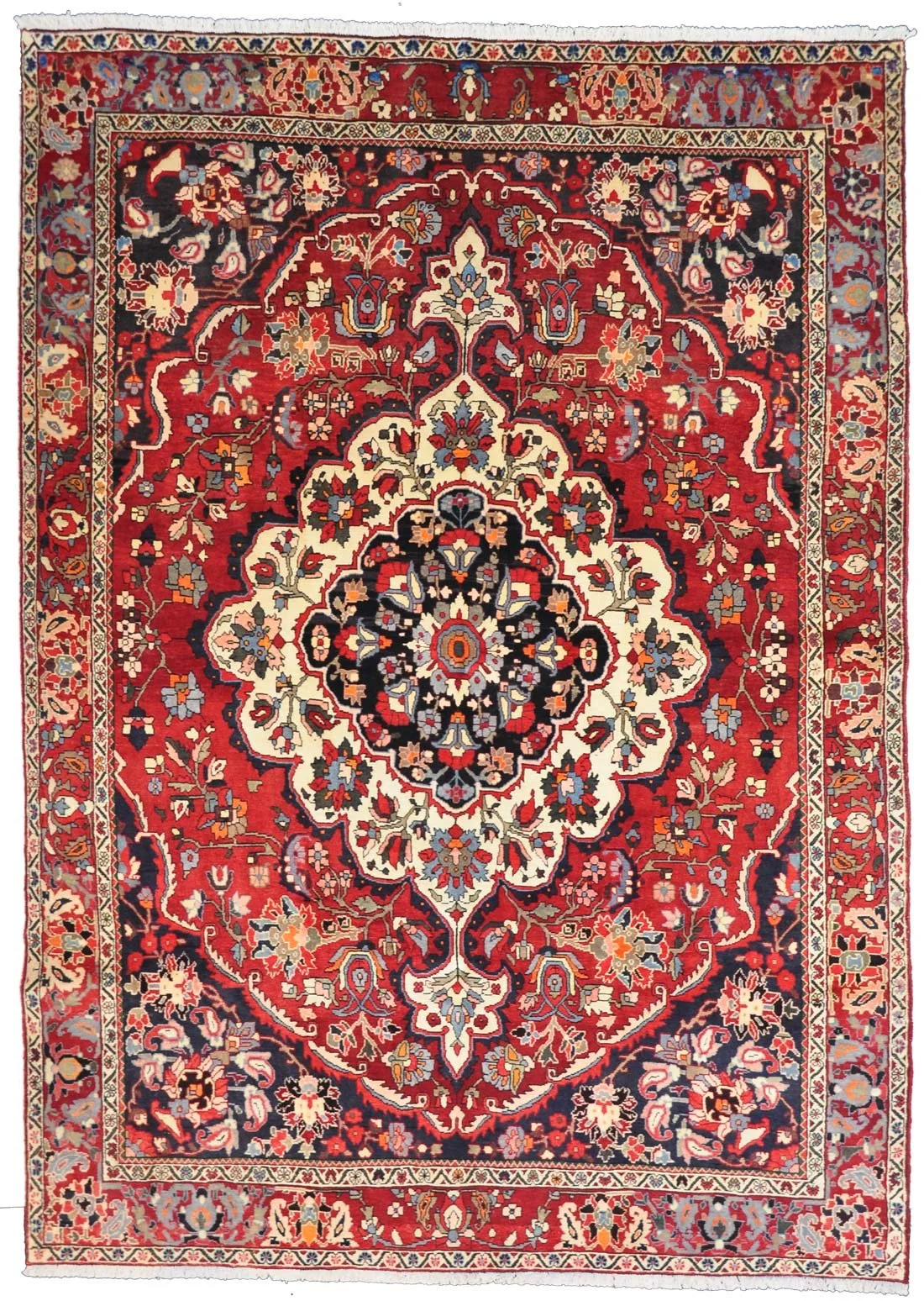
The Bakhtiari are among the oldest weaving cultures of Iran, living for centuries among the valleys and foothills of the Zagros Mountains. Their carpets reflect a way of life shaped by pastoral traditions, seasonal migration, and a close relationship with nature.
This beautiful Bakhtiari carpet was woven around seventy years ago, at a time when many weavers still raised their own sheep, spun their own wool, and dyed their yarns using natural materials gathered from their surroundings. The richness of the colours, the softness of the wool, and the character of the piece are all products of that slow and deeply personal process.
The design centres on a magnificent floral medallion surrounded by blossoms, vines, and palmettes inspired by the gardens of Persia. Although rooted in tradition, such carpets were woven largely from memory, allowing each weaver to add her own interpretation and individuality to the pattern.
The result is a rug with warmth, character, and authenticity. Well preserved and structurally sound, it remains as practical today as when it was first woven. Antique Bakhtiari carpets are becoming increasingly difficult to find, especially examples with such vibrant colours and strong presence. It is a piece that brings together beauty, history, and craftsmanship in a way that modern production rarely achieves.
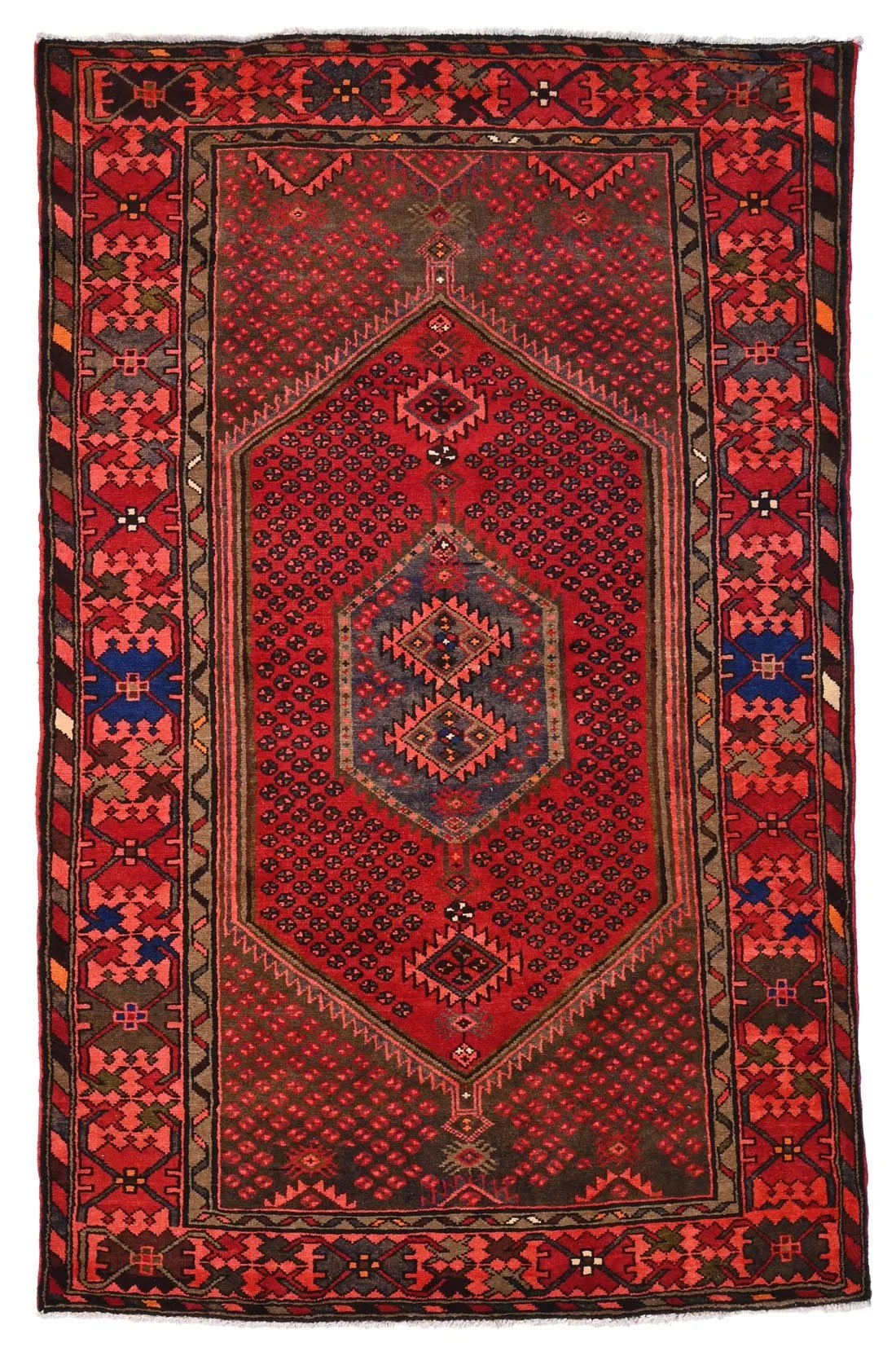
There are hundreds of villages scattered around the three major cities of Qazvin, Zanjan, and Hamedan, each with its own traditions of carpet weaving. Most of these village rugs are woven entirely from memory in geometric patterns, and each village has its own distinctive style, choice of colours, and visual language, making it possible to distinguish the work of one village from another.
Many of these rugs are grouped under the name Musel, most probably because the Iraqi city of Mosul was an important trading hub where such carpets were traded in large numbers. These rugs were especially popular among the Arab nomads and Bedouins of Iraq and Arabia, appreciated for their durability, portability, and rich geometric character. Through this strong connection with the bazaars of Mosul, the name Musel gradually became associated with this category of village rugs.
What makes these rugs truly fascinating is the extraordinary diversity of their designs. That diversity reflects not only the countless weaving traditions preserved in these villages, but also the creativity of individual weavers, each adding something personal to an inherited visual language rooted deeply in collective memory shaped over centuries.
This particular piece, woven in a village near the city of Zanjan, is a beautiful example of that tradition. It carries rich natural colours and excellent wool of very high quality. The dyes are extracted from herbs, plants, and other natural sources, giving the rug a depth and softness that only improve with time.
These are carpets made to last generations. Yet their beauty goes far beyond durability or aesthetics. Once one begins to explore the history, culture, and lives of the people behind such weavings, an entirely new layer of meaning appears. A rug like this does not simply decorate a space; it brings with it stories, memories, and a quiet cultural depth that can inspire endless conversations.

The Qashqai are nomads. Their sheep are their livelihood, their wool their own, and the land they migrate through their colour palette. During their seasonal journeys across the Zagros, they gather roots, leaves, fruits, plants, indigo, madder, and whatever nature offers, and dye their hand-spun yarn in small batches over charcoal fires, as their ancestors taught them. The inconsistencies this creates, in the weight of the yarn, in the subtlety of the tones, are precisely what give their wool its warmth, its sheen, and its extraordinary tactile beauty. No chemical has touched it. The natural oils remain. You can feel the difference.
Gabbehs are woven without a pattern. The weaver sits at her loom and reflects on what surrounds her: the landscape, the animals, the sky, and the movements of her daily life. What emerges is not a design but a state of mind. This is why gabbehs from the Qashqai are among the most free and alive of all Persian weavings.
This piece is woven in a deep, enveloping indigo. Across it drift abstract forms, saffron, rust, ivory, black, that one could read as clouds, or as land seen from above, or simply as what they are: the weaver's feeling translated into colour.
Look more carefully, and you will find her. At the bottom of the rug, a small human figure, and beside her, two or three goats. She has woven herself into her own rug, alongside the animals she tends. It was done spontaneously, without calculation. That is what makes it so moving.
This is a small, very personal piece. It carries the personality, lifestyle, and spirit of the person who made it. It is also a conversation piece — and an invitation, for those curious enough to follow it, into the history and culture of one of Iran's most fascinating peoples.
One never tires of looking at pieces like this. Nor of wondering about the woman who made it.

Persian carpets from the early 20th century, such as this beautiful Sarouk carpet from central Iran, are admired not only for their aesthetics but also for the exceptional quality of their materials and craftsmanship.
One of the most remarkable aspects of these rugs is the quality of wool and the variety of natural dyes used to produce their rich and harmonious colours. The beauty of such carpets does not come only from the original colours themselves. Over more than a century, exposure to air, oxidation, and the natural aging process gradually transform both the wool and the dyes.
As time passes, the natural lanolin, the oil contained within wool fibres, slowly rises toward the surface of the yarn. This process gives antique carpets a gentle sheen while deepening the character of the colours. The result is a richness and softness that cannot be replicated in new pieces.
Carpets like this are the product of several elements coming together: the skill of the weavers, the refined taste of the designers, the quality of the materials, and above all the passage of time. Each of these factors contributes to the unique character of early Persian carpets.
The Sarouk region of central Iran became particularly famous in the western markets during the late 19th and early 20th centuries for producing carpets with strong structures, excellent wool, and beautifully balanced colours. This example reflects those qualities perfectly.
With its harmonious palette, matured sheen, and refined craftsmanship, this antique Sarouk carpet represents a classic piece of Persian weaving—one that carries both artistic beauty and the irreplaceable charm that only time can create.
Material: Wool pile on cotton foundation
Origin: Sarouk, central Iran
Age: Early 20th century
Size: 204 × 133 cm
Item No.: 146840

Vintage rugs are stunning. Their charm is not aesthetic and superficial but far more profound; they are beautiful pieces from different times, an era when their makers created them with a deep passion out of respect and attachment to their sacred traditions.
Due to decades of age, the natural wear and tears have only added to their beauty and have given them more character. Their colours have toned down and have acquired a fascinating patina; thus, they blend in many different settings, enhance many spaces with their unique charm and glamour, and enrich the ambience with their sophisticated cultural and historical background.
The rug here is a Persian design Tabriz, painstakingly hand woven circa the 1920s. The remnant of the classic pattern is gently faded into the background to create a monotonous carpet that works perfectly well both in modern spaces and classic homes.
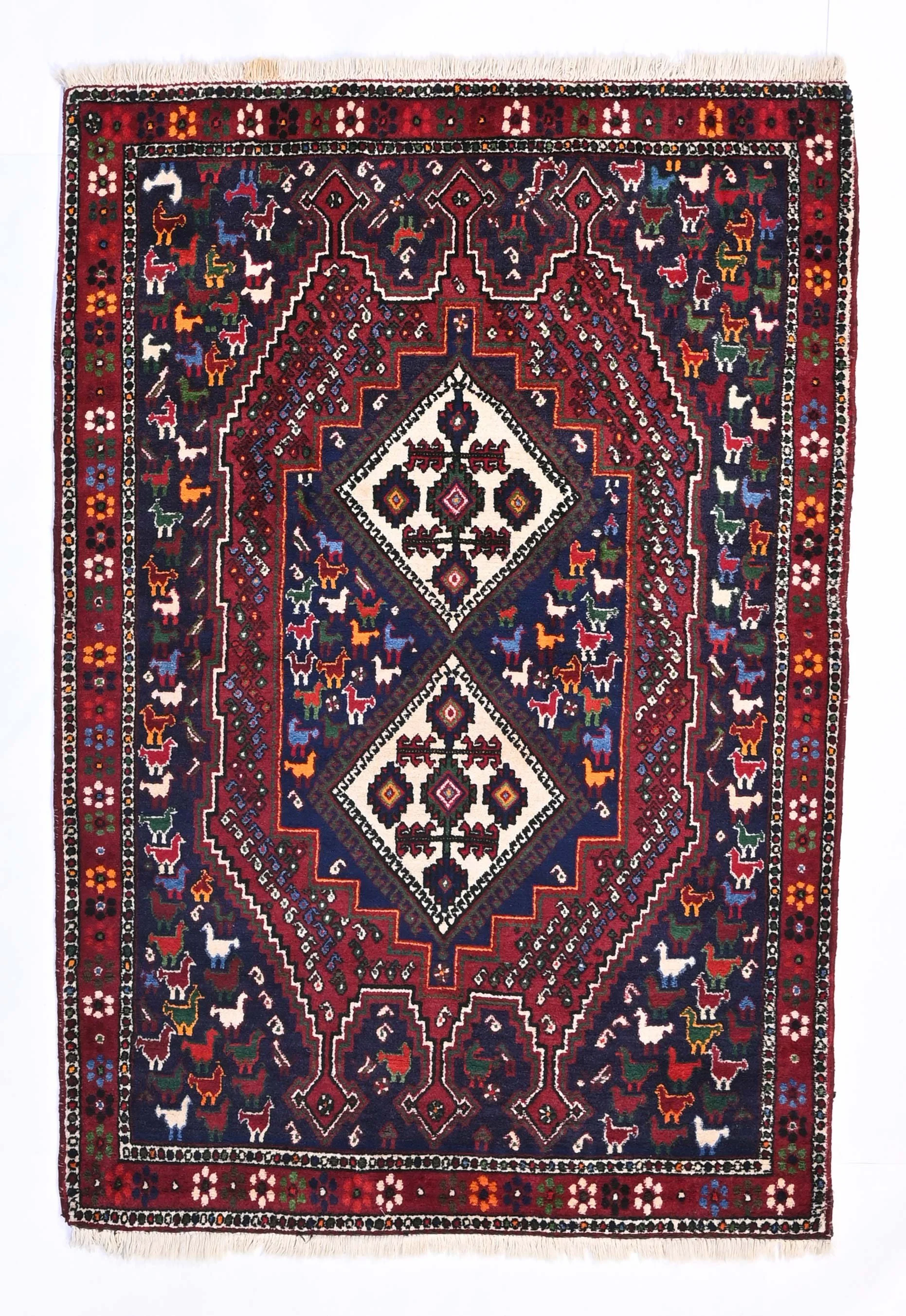
The Afshar tribes were among the most prominent nomadic groups of Iran, known for their strong character, independence, and deep tribal identity. Their name became especially significant in Iranian history through the rise of Nader Shah Afshar, the charismatic military leader who later became king and succeeded in uniting Iran during one of its most turbulent periods. His military campaigns, particularly the famous invasion of India, left a lasting cultural influence across the region and strengthened the presence of Persian culture far beyond Iran’s borders.
This carpet was woven by Afshar tribes settled in the small town of Shahr-e Babak in southeast Iran. Although these communities once lived a fully nomadic life, many gradually settled in villages and towns while preserving their weaving traditions and inherited designs.
The rug reflects those traditions beautifully. It is woven using fine local wool produced in the area and carries the geometric patterns and rich colour combinations long associated with Afshar tribal weaving. What makes this particular piece remarkable is its extraordinary vibrancy and balance of colours, qualities that give the carpet both strength and elegance.
Like many authentic tribal rugs, this piece is not merely decorative. It carries history, identity, and the memory of a people whose culture was shaped through movement, resilience, and craftsmanship. It is a rug that can last for generations while adding not only beauty to a room, but also depth, meaning, and cultural character.
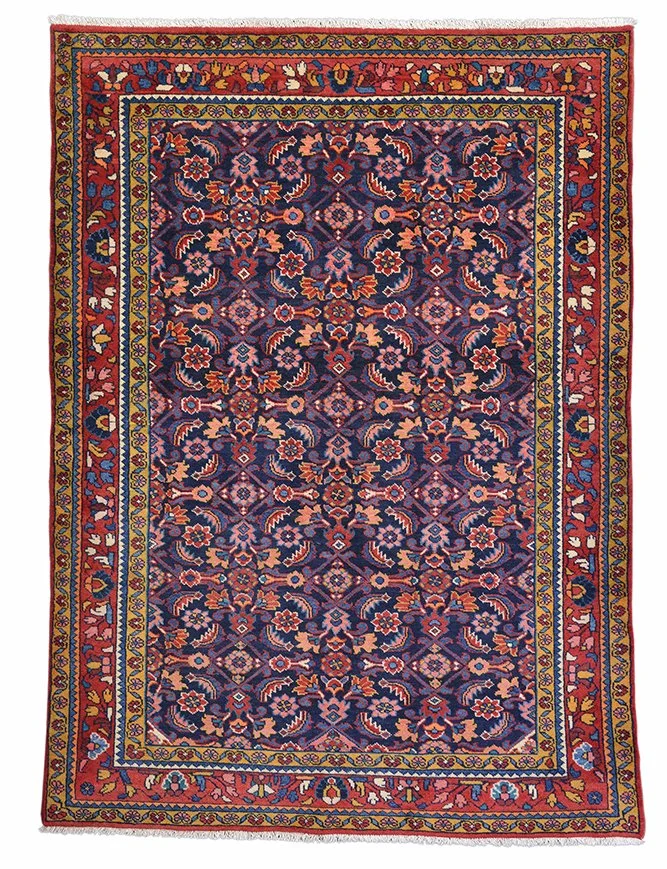
Persian carpets are not just decorative pieces, many of them are windows into history. They carry stories, reflecting the soul behind their making and the culture they come from.
This beautiful Lilian carpet, measuring 225 × 162 cm and dating to circa 1950s, is a perfect example. It was woven by descendants of Armenians who were moved to central Iran in the early 17th century, during the conflicts between the Persian and Ottoman empires. Over time, they settled, integrated, and continued their weaving traditions.
What makes this rug especially interesting is the meeting of two cultures. In technique, it reflects the precision associated with Armenian weavers, while in design, it carries the classic Persian Mahi pattern, with its repeating stylised fish motifs across the field.
Woven with hand-spun wool and mostly natural dyes, this piece reflects an honest approach to craftsmanship, where material, technique, and cultural memory come together.
A quiet example of how traditions evolve, and how beauty is shaped when cultures meet.
Every nomadic rug is a reflection of the people who made it. Woven by the Qashqai nomads of southwestern Iran, this piece carries the colours, memories, and spirit of a life lived close to nature. Birds, flowers, trees, and ancient symbols fill the field, forming a visual language passed from generation to generation through memory rather than written design.
The rug was woven entirely by hand using the wool of the weavers' own flocks. Its thick pile, wool foundation, and vibrant colours are characteristic of the finest Qashqai weavings. The exuberance of the palette and the joyful abundance of motifs suggest the hand of a young weaver, translating her world into wool, knot by knot.
Like many authentic nomadic rugs, it contains small asymmetries and charming irregularities. Far from flaws, these are reminders that the rug was not produced to the dictates of a graph or the demands of the market, but woven in continuation of a millennia-old tradition and way of life. They give the piece character, warmth, and authenticity.
Rich in colour, texture, and symbolism, this is more than a floor covering. It is a glimpse into a world where beauty was found in the simplest things: a bird in flight, a flower in bloom, or the changing colours of the seasons. It is a celebration of the creativity of the women who preserved these traditions and transformed the memories of their lives into enduring works of art.
