
 Image 1 of 1
The signature woven into this carpet reads Iran, Habibian, Nain, a name that occupies a special place in the history of Persian carpet weaving. Nain, a small desert town on the edge of central Iran, only became a major carpet-producing centre in the early twentieth century. Before that, it was renowned for producing fine textiles, particularly the woollen aba cloaks worn throughout Iran. When industrially produced fabrics and changing fashions diminished this trade, local masters redirected their knowledge of spinning, dyeing, and design towards carpet weaving. The result was the birth of one of the most refined weaving traditions in Persia.
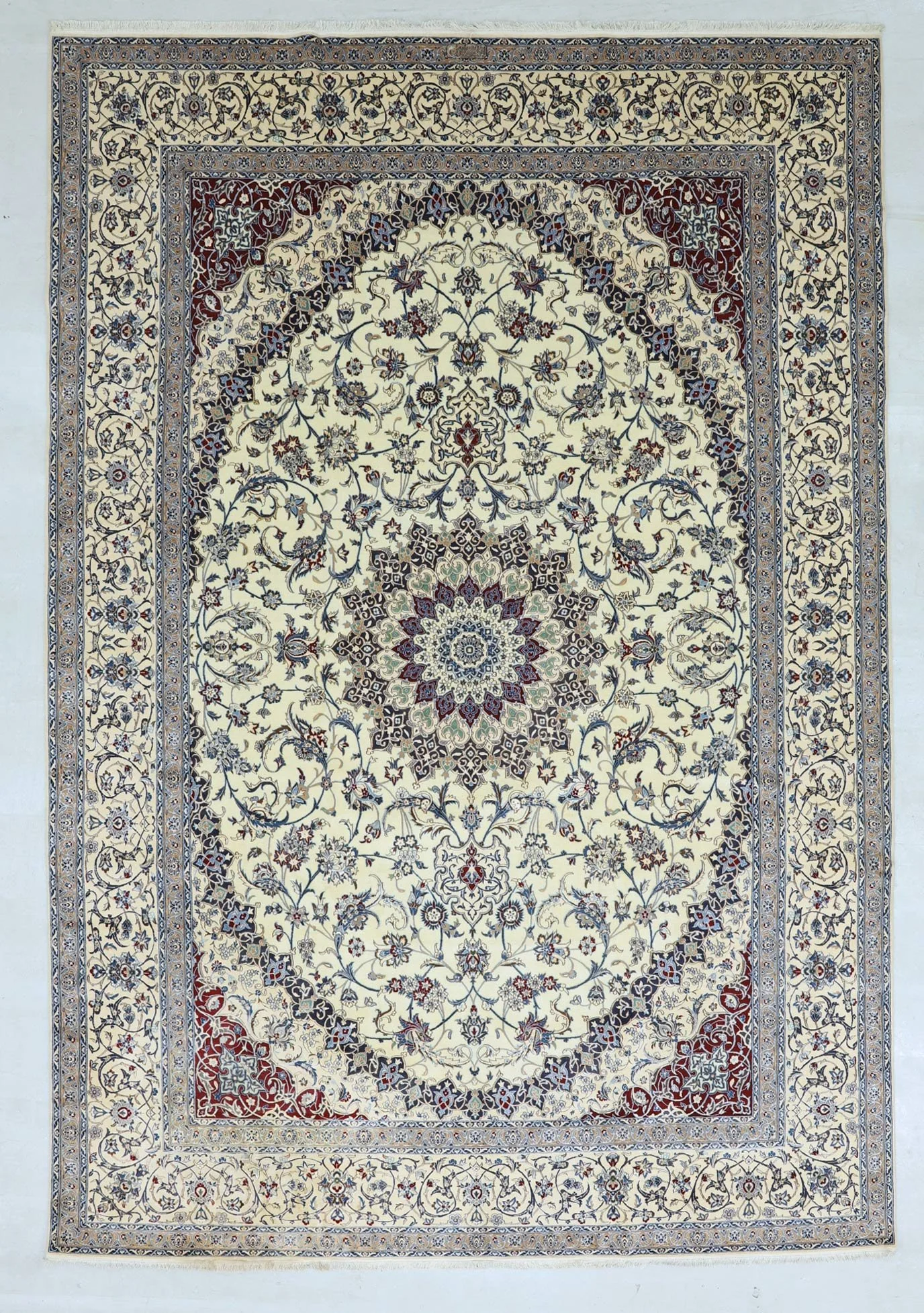
Among the pioneers of this transformation was the Habibian family. Their workshop established the standards by which fine Nain carpets are judged today, combining extraordinary precision with designs inspired by the masterpieces of Safavid Isfahan. The colours they employed—soft ivory, deep blues, beige, and burgundy—echo the palette of the textiles that had once made the town famous.
This carpet is a beautiful example of that tradition. The elegant Shah Abbasi design unfolds across a luminous ivory field, filled with delicate vines, blossoms, arabesques, and palmettes arranged around a finely drawn medallion. The drawing is remarkably precise, yet the composition remains graceful and effortless, allowing the eye to wander through a garden of flowers and foliage without ever feeling overwhelmed.
What truly distinguishes a fine Nain carpet is the discipline and skill required to execute such a design. Thousands upon thousands of knots are placed with extraordinary accuracy to create curves, flowers, and details that approach the refinement of miniature painting. The short pile and fine weave allow every element of the design to appear crisp and clear.
The wool used in carpets of this quality is carefully selected for its softness and lustre. As light moves across the surface, the pile reflects it differently from various angles, creating subtle changes in tone and giving the carpet a gentle radiance that enhances the beauty of the design.
More than a decorative object, this carpet represents the successful revival of an ancient artistic tradition. It carries within it the heritage of Nain's textile masters, the influence of the great Safavid designers, and the skill of generations of weavers who transformed a small desert town into one of the world's most respected centres of carpet production. Elegant, timeless, and remarkably refined, it is a carpet that rewards close inspection and remains a source of pleasure for decades.
The signature woven into this carpet reads Iran, Habibian, Nain, a name that occupies a special place in the history of Persian carpet weaving. Nain, a small desert town on the edge of central Iran, only became a major carpet-producing centre in the early twentieth century. Before that, it was renowned for producing fine textiles, particularly the woollen aba cloaks worn throughout Iran. When industrially produced fabrics and changing fashions diminished this trade, local masters redirected their knowledge of spinning, dyeing, and design towards carpet weaving. The result was the birth of one of the most refined weaving traditions in Persia.
Among the pioneers of this transformation was the Habibian family. Their workshop established the standards by which fine Nain carpets are judged today, combining extraordinary precision with designs inspired by the masterpieces of Safavid Isfahan. The colours they employed—soft ivory, deep blues, beige, and burgundy—echo the palette of the textiles that had once made the town famous.
This carpet is a beautiful example of that tradition. The elegant Shah Abbasi design unfolds across a luminous ivory field, filled with delicate vines, blossoms, arabesques, and palmettes arranged around a finely drawn medallion. The drawing is remarkably precise, yet the composition remains graceful and effortless, allowing the eye to wander through a garden of flowers and foliage without ever feeling overwhelmed.
What truly distinguishes a fine Nain carpet is the discipline and skill required to execute such a design. Thousands upon thousands of knots are placed with extraordinary accuracy to create curves, flowers, and details that approach the refinement of miniature painting. The short pile and fine weave allow every element of the design to appear crisp and clear.
The wool used in carpets of this quality is carefully selected for its softness and lustre. As light moves across the surface, the pile reflects it differently from various angles, creating subtle changes in tone and giving the carpet a gentle radiance that enhances the beauty of the design.
More than a decorative object, this carpet represents the successful revival of an ancient artistic tradition. It carries within it the heritage of Nain's textile masters, the influence of the great Safavid designers, and the skill of generations of weavers who transformed a small desert town into one of the world's most respected centres of carpet production. Elegant, timeless, and remarkably refined, it is a carpet that rewards close inspection and remains a source of pleasure for decades.
