
 Image 1 of 1
The town of Ardabil in northwest Iran has been one of the major carpet-producing centres of Persia for centuries. It possesses a rich weaving culture and a remarkable variety of designs, largely due to the Shahsavan tribes who live around the city and the Shahsavan population of the town itself, who have inherited a wealth of patterns and motifs from their ancestors.
Ardabil lies close to the Caucasus, particularly present-day Armenia and Azerbaijan, and its carpets reflect centuries of cultural exchange across these borders. The result is a distinctive weaving tradition that combines Persian refinement with tribal vigour and Caucasian geometry.
Traditionally, Ardabil weavers produced wool carpets on wool or cotton foundations. Yet for a brief and unusual period in the early years of the 21st century, roughly between 2000 and 2007, a collapse in the silk market made silk yarn unexpectedly affordable. Taking advantage of this rare opportunity, some weavers began incorporating silk into carpets that otherwise retained their village and tribal character.
The experiment was short-lived. As silk prices recovered and rose beyond their previous levels, the practice became economically impractical and quickly disappeared. Carpets such as this one therefore belong to a very limited chapter in the history of Ardabil weaving—a chapter unlikely ever to be repeated.
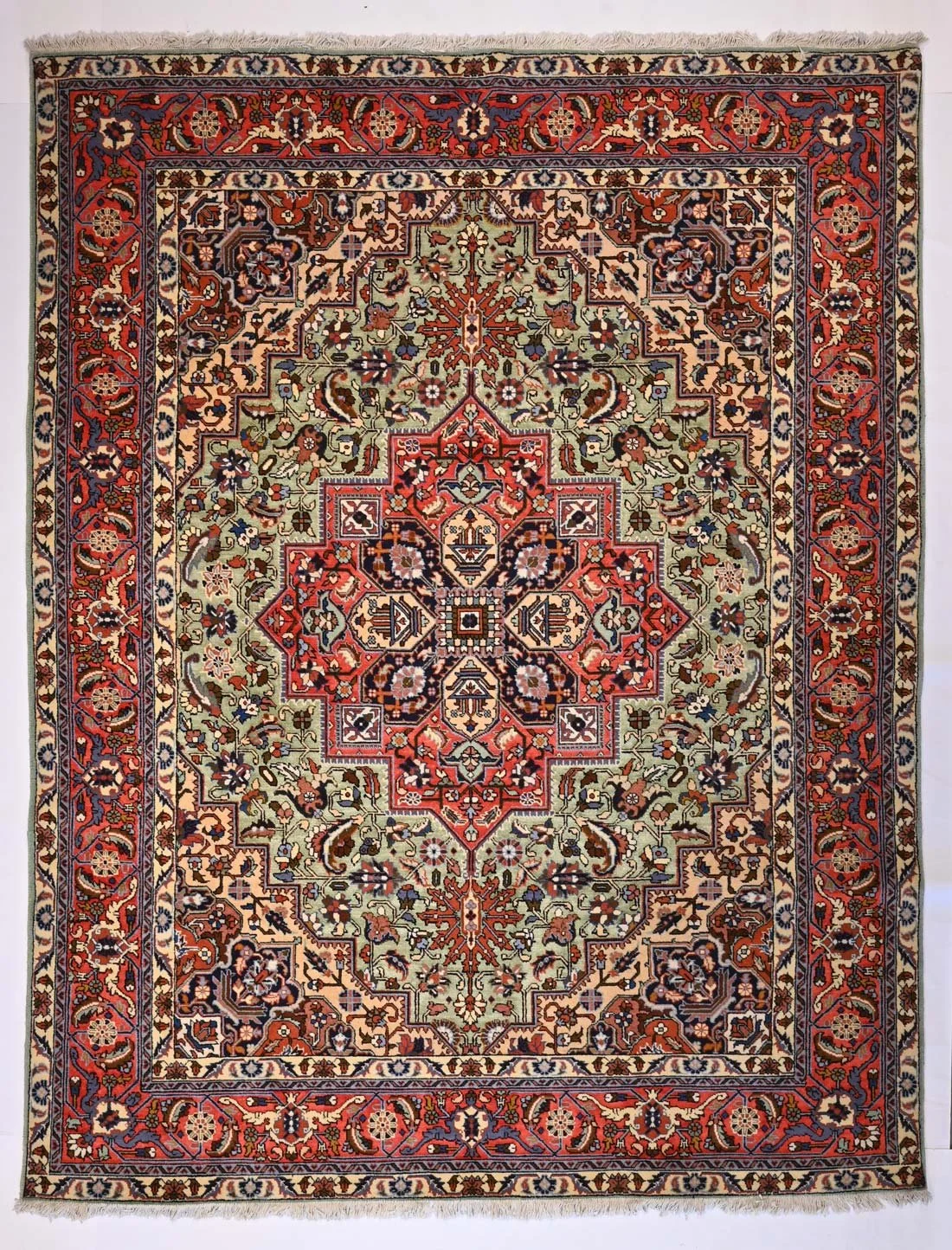
The rug shown here is woven in a geometric pattern related to the designs of neighbouring Heriz, centred around a bold medallion. What makes it particularly fascinating is the use of silk in the green field and the salmon-coloured border. Silk reflects light differently from wool and lies flatter within the pile. As a result, the wool rises slightly higher while the silk areas shimmer softly, creating subtle variations in texture and appearance that change with the light.
The combination of tribal design, village weaving traditions, and the unexpected use of silk makes this a truly unusual piece. Its rich colours, striking geometry, and constantly shifting surface give it a presence that is difficult to ignore.
Adding further to its appeal is its uncommon size of 250 × 200 cm. Its almost square proportions make it particularly versatile and well suited to many interiors.
Rare, distinctive, and born from a unique moment in history, this is a carpet that naturally becomes a subject of conversation and a piece one could genuinely be proud to own.
The town of Ardabil in northwest Iran has been one of the major carpet-producing centres of Persia for centuries. It possesses a rich weaving culture and a remarkable variety of designs, largely due to the Shahsavan tribes who live around the city and the Shahsavan population of the town itself, who have inherited a wealth of patterns and motifs from their ancestors.
Ardabil lies close to the Caucasus, particularly present-day Armenia and Azerbaijan, and its carpets reflect centuries of cultural exchange across these borders. The result is a distinctive weaving tradition that combines Persian refinement with tribal vigour and Caucasian geometry.
Traditionally, Ardabil weavers produced wool carpets on wool or cotton foundations. Yet for a brief and unusual period in the early years of the 21st century, roughly between 2000 and 2007, a collapse in the silk market made silk yarn unexpectedly affordable. Taking advantage of this rare opportunity, some weavers began incorporating silk into carpets that otherwise retained their village and tribal character.
The experiment was short-lived. As silk prices recovered and rose beyond their previous levels, the practice became economically impractical and quickly disappeared. Carpets such as this one therefore belong to a very limited chapter in the history of Ardabil weaving—a chapter unlikely ever to be repeated.
The rug shown here is woven in a geometric pattern related to the designs of neighbouring Heriz, centred around a bold medallion. What makes it particularly fascinating is the use of silk in the green field and the salmon-coloured border. Silk reflects light differently from wool and lies flatter within the pile. As a result, the wool rises slightly higher while the silk areas shimmer softly, creating subtle variations in texture and appearance that change with the light.
The combination of tribal design, village weaving traditions, and the unexpected use of silk makes this a truly unusual piece. Its rich colours, striking geometry, and constantly shifting surface give it a presence that is difficult to ignore.
Adding further to its appeal is its uncommon size of 250 × 200 cm. Its almost square proportions make it particularly versatile and well suited to many interiors.
Rare, distinctive, and born from a unique moment in history, this is a carpet that naturally becomes a subject of conversation and a piece one could genuinely be proud to own.
