
 Image 1 of 1
There are hundreds of villages scattered around the three major cities of Qazvin, Zanjan, and Hamedan, each with its own traditions of carpet weaving. Most of these village rugs are woven entirely from memory in geometric patterns, and each village has its own distinctive style, choice of colours, and visual language, making it possible to distinguish the work of one village from another.
Many of these rugs are grouped under the name Musel, most probably because the Iraqi city of Mosul was an important trading hub where such carpets were traded in large numbers. These rugs were especially popular among the Arab nomads and Bedouins of Iraq and Arabia, appreciated for their durability, portability, and rich geometric character. Through this strong connection with the bazaars of Mosul, the name Musel gradually became associated with this category of village rugs.
What makes these rugs truly fascinating is the extraordinary diversity of their designs. That diversity reflects not only the countless weaving traditions preserved in these villages, but also the creativity of individual weavers, each adding something personal to an inherited visual language rooted deeply in collective memory shaped over centuries.
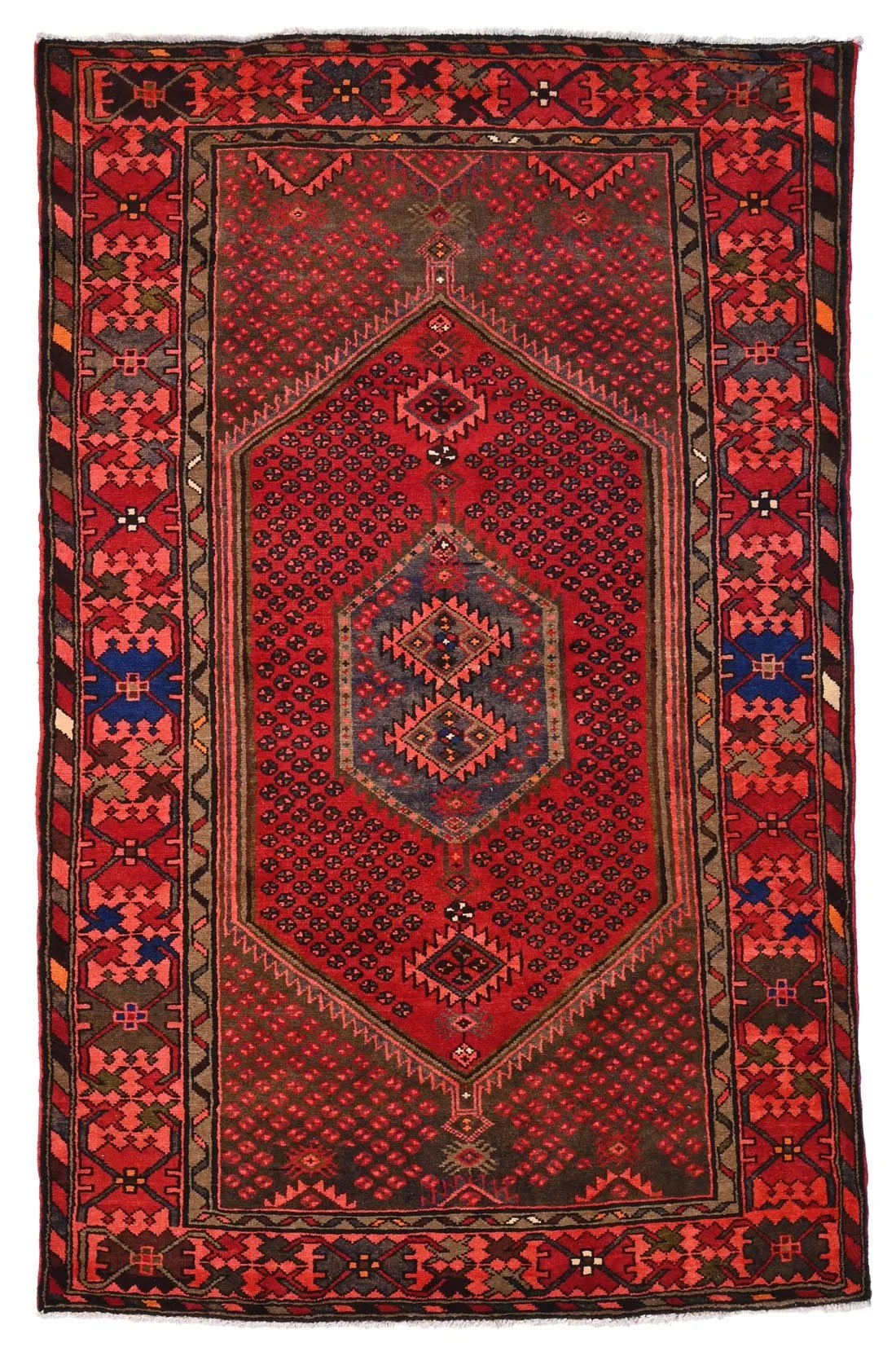
This particular piece, woven in a village near the city of Zanjan, is a beautiful example of that tradition. It carries rich natural colours and excellent wool of very high quality. The dyes are extracted from herbs, plants, and other natural sources, giving the rug a depth and softness that only improve with time.
These are carpets made to last generations. Yet their beauty goes far beyond durability or aesthetics. Once one begins to explore the history, culture, and lives of the people behind such weavings, an entirely new layer of meaning appears. A rug like this does not simply decorate a space; it brings with it stories, memories, and a quiet cultural depth that can inspire endless conversations.
There are hundreds of villages scattered around the three major cities of Qazvin, Zanjan, and Hamedan, each with its own traditions of carpet weaving. Most of these village rugs are woven entirely from memory in geometric patterns, and each village has its own distinctive style, choice of colours, and visual language, making it possible to distinguish the work of one village from another.
Many of these rugs are grouped under the name Musel, most probably because the Iraqi city of Mosul was an important trading hub where such carpets were traded in large numbers. These rugs were especially popular among the Arab nomads and Bedouins of Iraq and Arabia, appreciated for their durability, portability, and rich geometric character. Through this strong connection with the bazaars of Mosul, the name Musel gradually became associated with this category of village rugs.
What makes these rugs truly fascinating is the extraordinary diversity of their designs. That diversity reflects not only the countless weaving traditions preserved in these villages, but also the creativity of individual weavers, each adding something personal to an inherited visual language rooted deeply in collective memory shaped over centuries.
This particular piece, woven in a village near the city of Zanjan, is a beautiful example of that tradition. It carries rich natural colours and excellent wool of very high quality. The dyes are extracted from herbs, plants, and other natural sources, giving the rug a depth and softness that only improve with time.
These are carpets made to last generations. Yet their beauty goes far beyond durability or aesthetics. Once one begins to explore the history, culture, and lives of the people behind such weavings, an entirely new layer of meaning appears. A rug like this does not simply decorate a space; it brings with it stories, memories, and a quiet cultural depth that can inspire endless conversations.
