
 Image 1 of 1
The Kurds of Kelardasht are believed to be descendants of Kurdish tribes who were moved from western Iran to Khorasan by Shah Abbas the Great in the early seventeenth century to defend the northeastern frontiers of the Safavid Empire against Uzbek and Turkmen incursions. Over time, some of these communities migrated again and settled on the northern slopes of the Alborz Mountains around the beautiful valley of Kelardasht.
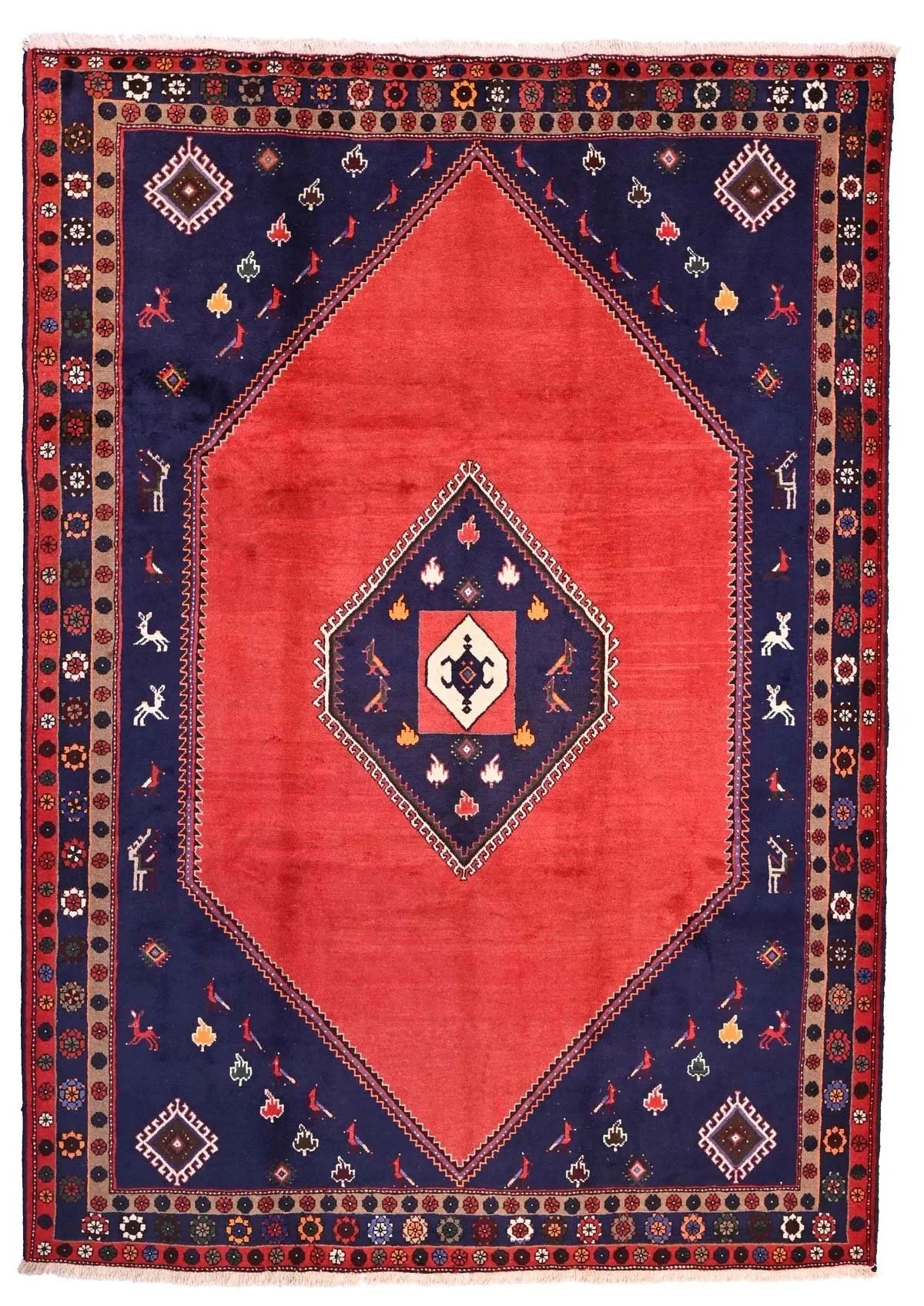
Living among forests and mountains, they developed a weaving tradition distinctly their own. While retaining elements of their Kurdish heritage, their carpets gradually diverged from those woven by their cousins in Khorasan and western Iran. The open fields, bold geometric medallions, stylised animals, and spacious compositions have become characteristic features of Kelardasht rugs.
Unlike many village carpets crowded with ornament, these weavings often celebrate simplicity. The large open field of this rug allows the powerful contrast between the glowing madder red and deep indigo blue to dominate the composition. Small stylised birds, animals, and protective symbols scattered throughout the field reflect the natural world surrounding the weavers and connect the rug to centuries of tribal symbolism.
Traditionally, weaving was a family activity. Large looms were often mounted against the exterior walls of wooden houses, allowing several members of the family to work together on larger pieces such as this one. The result is a carpet that combines tribal spontaneity with impressive scale and presence.
Woven of wool on a cotton foundation, this rug possesses the durability for which Kelardasht carpets are admired. The excellent wool, strong colours, and confident simplicity of the design give it a timeless quality. It is a rug that can easily last for generations while bringing warmth, character, and a sense of authenticity to any interior.
More than a decorative object, it is a reflection of a people, their history, and their adaptation to a new landscape. The mountains, forests, memories, and traditions of Kelardasht are all woven into its bold and beautiful design.
The Kurds of Kelardasht are believed to be descendants of Kurdish tribes who were moved from western Iran to Khorasan by Shah Abbas the Great in the early seventeenth century to defend the northeastern frontiers of the Safavid Empire against Uzbek and Turkmen incursions. Over time, some of these communities migrated again and settled on the northern slopes of the Alborz Mountains around the beautiful valley of Kelardasht.
Living among forests and mountains, they developed a weaving tradition distinctly their own. While retaining elements of their Kurdish heritage, their carpets gradually diverged from those woven by their cousins in Khorasan and western Iran. The open fields, bold geometric medallions, stylised animals, and spacious compositions have become characteristic features of Kelardasht rugs.
Unlike many village carpets crowded with ornament, these weavings often celebrate simplicity. The large open field of this rug allows the powerful contrast between the glowing madder red and deep indigo blue to dominate the composition. Small stylised birds, animals, and protective symbols scattered throughout the field reflect the natural world surrounding the weavers and connect the rug to centuries of tribal symbolism.
Traditionally, weaving was a family activity. Large looms were often mounted against the exterior walls of wooden houses, allowing several members of the family to work together on larger pieces such as this one. The result is a carpet that combines tribal spontaneity with impressive scale and presence.
Woven of wool on a cotton foundation, this rug possesses the durability for which Kelardasht carpets are admired. The excellent wool, strong colours, and confident simplicity of the design give it a timeless quality. It is a rug that can easily last for generations while bringing warmth, character, and a sense of authenticity to any interior.
More than a decorative object, it is a reflection of a people, their history, and their adaptation to a new landscape. The mountains, forests, memories, and traditions of Kelardasht are all woven into its bold and beautiful design.
