
 Image 1 of 1
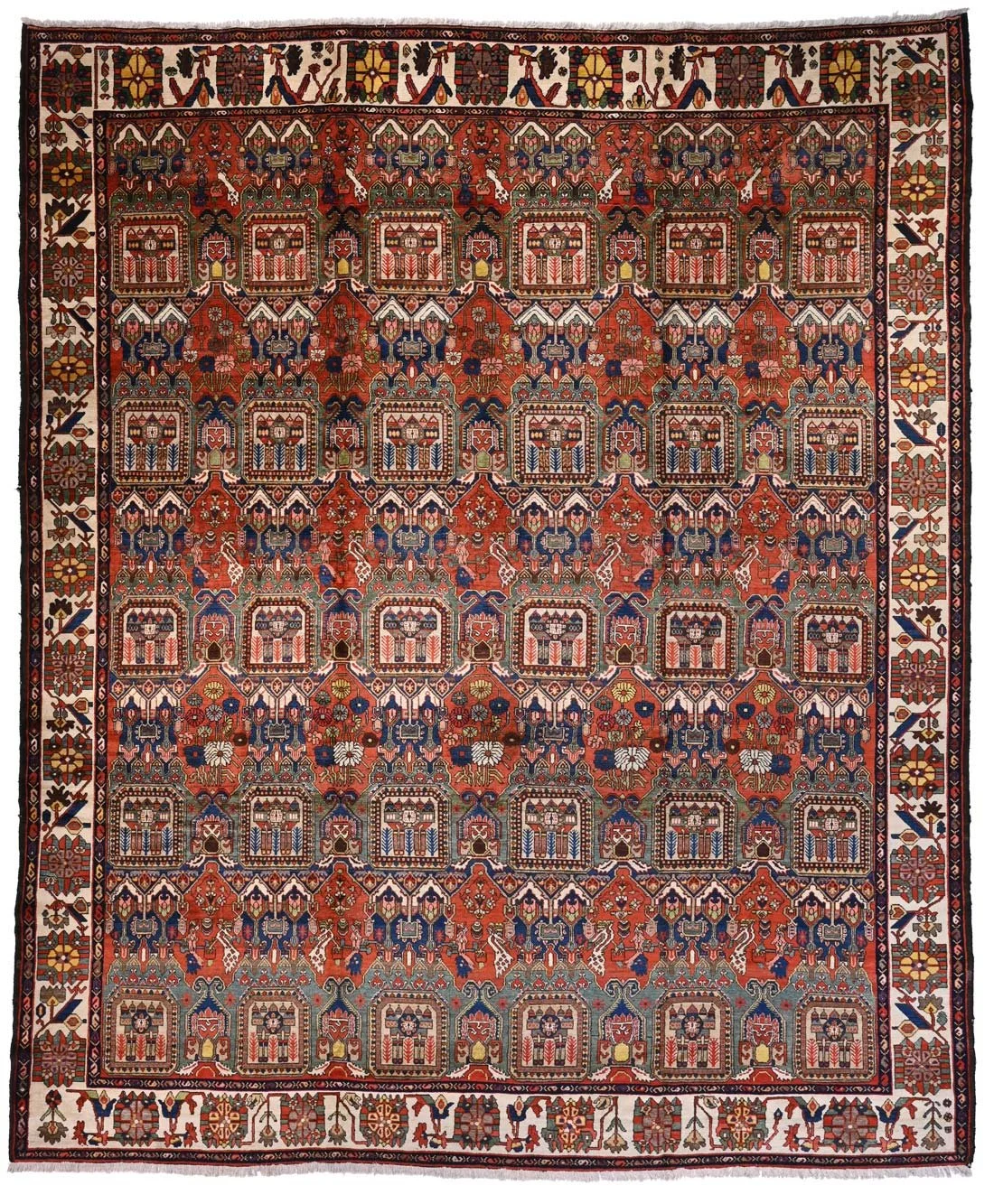
140715-400 x 336 cm | Antique Bakhtiari carpet with architectural motifs, Circa 1930s
The Bakhtiari are among the oldest peoples of the Iranian plateau, inhabiting the Zagros Mountains of central and southwestern Iran for thousands of years. Renowned for their courage, independence, and rich pastoral traditions, they have produced some of Persia's most distinctive tribal carpets. Their weavings are celebrated not only for their durability and beautiful natural colours, but also for the remarkable freedom with which each weaver interprets inherited designs.
This exceptional carpet was woven in the mid-1930s using hand-spun wool on a cotton foundation, coloured entirely with natural vegetable dyes. Like most Bakhtiari tribal rugs, it was woven completely from memory. No cartoon or graph guided the weaver's hand. Instead, the design was carried in memory and recreated knot by knot, resulting in the subtle variations that give the carpet its unmistakable vitality.
The most striking feature of this rug is the repeated architectural motif arranged across the entire field. At first glance it resembles a stylised pavilion or clock tower, repeated rhythmically to create an almost architectural landscape. It is tempting to compare the motif with the famous Clock Tower of Tabriz, one of the city's best-known landmarks. Whether this resemblance is intentional or coincidental cannot be known, yet it opens an intriguing possibility.
One can imagine a Bakhtiari Khan travelling across Iran, visiting the great cities of the country, and returning inspired by one of their remarkable monuments. Such journeys were not uncommon among the tribal leaders of the nineteenth and early twentieth centuries. If this interpretation is correct, the carpet becomes more than a decorative object—it becomes a celebration of travel, memory, and the transformation of architecture into a woven language. Even if the original inspiration has been lost, the design demonstrates the extraordinary creativity of the tribal designer, who reduced a monumental structure into a harmonious geometric pattern without losing its character.
Between these architectural forms bloom stylised flowers, birds, and ancient symbols inherited through generations. The composition reflects the Bakhtiari gift for abstraction, where the natural world is transformed into a language of geometry while remaining instantly alive and recognisable.
Nearly a century has mellowed the colours into a magnificent patina. The reds from madder root, the deep indigo blues, and the soft ivory tones have acquired the quiet harmony that only natural dyes and decades of gentle ageing can produce. The hand-spun wool has retained its natural lustre, giving the carpet a richness of texture impossible to imitate in modern production.
Like all great tribal carpets, this piece rewards prolonged observation. The repeated forms begin to suggest stories. One viewer may see towers, another gardens, another villages, and another simply an abstract rhythm of shapes. That openness is precisely what makes tribal art so compelling. It invites the imagination to participate in the work itself.
Today this carpet is not only a beautiful furnishing but also a conversation piece. It speaks of the ancient Bakhtiari people, of journeys across Iran, of architecture transformed into ornament, and of a tradition in which every weaver was not merely a craftswoman but also a designer and storyteller.
A century after it was woven, it remains remarkably well preserved. Its structure is strong, its colours have matured beautifully, and its timeless design allows it to sit effortlessly in both contemporary and traditional interiors.
Material: Hand-spun wool on a cotton foundation, coloured entirely with natural vegetable dyes.
The Bakhtiari are among the oldest peoples of the Iranian plateau, inhabiting the Zagros Mountains of central and southwestern Iran for thousands of years. Renowned for their courage, independence, and rich pastoral traditions, they have produced some of Persia's most distinctive tribal carpets. Their weavings are celebrated not only for their durability and beautiful natural colours, but also for the remarkable freedom with which each weaver interprets inherited designs.
This exceptional carpet was woven in the mid-1930s using hand-spun wool on a cotton foundation, coloured entirely with natural vegetable dyes. Like most Bakhtiari tribal rugs, it was woven completely from memory. No cartoon or graph guided the weaver's hand. Instead, the design was carried in memory and recreated knot by knot, resulting in the subtle variations that give the carpet its unmistakable vitality.
The most striking feature of this rug is the repeated architectural motif arranged across the entire field. At first glance it resembles a stylised pavilion or clock tower, repeated rhythmically to create an almost architectural landscape. It is tempting to compare the motif with the famous Clock Tower of Tabriz, one of the city's best-known landmarks. Whether this resemblance is intentional or coincidental cannot be known, yet it opens an intriguing possibility.
One can imagine a Bakhtiari Khan travelling across Iran, visiting the great cities of the country, and returning inspired by one of their remarkable monuments. Such journeys were not uncommon among the tribal leaders of the nineteenth and early twentieth centuries. If this interpretation is correct, the carpet becomes more than a decorative object—it becomes a celebration of travel, memory, and the transformation of architecture into a woven language. Even if the original inspiration has been lost, the design demonstrates the extraordinary creativity of the tribal designer, who reduced a monumental structure into a harmonious geometric pattern without losing its character.
Between these architectural forms bloom stylised flowers, birds, and ancient symbols inherited through generations. The composition reflects the Bakhtiari gift for abstraction, where the natural world is transformed into a language of geometry while remaining instantly alive and recognisable.
Nearly a century has mellowed the colours into a magnificent patina. The reds from madder root, the deep indigo blues, and the soft ivory tones have acquired the quiet harmony that only natural dyes and decades of gentle ageing can produce. The hand-spun wool has retained its natural lustre, giving the carpet a richness of texture impossible to imitate in modern production.
Like all great tribal carpets, this piece rewards prolonged observation. The repeated forms begin to suggest stories. One viewer may see towers, another gardens, another villages, and another simply an abstract rhythm of shapes. That openness is precisely what makes tribal art so compelling. It invites the imagination to participate in the work itself.
Today this carpet is not only a beautiful furnishing but also a conversation piece. It speaks of the ancient Bakhtiari people, of journeys across Iran, of architecture transformed into ornament, and of a tradition in which every weaver was not merely a craftswoman but also a designer and storyteller.
A century after it was woven, it remains remarkably well preserved. Its structure is strong, its colours have matured beautifully, and its timeless design allows it to sit effortlessly in both contemporary and traditional interiors.
Material: Hand-spun wool on a cotton foundation, coloured entirely with natural vegetable dyes.
