
 Image 1 of 1
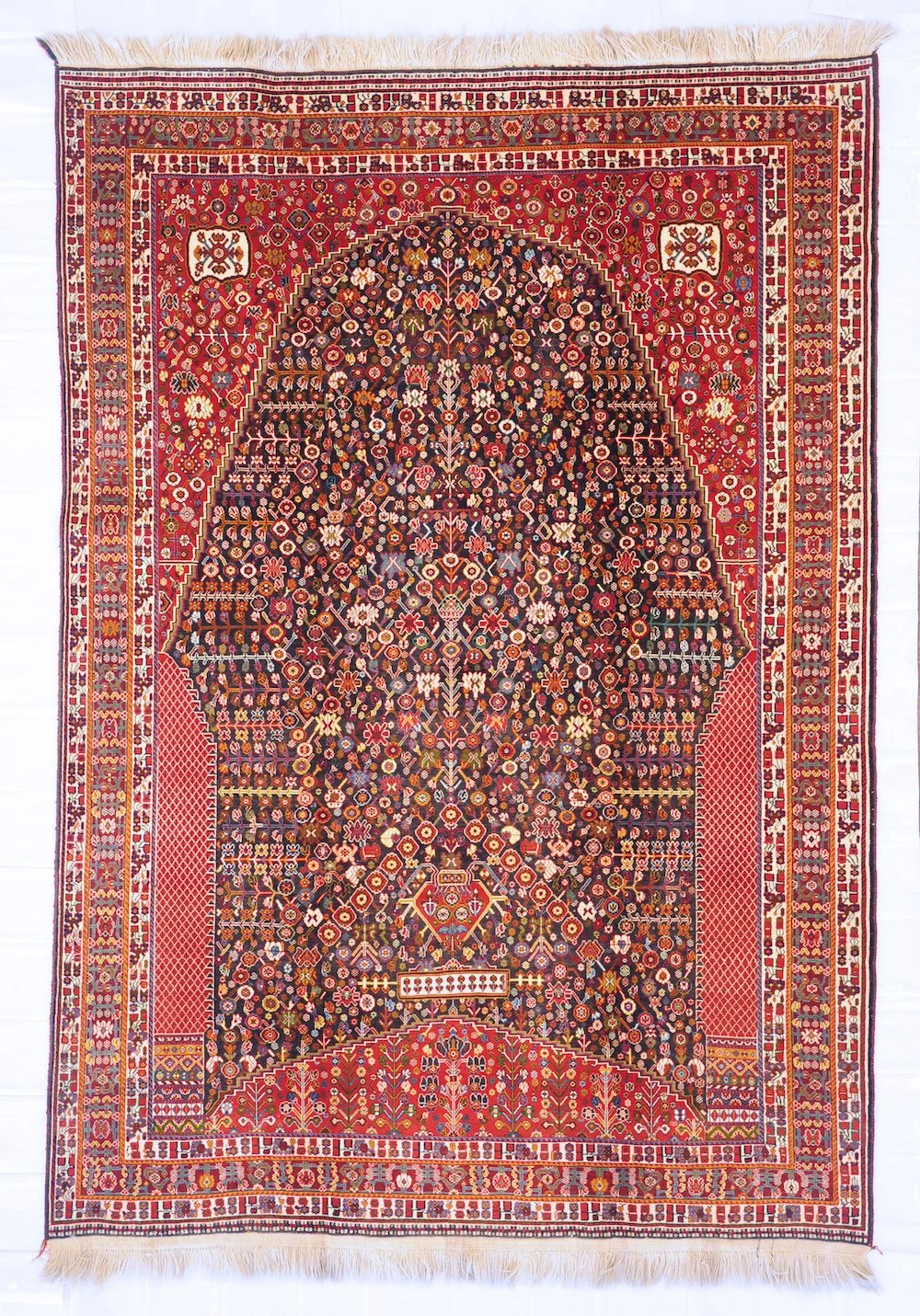
8197-292x203 | A Magnificent Qashghai, Circa 1960s.
Wool on a wool base.
Some designs are mysterious. They have been woven for centuries, yet one can never be certain what first inspired their creator. In such cases, the motifs invite contemplation and allow the imagination to wander among ancient myths and symbols.
The great arch that dominates this rug is particularly intriguing. One may see it as a window opening onto a heavenly garden, a celestial niche beyond which a multitude of flowers emerges. Equally, one may be reminded of the Tree of Life, or perhaps the Tree of Tuba described in Persian mystical literature. In Suhrawardi's Aql-e Sorkh, the Tuba Tree stands upon the summit of Mount Qaf, while the Simurgh rests upon its branches and all fruits and seeds of the world originate from it.
The cypress trees that appear throughout the composition add another layer of meaning. The cypress is among the oldest symbols in Iranian culture. It appears on the reliefs of Persepolis and occupies a special place in Persian tradition. In the Shahnameh and later literature, it is associated with beauty, endurance, and spiritual aspiration, while Zoroastrian tradition remembers the sacred Cypress of Kashmar, said to have been brought from heaven by Zarathustra.
Yet perhaps the greatest beauty of such rugs lies in their ambiguity. The weaver may never have intended any single interpretation. Like poetry, the design remains open, allowing every generation to discover something different within it.
This carpet was woven by the Qashqai tribes of southern Iran, among the finest nomadic weavers of the country. Rugs of this type were woven on horizontal looms by women working side by side, talking, laughing, singing, and weaving at the same time. The result is more than a carpet. It is a reflection of the weavers themselves, their traditions, their memories, their moods, and their love of beauty.
The extraordinary fineness of this example, combined with its rich natural dyes and remarkable complexity of design, places it among the finest Qashqai weavings of its period. Woven in the 1950s, it remains both a work of craftsmanship and a doorway into a world where mythology, nature, memory, and daily life were woven together knot by knot.
8197-292x203 | A Magnificent Qashghai, Circa 1960s.
Wool on a wool base.
Some designs are mysterious. They have been woven for centuries, yet one can never be certain what first inspired their creator. In such cases, the motifs invite contemplation and allow the imagination to wander among ancient myths and symbols.
The great arch that dominates this rug is particularly intriguing. One may see it as a window opening onto a heavenly garden, a celestial niche beyond which a multitude of flowers emerges. Equally, one may be reminded of the Tree of Life, or perhaps the Tree of Tuba described in Persian mystical literature. In Suhrawardi's Aql-e Sorkh, the Tuba Tree stands upon the summit of Mount Qaf, while the Simurgh rests upon its branches and all fruits and seeds of the world originate from it.
The cypress trees that appear throughout the composition add another layer of meaning. The cypress is among the oldest symbols in Iranian culture. It appears on the reliefs of Persepolis and occupies a special place in Persian tradition. In the Shahnameh and later literature, it is associated with beauty, endurance, and spiritual aspiration, while Zoroastrian tradition remembers the sacred Cypress of Kashmar, said to have been brought from heaven by Zarathustra.
Yet perhaps the greatest beauty of such rugs lies in their ambiguity. The weaver may never have intended any single interpretation. Like poetry, the design remains open, allowing every generation to discover something different within it.
This carpet was woven by the Qashqai tribes of southern Iran, among the finest nomadic weavers of the country. Rugs of this type were woven on horizontal looms by women working side by side, talking, laughing, singing, and weaving at the same time. The result is more than a carpet. It is a reflection of the weavers themselves, their traditions, their memories, their moods, and their love of beauty.
The extraordinary fineness of this example, combined with its rich natural dyes and remarkable complexity of design, places it among the finest Qashqai weavings of its period. Woven in the 1950s, it remains both a work of craftsmanship and a doorway into a world where mythology, nature, memory, and daily life were woven together knot by knot.
