
 Image 1 of 1
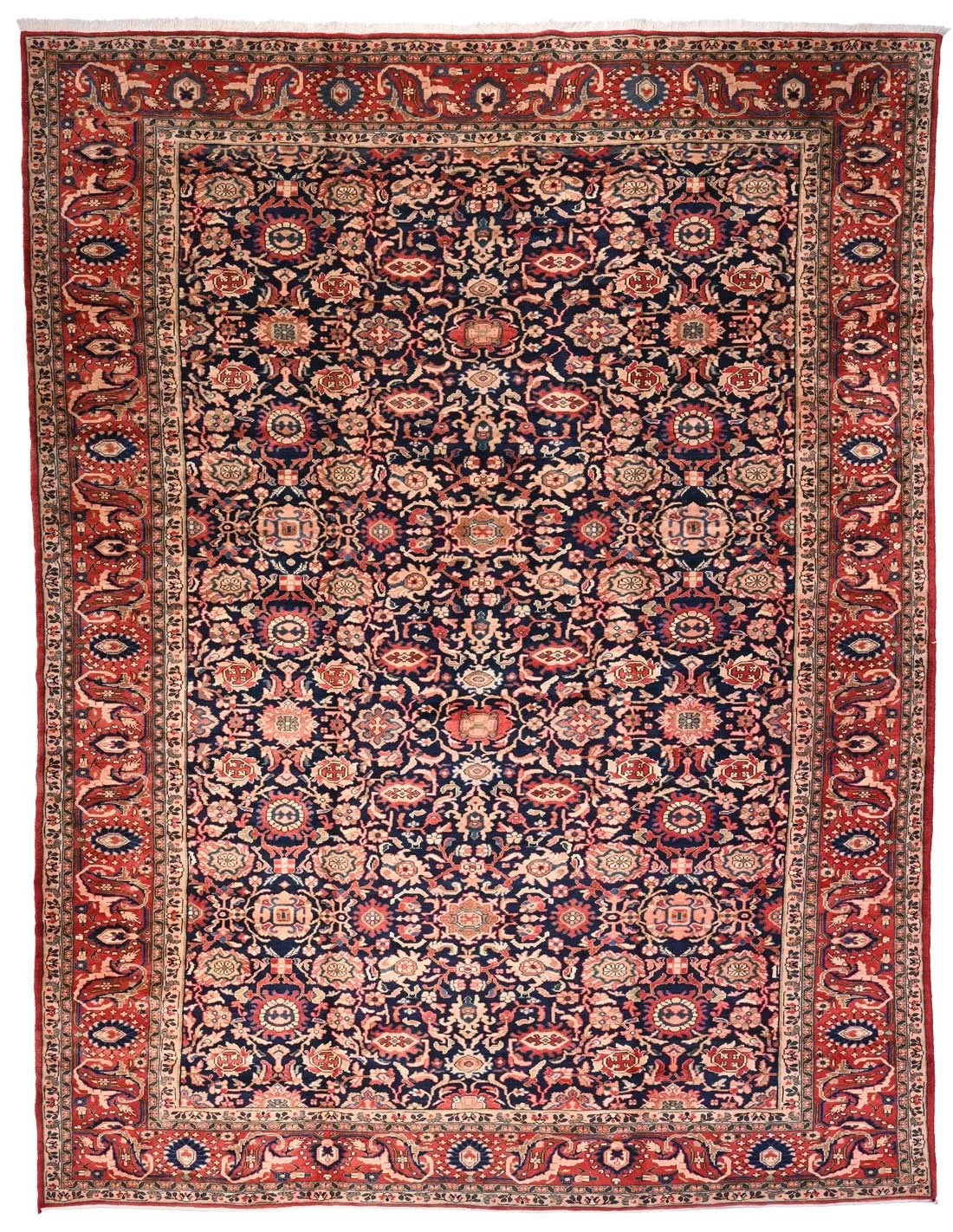
72475-418 x 322 cm | Exceptional Nanaj carpet, Circa mid 20th century
The village of Nanaj, together with the surrounding weaving villages, lies in the Malayer district of Hamadan Province in western Iran. This mountainous region belongs to one of the oldest settled landscapes of the Iranian plateau and has long been known for pastoral life, sheep farming, and village carpet weaving. Its proximity to Kurdistan and its cold highland climate contributed to the availability of strong, lustrous wool particularly well suited to durable carpets.
Nanaj carpets have earned a distinguished place in the carpet world for their excellent wool, rich colours, and spontaneous floral patterns. They were generally woven on relatively simple village looms, which makes the remarkable size of this carpet especially impressive. At 418 × 322 centimetres, it would have required an unusually large loom and most probably the combined work of several members of one family.
This magnificent example was woven around the middle of the twentieth century using hand-spun wool and natural dyes. Its deep indigo field provides a dramatic background for a dense garden of stylised flowers, leaves, palmettes, and scrolling branches. The rich reds were obtained predominantly from madder root, while natural indigo created the exceptionally deep and luminous blue. Other local plants and materials provided the softer shades that give the composition depth and variety.
At first glance, the design appears highly ordered and repetitive. Yet closer observation reveals that no two flowers are precisely alike. The weavers worked from memory rather than following a prepared cartoon or graph. They inherited the general composition and its visual language from earlier generations, but recreated every element freely as the carpet developed on the loom.
Despite the enormous scale of the rug, they maintained an extraordinary sense of symmetry and harmony. The repeated floral forms establish a steady rhythm across the field, yet their subtle variations prevent the design from becoming mechanical. This balance between order and freedom is one of the most appealing characteristics of authentic village weaving.
Occasionally, small spaces appear naturally between the larger motifs. Rather than leaving them empty, the weavers filled them playfully with tiny birds and bird-like figures. Some are clearly formed, while others seem almost unfinished or transformed into abstract shapes. These charming details are not merely decorative fillers. They reveal moments when the weavers allowed their imagination to wander, adding something personal to the inherited design.
The broad border gives the carpet a powerful architectural frame. Its bold palmettes and flowing forms contrast beautifully with the intricate floral field, containing the abundance of the design without diminishing its energy.
The hand-spun wool is exceptionally plush and possesses the distinctive sheen associated with the highland wool of the Hamadan and neighbouring Kurdish regions. Because each strand was spun by hand, the yarn varies gently in thickness, giving the surface a rich and living texture. The natural dyes have also mellowed beautifully with age, creating colours that remain intense without appearing harsh.
This is a carpet made to endure. Its strong structure, resilient wool, and generous pile allow it to withstand heavy use, while decades of wear will only soften and enrich its appearance. It is both a magnificent decorative carpet and a remarkable expression of village creativity, created on a primitive loom, entirely from memory, yet with astonishing control over scale, rhythm, and colour.
Material: Hand-spun wool on a cotton foundation, coloured entirely with natural vegetable dyes.
The village of Nanaj, together with the surrounding weaving villages, lies in the Malayer district of Hamadan Province in western Iran. This mountainous region belongs to one of the oldest settled landscapes of the Iranian plateau and has long been known for pastoral life, sheep farming, and village carpet weaving. Its proximity to Kurdistan and its cold highland climate contributed to the availability of strong, lustrous wool particularly well suited to durable carpets.
Nanaj carpets have earned a distinguished place in the carpet world for their excellent wool, rich colours, and spontaneous floral patterns. They were generally woven on relatively simple village looms, which makes the remarkable size of this carpet especially impressive. At 418 × 322 centimetres, it would have required an unusually large loom and most probably the combined work of several members of one family.
This magnificent example was woven around the middle of the twentieth century using hand-spun wool and natural dyes. Its deep indigo field provides a dramatic background for a dense garden of stylised flowers, leaves, palmettes, and scrolling branches. The rich reds were obtained predominantly from madder root, while natural indigo created the exceptionally deep and luminous blue. Other local plants and materials provided the softer shades that give the composition depth and variety.
At first glance, the design appears highly ordered and repetitive. Yet closer observation reveals that no two flowers are precisely alike. The weavers worked from memory rather than following a prepared cartoon or graph. They inherited the general composition and its visual language from earlier generations, but recreated every element freely as the carpet developed on the loom.
Despite the enormous scale of the rug, they maintained an extraordinary sense of symmetry and harmony. The repeated floral forms establish a steady rhythm across the field, yet their subtle variations prevent the design from becoming mechanical. This balance between order and freedom is one of the most appealing characteristics of authentic village weaving.
Occasionally, small spaces appear naturally between the larger motifs. Rather than leaving them empty, the weavers filled them playfully with tiny birds and bird-like figures. Some are clearly formed, while others seem almost unfinished or transformed into abstract shapes. These charming details are not merely decorative fillers. They reveal moments when the weavers allowed their imagination to wander, adding something personal to the inherited design.
The broad border gives the carpet a powerful architectural frame. Its bold palmettes and flowing forms contrast beautifully with the intricate floral field, containing the abundance of the design without diminishing its energy.
The hand-spun wool is exceptionally plush and possesses the distinctive sheen associated with the highland wool of the Hamadan and neighbouring Kurdish regions. Because each strand was spun by hand, the yarn varies gently in thickness, giving the surface a rich and living texture. The natural dyes have also mellowed beautifully with age, creating colours that remain intense without appearing harsh.
This is a carpet made to endure. Its strong structure, resilient wool, and generous pile allow it to withstand heavy use, while decades of wear will only soften and enrich its appearance. It is both a magnificent decorative carpet and a remarkable expression of village creativity, created on a primitive loom, entirely from memory, yet with astonishing control over scale, rhythm, and colour.
Material: Hand-spun wool on a cotton foundation, coloured entirely with natural vegetable dyes.
