
 Image 1 of 1
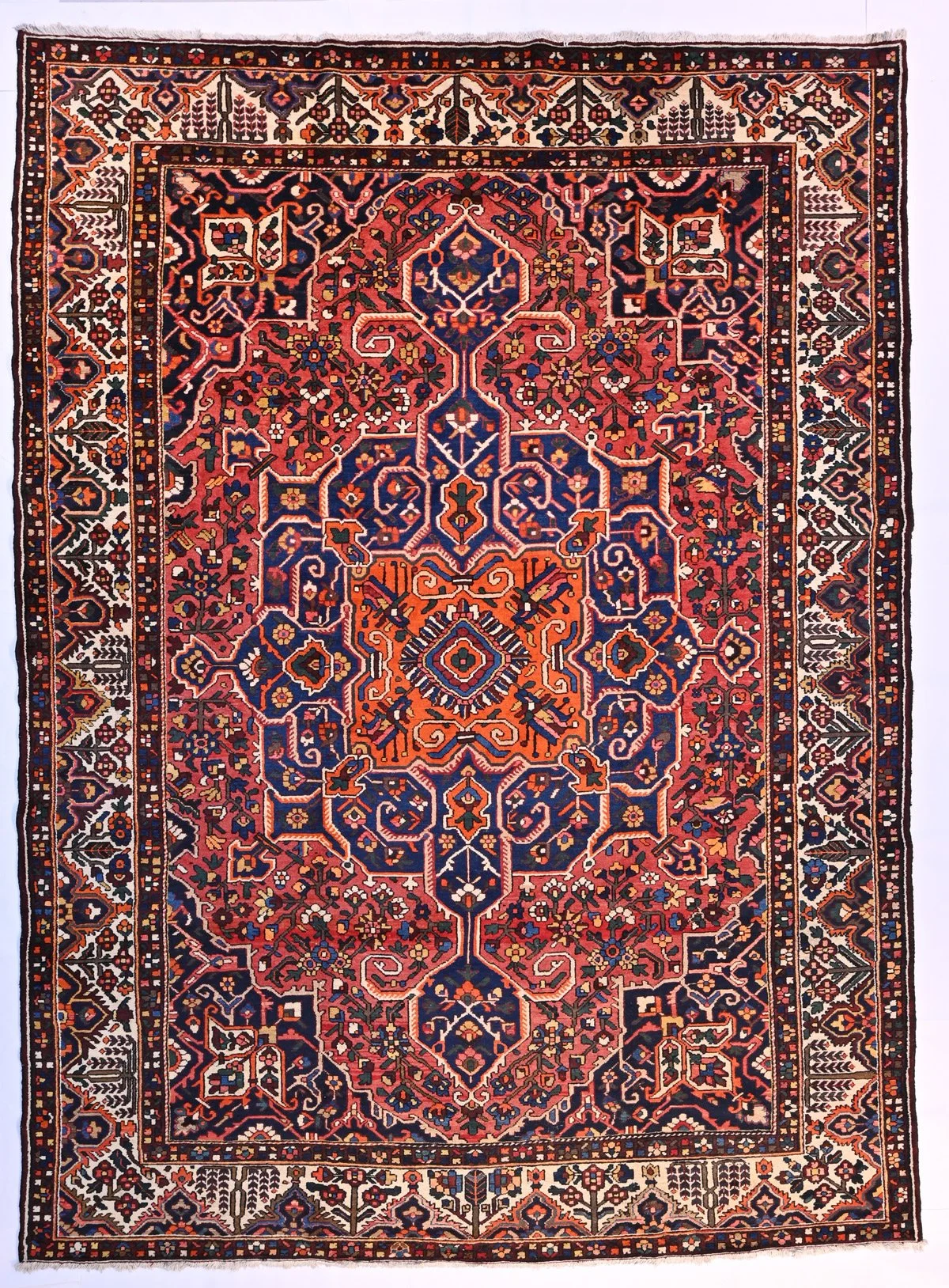
68828-420 x 308 cm | Antique Bakhtiari tribal rug with a geometric medallion, Circa 1900
The Bakhtiari are among the most prominent tribal peoples of central Iran. For centuries they inhabited the Zagros Mountains, living as pastoral nomads whose seasonal migrations shaped one of Persia's richest weaving traditions. Fiercely independent and renowned as courageous fighters, they played a decisive role in the Constitutional Revolution of Iran in the early twentieth century. Although most Bakhtiaris have now settled in villages, they continue weaving carpets that preserve the spirit and freedom of their nomadic ancestors.
This remarkable rug was woven around the turn of the twentieth century. Like most tribal carpets, it was woven entirely from memory. The weaver was also the designer. She inherited the traditional composition from generations of mothers and grandmothers, yet freely transformed it through her own imagination. Every Bakhtiari carpet therefore becomes an individual creation rather than the reproduction of a fixed pattern.
What immediately distinguishes this piece is the extraordinary use of orange. Rarely does one encounter such a bold and confident field surrounding such a powerful geometric medallion. The orange creates an irresistible focal point, making the great central medallion appear almost luminous.
Viewed through a Jungian perspective, this commanding centre recalls what Carl Gustav Jung described as the archetype of the Self, often represented by mandalas and centred symbolic forms. For Jung, such images arise spontaneously in many cultures as expressions of psychic wholeness, the ordering principle of the personality, and the unconscious striving towards individuation. Whether or not (most probably the latter is the case) the weaver consciously intended such symbolism, the composition naturally lends itself to this reading, with the great medallion standing like an inner centre around which the whole universe of the carpet finds its order.
Surrounding this centre is a world drawn from nature. Stylised flowers spread across the field alongside one of the oldest symbols of Iranian civilisation, the cypress tree. Revered since antiquity and appearing already in Achaemenid art, the evergreen cypress became in Persian literature the enduring image of the beloved, admired for its graceful form and everlasting vitality. Beside it appear the graceful weeping willows, whose flowing branches have long been compared by Persian poets to the beautiful hair of the beloved, bending gently in longing and love.
The carpet is not merely a collection of ornaments but a woven poem. Every flower, tree and branch contributes to an atmosphere of beauty, memory and quiet emotion. It reflects the soul of a people whose lives were closely bound to nature and whose artistic language evolved over countless generations.
The age of the carpet only deepens its beauty. More than a century of gentle ageing has softened the colours and created the wonderful texture and patina that collectors treasure. The hand-spun wool has retained its natural oils and lustre, while the natural dyes have mellowed into rich, harmonious tones that no modern chemical dye can imitate.
This is a carpet that rewards time. At first one admires its colours. Then the eye begins to wander through its maze of forms. Gradually it becomes less a carpet than a conversation. Like many great Persian rugs, it keeps part of its story hidden, whispering rather than declaring its meaning. One returns to it again and again, and each time it reveals something new. Perhaps that enduring mystery is one of the defining qualities of the finest Persian carpets.
Material: Hand-spun wool on a cotton foundation, coloured entirely with natural dyes.
The Bakhtiari are among the most prominent tribal peoples of central Iran. For centuries they inhabited the Zagros Mountains, living as pastoral nomads whose seasonal migrations shaped one of Persia's richest weaving traditions. Fiercely independent and renowned as courageous fighters, they played a decisive role in the Constitutional Revolution of Iran in the early twentieth century. Although most Bakhtiaris have now settled in villages, they continue weaving carpets that preserve the spirit and freedom of their nomadic ancestors.
This remarkable rug was woven around the turn of the twentieth century. Like most tribal carpets, it was woven entirely from memory. The weaver was also the designer. She inherited the traditional composition from generations of mothers and grandmothers, yet freely transformed it through her own imagination. Every Bakhtiari carpet therefore becomes an individual creation rather than the reproduction of a fixed pattern.
What immediately distinguishes this piece is the extraordinary use of orange. Rarely does one encounter such a bold and confident field surrounding such a powerful geometric medallion. The orange creates an irresistible focal point, making the great central medallion appear almost luminous.
Viewed through a Jungian perspective, this commanding centre recalls what Carl Gustav Jung described as the archetype of the Self, often represented by mandalas and centred symbolic forms. For Jung, such images arise spontaneously in many cultures as expressions of psychic wholeness, the ordering principle of the personality, and the unconscious striving towards individuation. Whether or not (most probably the latter is the case) the weaver consciously intended such symbolism, the composition naturally lends itself to this reading, with the great medallion standing like an inner centre around which the whole universe of the carpet finds its order.
Surrounding this centre is a world drawn from nature. Stylised flowers spread across the field alongside one of the oldest symbols of Iranian civilisation, the cypress tree. Revered since antiquity and appearing already in Achaemenid art, the evergreen cypress became in Persian literature the enduring image of the beloved, admired for its graceful form and everlasting vitality. Beside it appear the graceful weeping willows, whose flowing branches have long been compared by Persian poets to the beautiful hair of the beloved, bending gently in longing and love.
The carpet is not merely a collection of ornaments but a woven poem. Every flower, tree and branch contributes to an atmosphere of beauty, memory and quiet emotion. It reflects the soul of a people whose lives were closely bound to nature and whose artistic language evolved over countless generations.
The age of the carpet only deepens its beauty. More than a century of gentle ageing has softened the colours and created the wonderful texture and patina that collectors treasure. The hand-spun wool has retained its natural oils and lustre, while the natural dyes have mellowed into rich, harmonious tones that no modern chemical dye can imitate.
This is a carpet that rewards time. At first one admires its colours. Then the eye begins to wander through its maze of forms. Gradually it becomes less a carpet than a conversation. Like many great Persian rugs, it keeps part of its story hidden, whispering rather than declaring its meaning. One returns to it again and again, and each time it reveals something new. Perhaps that enduring mystery is one of the defining qualities of the finest Persian carpets.
Material: Hand-spun wool on a cotton foundation, coloured entirely with natural dyes.
