The ancient city of Milas, in southwestern Turkey, is home to weavers who have practised the art of carpet weaving for centuries, gradually establishing a distinct style of their own. Situated in the historic region of Caria, not far from the Aegean coast, Milas has a history stretching back to antiquity and has passed through Carian, Greek, Roman, Byzantine and Ottoman periods.
The town and the villages around it became particularly known for their rugs, traditionally woven in wool and distinguished by strong geometric compositions, stylised floral forms and characteristic borders. As with many village weaving traditions, individual interpretation by the weaver gives these rugs much of their charm.
The piece here was woven in Milas, using soft colours and a simple geometric pattern. The restrained palette gives the rug a gentle appearance, while the geometry preserves the character of the old weaving tradition of the region.
It is a lovely example of how a centuries-old local tradition can continue to produce rugs that are both decorative and practical, carrying something of the history and character of the place in which they were woven.
The ancient city of Milas, in southwestern Turkey, is home to weavers who have practised the art of carpet weaving for centuries, gradually establishing a distinct style of their own. Situated in the historic region of Caria, not far from the Aegean coast, Milas has a history stretching back to antiquity and has passed through Carian, Greek, Roman, Byzantine and Ottoman periods.
The town and the villages around it became particularly known for their rugs, traditionally woven in wool and distinguished by strong geometric compositions, stylised floral forms and characteristic borders. As with many village weaving traditions, individual interpretation by the weaver gives these rugs much of their charm.
The piece here was woven in Milas, using soft colours and a simple geometric pattern. The restrained palette gives the rug a gentle appearance, while the geometry preserves the character of the old weaving tradition of the region.
It is a lovely example of how a centuries-old local tradition can continue to produce rugs that are both decorative and practical, carrying something of the history and character of the place in which they were woven.

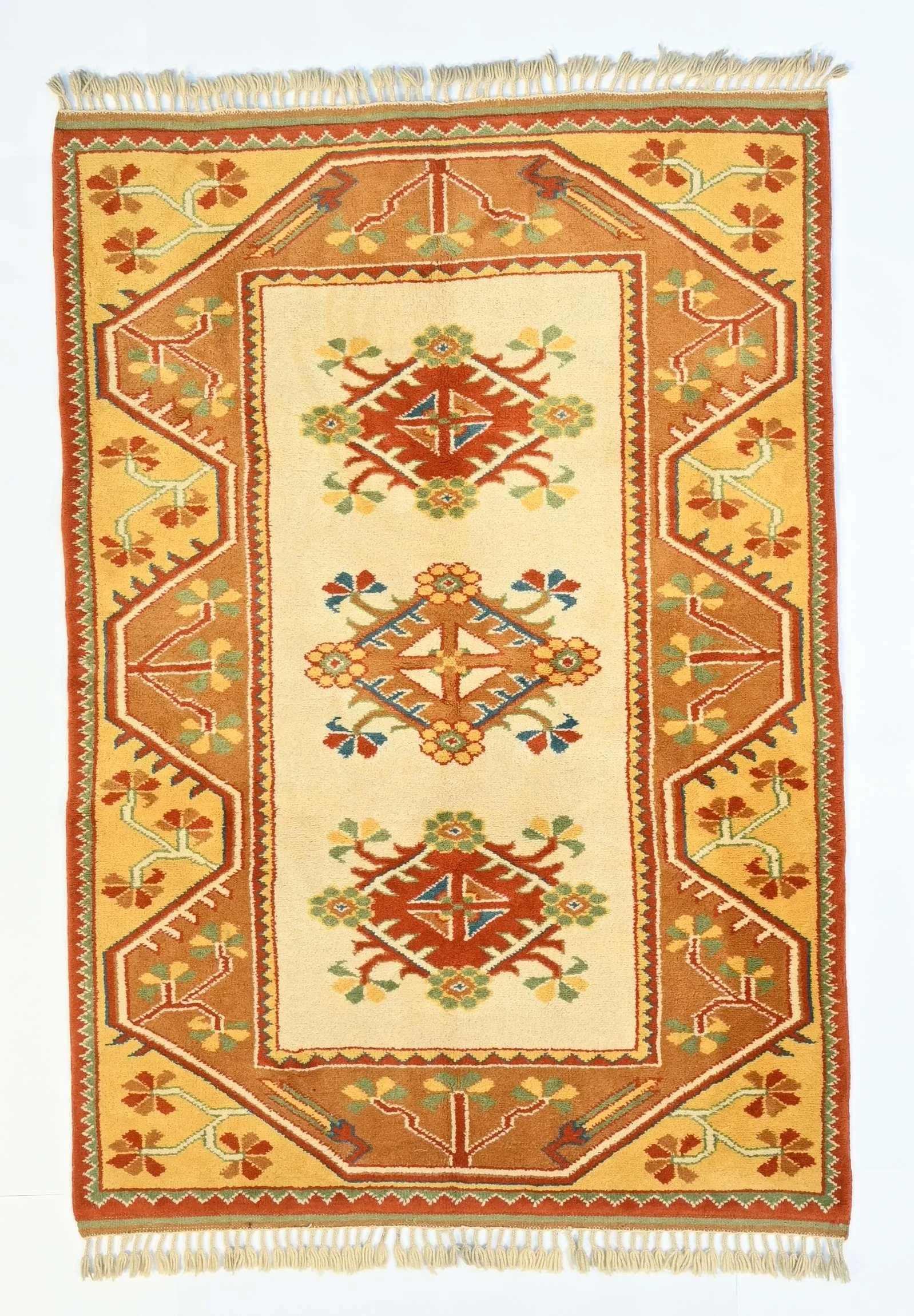 Image 1 of 1
