
 Image 1 of 1
The village of Shul in Fars province, not far from the shores of the Persian Gulf, is home to a distinctive weaving tradition practised by settled Qashqai tribes. Their rugs are admired for their honesty and restraint. Rather than relying on elaborate colours and complex ornamentation, the weavers often favour natural undyed wool and simple geometric forms, allowing the beauty of the material and the clarity of the design to speak for themselves.
The appeal of Shul rugs lies precisely in this simplicity. Their patterns are minimal yet thoughtful, their colours soft and harmonious, and their character deeply rooted in the traditions of the Qashqai tribes, many of whom gradually settled in villages while preserving elements of their nomadic heritage. Collectors value these rugs not for technical complexity but for their authenticity, sincerity, and quiet elegance.
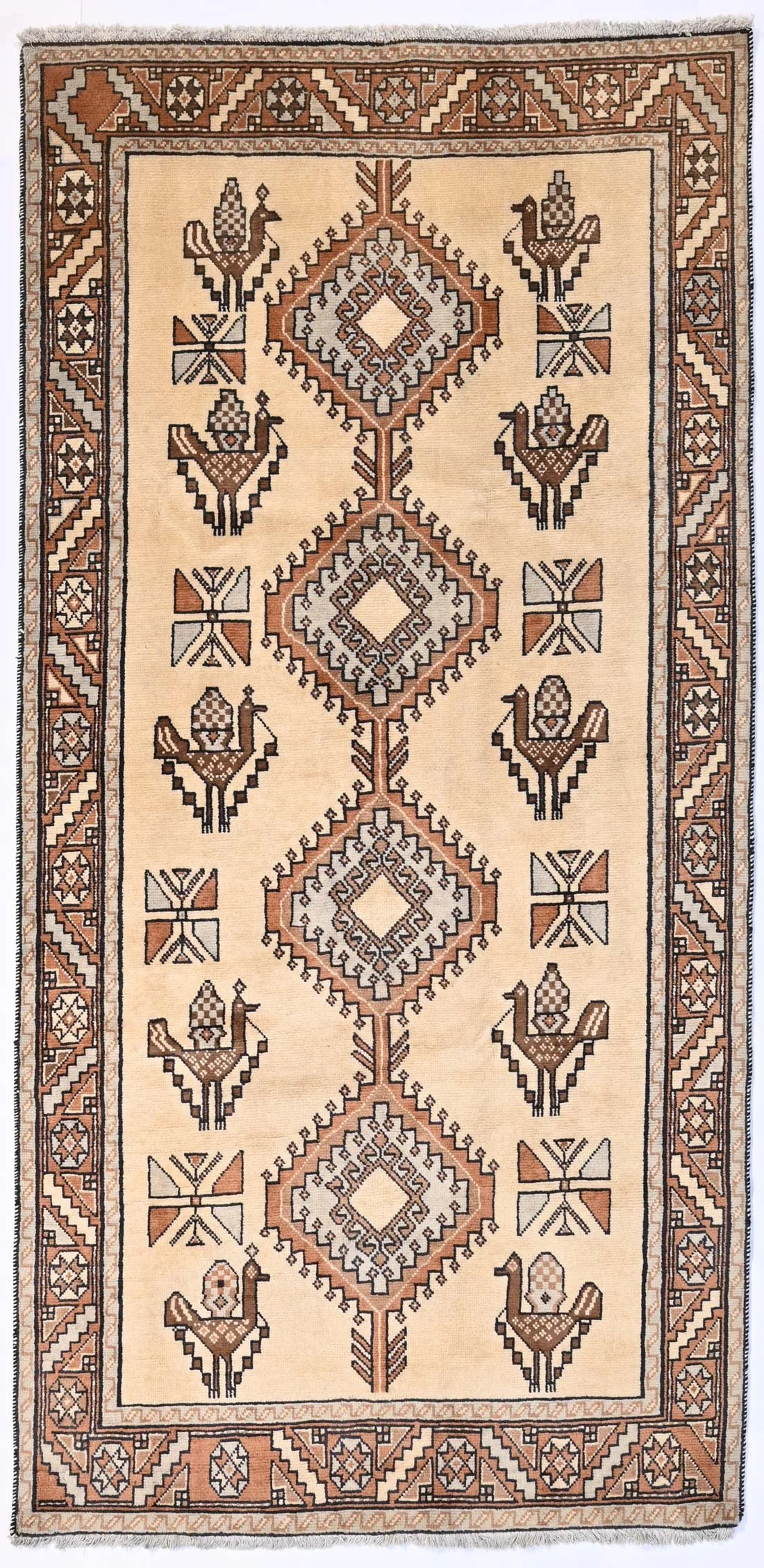
This mid-20th-century example is woven from excellent hand-spun wool and displays many of the qualities that make Shul rugs so distinctive. The composition is balanced and rhythmic, with geometric medallions arranged along the central axis and surrounded by stylised motifs rendered with remarkable confidence and economy.
Particularly intriguing are the birds that flank the design. Such motifs are often interpreted as representations of the Simorgh, the legendary bird of Persian mythology. Celebrated in Persian literature, most famously in Attar's Conference of the Birds, the Simorgh is associated with wisdom, knowledge, self-discovery, and spiritual awakening. Whether the weaver consciously intended this meaning or inherited the motif through generations of tradition, the presence of the birds adds another layer of depth to the rug.
The result is a carpet that combines simplicity with symbolism. Its restrained palette, fine hand-spun wool, and timeless design make it as relevant today as when it was woven. A piece of quiet beauty, carrying within it both the humility of village weaving and echoes of some of the oldest stories in Persian culture.
The village of Shul in Fars province, not far from the shores of the Persian Gulf, is home to a distinctive weaving tradition practised by settled Qashqai tribes. Their rugs are admired for their honesty and restraint. Rather than relying on elaborate colours and complex ornamentation, the weavers often favour natural undyed wool and simple geometric forms, allowing the beauty of the material and the clarity of the design to speak for themselves.
The appeal of Shul rugs lies precisely in this simplicity. Their patterns are minimal yet thoughtful, their colours soft and harmonious, and their character deeply rooted in the traditions of the Qashqai tribes, many of whom gradually settled in villages while preserving elements of their nomadic heritage. Collectors value these rugs not for technical complexity but for their authenticity, sincerity, and quiet elegance.
This mid-20th-century example is woven from excellent hand-spun wool and displays many of the qualities that make Shul rugs so distinctive. The composition is balanced and rhythmic, with geometric medallions arranged along the central axis and surrounded by stylised motifs rendered with remarkable confidence and economy.
Particularly intriguing are the birds that flank the design. Such motifs are often interpreted as representations of the Simorgh, the legendary bird of Persian mythology. Celebrated in Persian literature, most famously in Attar's Conference of the Birds, the Simorgh is associated with wisdom, knowledge, self-discovery, and spiritual awakening. Whether the weaver consciously intended this meaning or inherited the motif through generations of tradition, the presence of the birds adds another layer of depth to the rug.
The result is a carpet that combines simplicity with symbolism. Its restrained palette, fine hand-spun wool, and timeless design make it as relevant today as when it was woven. A piece of quiet beauty, carrying within it both the humility of village weaving and echoes of some of the oldest stories in Persian culture.
