
 Image 1 of 1
The simplicity of this rug is a fascinating reflection of a sophisticated culture whose roots reach deep into the history of the Iranian plateau. The Kurds have inhabited the Zagros and the mountainous regions of western Iran for centuries, and Kurdish communities have long been established across northwestern Iran. The relationship between the modern Kurds and the ancient Medes remains a subject of scholarly debate, although Kurdish tradition has often regarded the Medes as their ancestors. What is certain is that both belong to the long history of Iranian-speaking peoples of this mountainous region.
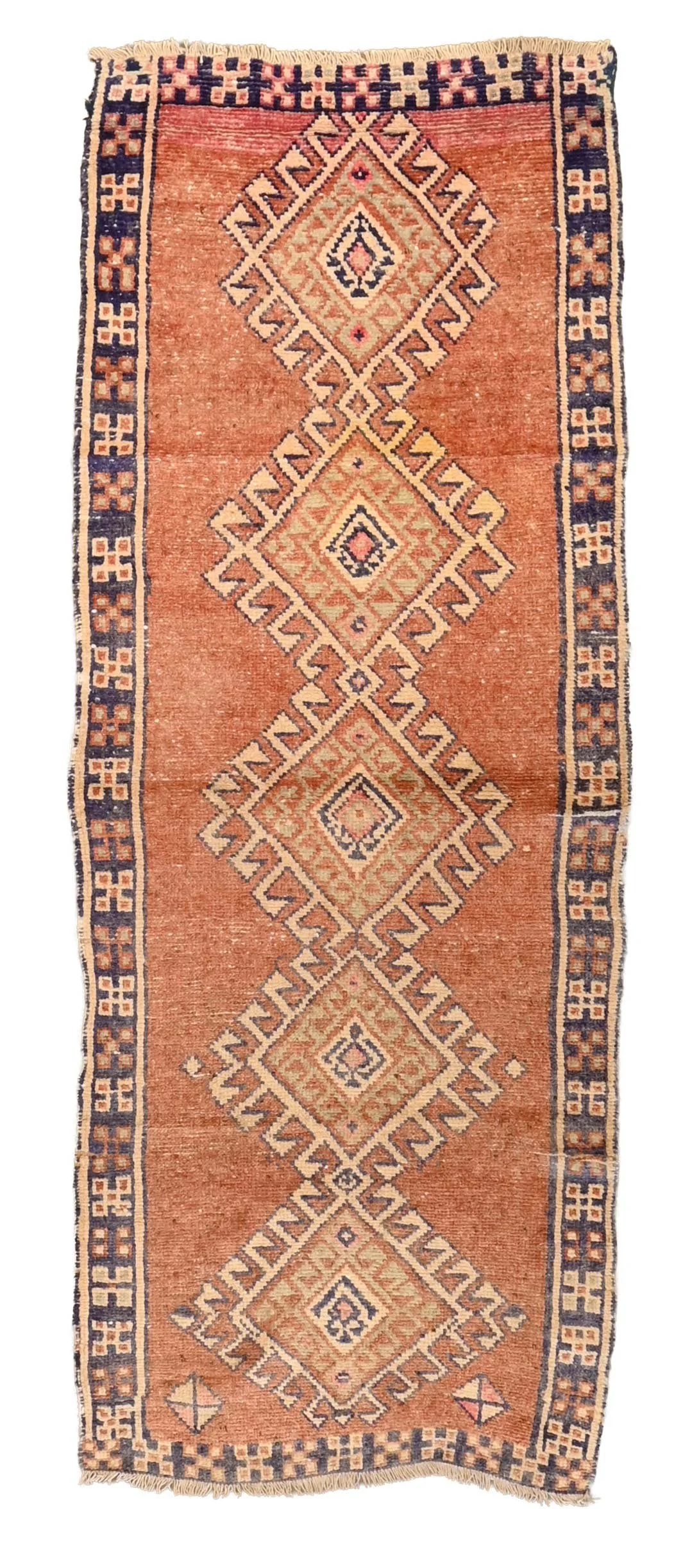
The rug itself speaks in a remarkably simple visual language. Five large lozenges float one above another on an open field, surrounded by a narrow geometric border. There are no elaborate flowers, no attempt to fill every empty space, and very few colours. Yet the result has an extraordinary presence.
The original meanings of many such tribal motifs have been lost to time. The designs survived because they were carried from one hand to another, from grandmother to mother, from mother to daughter, and from one generation to the next. The weaver inherited the forms, but each time they passed through another pair of hands they were subtly reinterpreted.
Today one encounters many explanations for these ancient symbols. Lozenges have been interpreted as fertility symbols, protective forms or even amulets associated with rain, while four-pointed motifs have been associated with the four seasons and the cycle of life. Such interpretations can be appealing, but in most cases it is impossible to establish with certainty what the original weaver, or her ancestors centuries before her, understood them to mean.
And perhaps that uncertainty is part of their beauty.
Something has survived even when its explanation has disappeared. The symbol remains while its original story has faded, leaving us with a mysterious message from the past. We recognise the form without necessarily knowing why it feels familiar.
Perhaps this is why such apparently simple rugs can possess such a sophisticated appeal. Their geometry seems to touch something deeper than decoration, awakening curiosity and perhaps even something inherited and hidden within our collective memory. We may never completely understand what these symbols once meant, yet we continue to respond to them.
This beautiful Kurdish rug was woven in northwestern Iran during the second quarter of the twentieth century. Its restrained geometry, limited palette and open field give it an almost contemporary appearance, although the visual language behind it is considerably older.
Nearly a century later, its simplicity remains its greatest strength. It is a rug that asks very little of the eye at first, yet the longer one lives with it, the more mysterious it becomes.
Material: Wool on a cotton base.
The simplicity of this rug is a fascinating reflection of a sophisticated culture whose roots reach deep into the history of the Iranian plateau. The Kurds have inhabited the Zagros and the mountainous regions of western Iran for centuries, and Kurdish communities have long been established across northwestern Iran. The relationship between the modern Kurds and the ancient Medes remains a subject of scholarly debate, although Kurdish tradition has often regarded the Medes as their ancestors. What is certain is that both belong to the long history of Iranian-speaking peoples of this mountainous region.
The rug itself speaks in a remarkably simple visual language. Five large lozenges float one above another on an open field, surrounded by a narrow geometric border. There are no elaborate flowers, no attempt to fill every empty space, and very few colours. Yet the result has an extraordinary presence.
The original meanings of many such tribal motifs have been lost to time. The designs survived because they were carried from one hand to another, from grandmother to mother, from mother to daughter, and from one generation to the next. The weaver inherited the forms, but each time they passed through another pair of hands they were subtly reinterpreted.
Today one encounters many explanations for these ancient symbols. Lozenges have been interpreted as fertility symbols, protective forms or even amulets associated with rain, while four-pointed motifs have been associated with the four seasons and the cycle of life. Such interpretations can be appealing, but in most cases it is impossible to establish with certainty what the original weaver, or her ancestors centuries before her, understood them to mean.
And perhaps that uncertainty is part of their beauty.
Something has survived even when its explanation has disappeared. The symbol remains while its original story has faded, leaving us with a mysterious message from the past. We recognise the form without necessarily knowing why it feels familiar.
Perhaps this is why such apparently simple rugs can possess such a sophisticated appeal. Their geometry seems to touch something deeper than decoration, awakening curiosity and perhaps even something inherited and hidden within our collective memory. We may never completely understand what these symbols once meant, yet we continue to respond to them.
This beautiful Kurdish rug was woven in northwestern Iran during the second quarter of the twentieth century. Its restrained geometry, limited palette and open field give it an almost contemporary appearance, although the visual language behind it is considerably older.
Nearly a century later, its simplicity remains its greatest strength. It is a rug that asks very little of the eye at first, yet the longer one lives with it, the more mysterious it becomes.
Material: Wool on a cotton base.
