
 Image 1 of 1
This is another Bakhtiari khersak, attributed to Armenian weavers of central Persia and dating to circa the 1930s. It offers a beautiful way of looking at the shared artistic life of the region, where Armenian communities and their Bakhtiari neighbours lived alongside one another, bringing their own taste and traditions to a common weaving landscape.
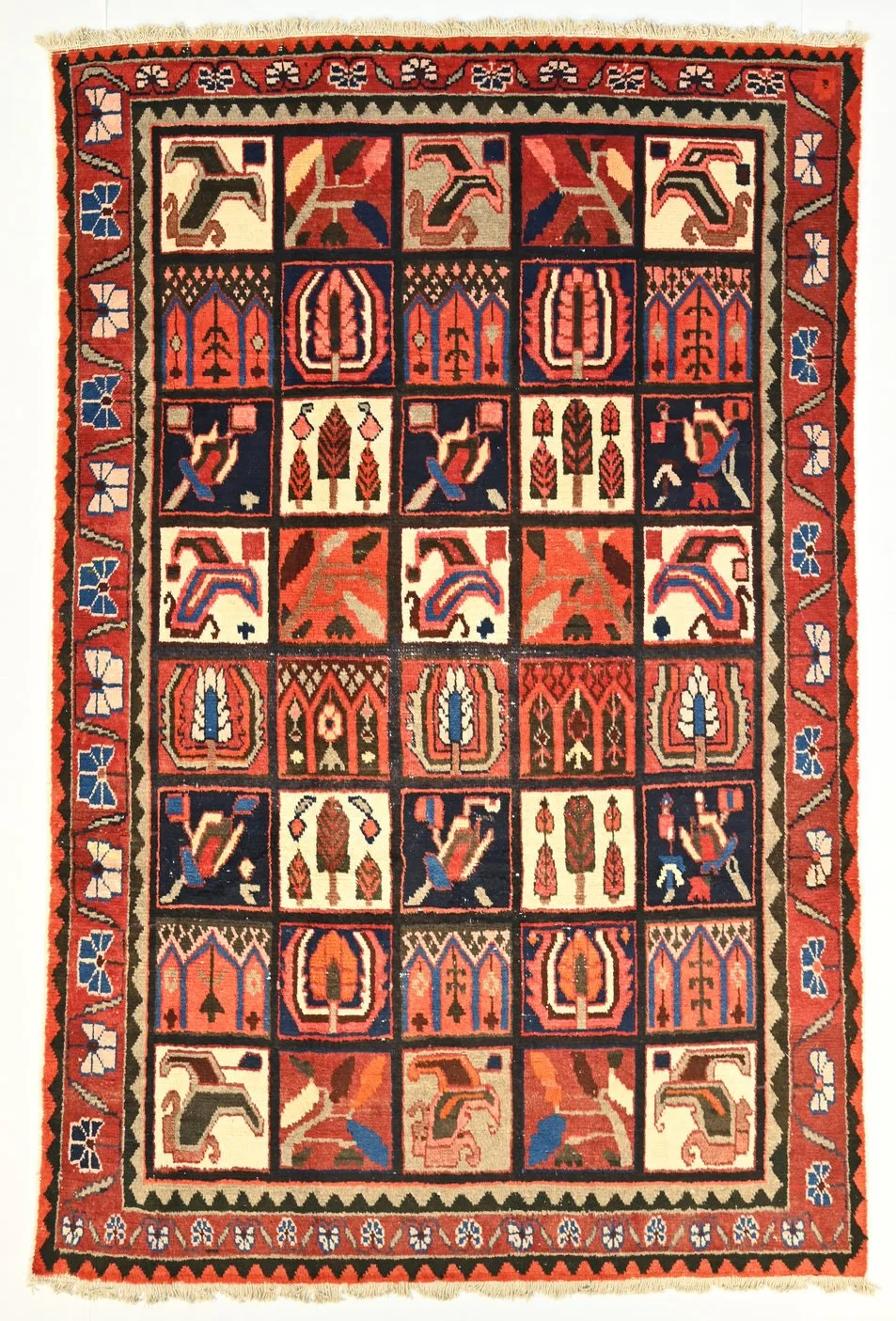
The garden design is one of the most celebrated patterns associated with Bakhtiari weaving. Here, it is divided into a series of rectangular compartments, often described as the kheshti, or brick, arrangement. Each little compartment contains its own image of nature, so that the carpet becomes a garden composed of many small gardens. The design gives the weaver a familiar structure within which individual interpretations can take shape.
Cypress trees, weeping willows, flowering stems and boldly stylised leaves appear in wonderfully simplified forms. What is interesting is the way these motifs have been reduced to their essential shapes, with a directness that gives them such presence. Their small differences in proportion, outline and placement give the drawing a personal character. It is a beautiful example of naïve tribal art, full of imagination and the pleasure of making.
The reds, deep blues, ivory and soft green tones create a rich and lively combination. The repeated panels bring a reassuring rhythm, while the floral border gathers the whole garden together. There is something very satisfying about moving from one compartment to the next, discovering familiar shapes that are never quite identical.
This carpet can really bring a sense of calm to a room. Setting an interior around it, one can imagine entering a different world, a slower world, a greener world, where there was more time to notice a tree, a flower or the changing colours of a garden. Looking at it, one can almost imagine the fragrance of flowers and the charm of natural life. This is the kind of comfort that comes from living with something made patiently and with feeling.
Woven in beautiful old handspun wool on a cotton foundation, the rug has a rich texture that adds another layer to its beauty. Its appeal is in the quality of its wool, the honesty of its drawing and the cultural memory carried through its patterns. It is a piece around which a room can find its character, with beauty that continues to invite the eye back. It is a garden that never stops flowering.
Size: 304 × 192 cm
Origin: Central Persia, Bakhtiari region; Armenian attribution
Pile material: Handspun wool
Foundation: Cotton
Period: Circa 1930s
Palette: P106
This is another Bakhtiari khersak, attributed to Armenian weavers of central Persia and dating to circa the 1930s. It offers a beautiful way of looking at the shared artistic life of the region, where Armenian communities and their Bakhtiari neighbours lived alongside one another, bringing their own taste and traditions to a common weaving landscape.
The garden design is one of the most celebrated patterns associated with Bakhtiari weaving. Here, it is divided into a series of rectangular compartments, often described as the kheshti, or brick, arrangement. Each little compartment contains its own image of nature, so that the carpet becomes a garden composed of many small gardens. The design gives the weaver a familiar structure within which individual interpretations can take shape.
Cypress trees, weeping willows, flowering stems and boldly stylised leaves appear in wonderfully simplified forms. What is interesting is the way these motifs have been reduced to their essential shapes, with a directness that gives them such presence. Their small differences in proportion, outline and placement give the drawing a personal character. It is a beautiful example of naïve tribal art, full of imagination and the pleasure of making.
The reds, deep blues, ivory and soft green tones create a rich and lively combination. The repeated panels bring a reassuring rhythm, while the floral border gathers the whole garden together. There is something very satisfying about moving from one compartment to the next, discovering familiar shapes that are never quite identical.
This carpet can really bring a sense of calm to a room. Setting an interior around it, one can imagine entering a different world, a slower world, a greener world, where there was more time to notice a tree, a flower or the changing colours of a garden. Looking at it, one can almost imagine the fragrance of flowers and the charm of natural life. This is the kind of comfort that comes from living with something made patiently and with feeling.
Woven in beautiful old handspun wool on a cotton foundation, the rug has a rich texture that adds another layer to its beauty. Its appeal is in the quality of its wool, the honesty of its drawing and the cultural memory carried through its patterns. It is a piece around which a room can find its character, with beauty that continues to invite the eye back. It is a garden that never stops flowering.
Size: 304 × 192 cm
Origin: Central Persia, Bakhtiari region; Armenian attribution
Pile material: Handspun wool
Foundation: Cotton
Period: Circa 1930s
Palette: P106
