
 Image 1 of 1
Khersak is the Bakhtiari name for a type of gabbeh, a rug tradition admired for its bold geometry, open fields of colour and direct, expressive character. This early 20th-century example is attributed to Armenian weavers of the Bakhtiari region of central Persia.
The Armenian communities of central Persia carry a history reaching back to the forced resettlements ordered by Shah Abbas I in the early 17th century. Families brought with them their skills, artistic taste and cultural memory. Living alongside the Bakhtiari and other communities, they became part of the cultural life of the region while preserving their own identity. This history of coexistence gives the Armenian attribution of such a rug a particularly fascinating dimension.
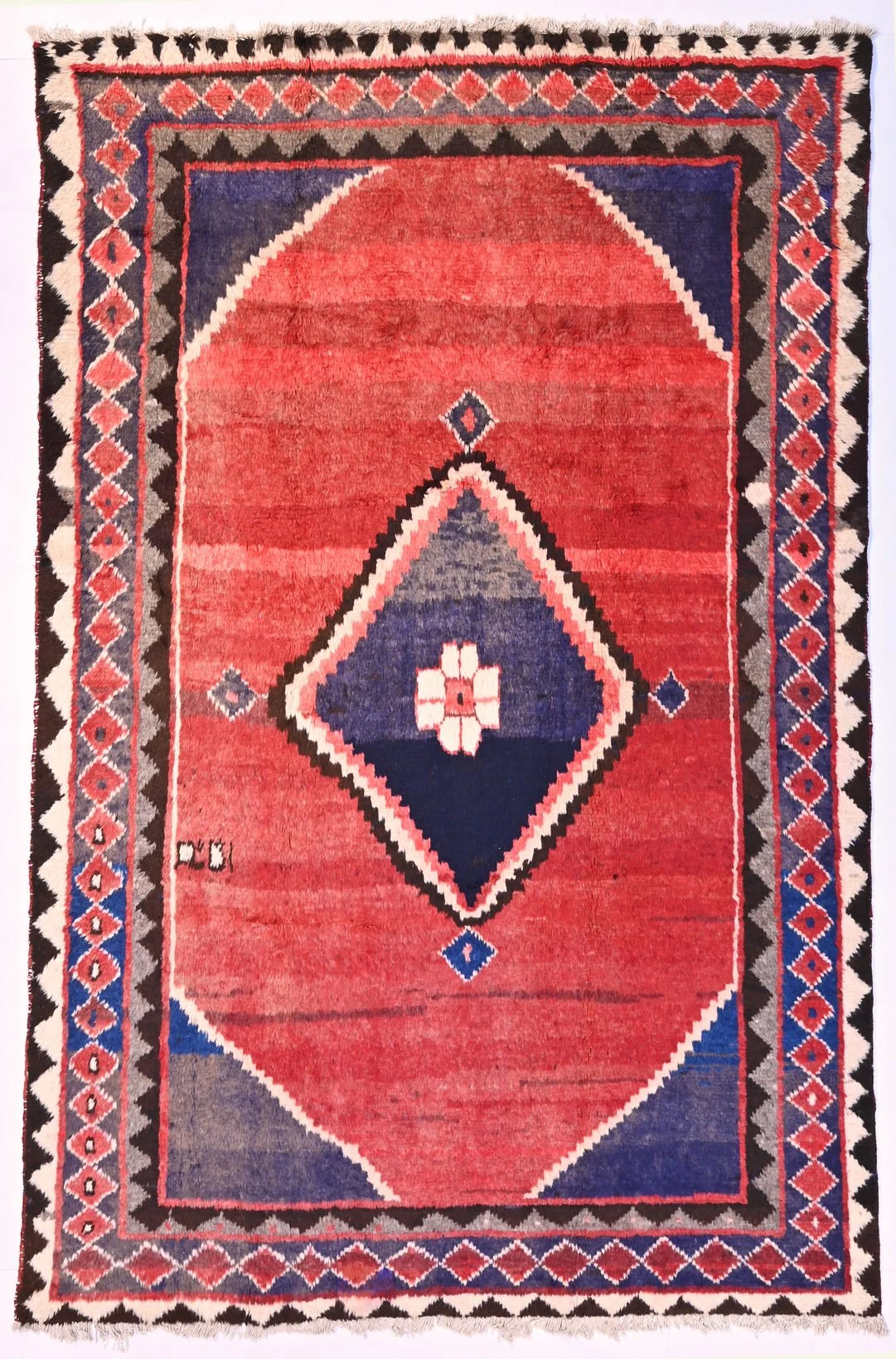
What is most notable in this piece is the confidence of its simplicity. A large blue diamond rests in a spacious red field, its pale, stepped outline giving the composition remarkable clarity. Smaller diamonds and a repeated geometric border add movement, while the bands of changing colour, known as abrash, bring life to the open spaces. These variations, together with the slight irregularities of the drawing, give the rug a very personal character.
It feels surprisingly modern, bold, direct and beautifully free of unnecessary complication. Woven in handspun wool with natural dyes on a cotton foundation, it has a rich, tactile surface that is very much part of its beauty.
This is a piece that contains history, contains culture and carries another layer of beauty beyond the pattern itself. Its expressive simplicity can give a contemporary interior a strong point of character, while its cultural background invites meaningful conversations. It is a work of textile art that can add charm, elegance and richness to a room, and continue to reveal something of itself each time one looks at it.
Size: 300 × 195 cm
Origin: Central Persia, Bakhtiari region; Armenian attribution
Pile material: Handspun wool
Foundation: Cotton
Period: Early 20th century
Palette: P106
Khersak is the Bakhtiari name for a type of gabbeh, a rug tradition admired for its bold geometry, open fields of colour and direct, expressive character. This early 20th-century example is attributed to Armenian weavers of the Bakhtiari region of central Persia.
The Armenian communities of central Persia carry a history reaching back to the forced resettlements ordered by Shah Abbas I in the early 17th century. Families brought with them their skills, artistic taste and cultural memory. Living alongside the Bakhtiari and other communities, they became part of the cultural life of the region while preserving their own identity. This history of coexistence gives the Armenian attribution of such a rug a particularly fascinating dimension.
What is most notable in this piece is the confidence of its simplicity. A large blue diamond rests in a spacious red field, its pale, stepped outline giving the composition remarkable clarity. Smaller diamonds and a repeated geometric border add movement, while the bands of changing colour, known as abrash, bring life to the open spaces. These variations, together with the slight irregularities of the drawing, give the rug a very personal character.
It feels surprisingly modern, bold, direct and beautifully free of unnecessary complication. Woven in handspun wool with natural dyes on a cotton foundation, it has a rich, tactile surface that is very much part of its beauty.
This is a piece that contains history, contains culture and carries another layer of beauty beyond the pattern itself. Its expressive simplicity can give a contemporary interior a strong point of character, while its cultural background invites meaningful conversations. It is a work of textile art that can add charm, elegance and richness to a room, and continue to reveal something of itself each time one looks at it.
Size: 300 × 195 cm
Origin: Central Persia, Bakhtiari region; Armenian attribution
Pile material: Handspun wool
Foundation: Cotton
Period: Early 20th century
Palette: P106
