
 Image 1 of 1
Without a doubt, Omar Khayyam is one of the most celebrated Persian poets in the world. His verses achieved global fame through the 1859 translation of Edward FitzGerald:
"A Book of Verses underneath the Bough,
A Jug of Wine, a Loaf of Bread—and Thou
Beside me singing in the Wilderness—
Oh, Wilderness were Paradise enow!"
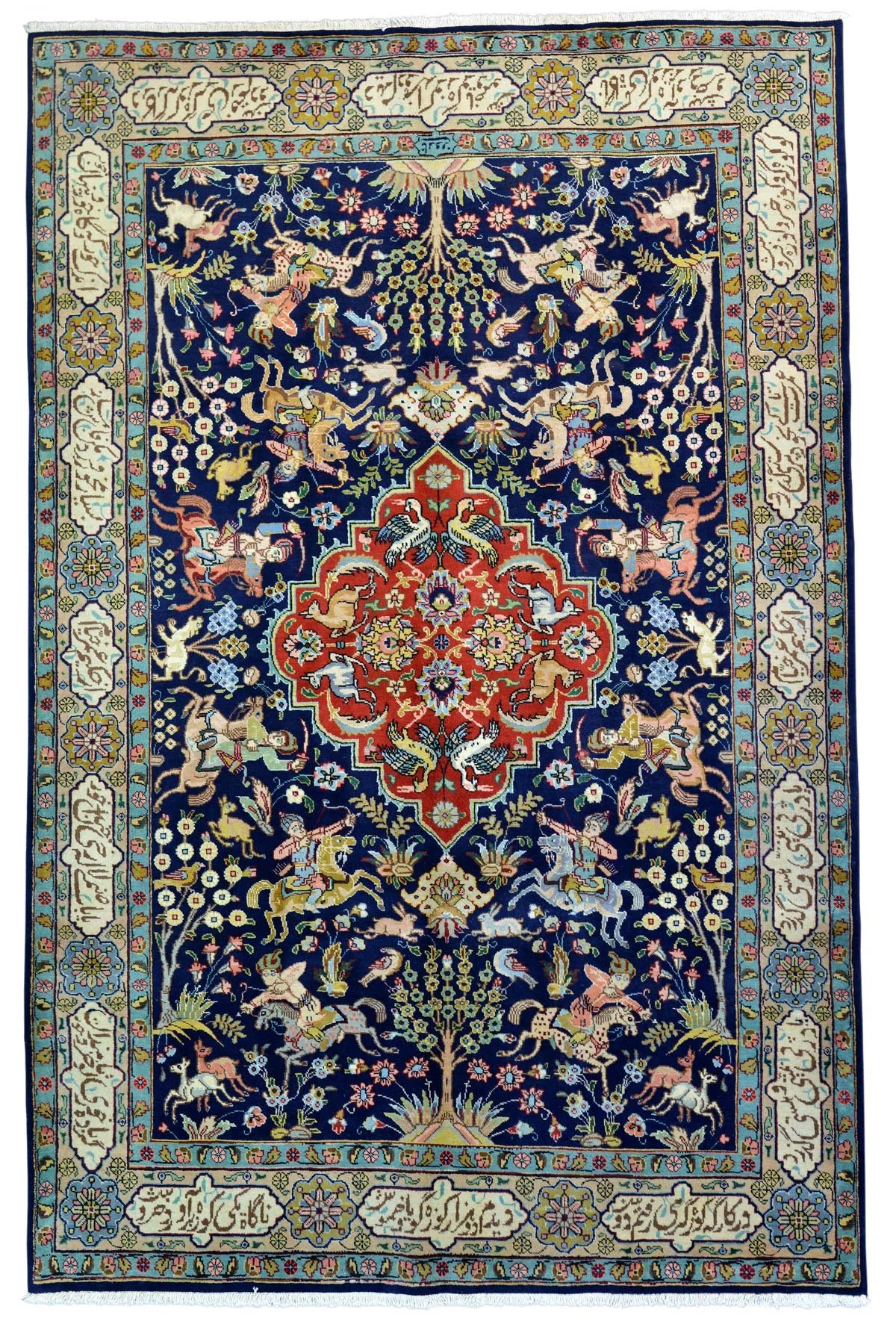
Poetry and weaving come together beautifully in this magnificent Tabriz carpet. Running gracefully along its border is the verse, “Drink not but with the wise,” a line attributed to Khayyam. Such inscriptions reflect a long Persian tradition in which poetry, music, and the visual arts existed in close dialogue, enriching one another across generations.
This carpet celebrates Khayyam not only through poetry but also through imagery. At its centre appears one of his favourite historical figures, Bahram the Hunter, the Sasanian king who ruled Persia from 420 to 438 AD. Bahram was renowned for his skill in hunting and was admired by Khayyam and other poets for bringing prosperity and justice to his realm. His legendary character made him a recurring figure in Persian literature and artistic expression.
Also woven into the carpet is one of Khayyam's most famous reflections on the passage of time:
"I went to the potter's shop yesterday,
I saw a thousand pots, mute and shouting, on display.
Suddenly, one roared as if to say,
Gone in clay are the potters, buyers, and sellers today."
The carpet itself was woven in Tabriz during the mid-20th century using fine hand-spun wool, natural dyes, and a cotton foundation. The clarity of the drawing, the balance of colours, and the calm rhythm of the composition reveal the hand of an accomplished master. Decades of careful use have allowed the colours to settle beautifully, while the wool has developed a soft and pleasing texture that only time can create.
The piece bears the signature of Master Narvani, a respected weaver known not only for his refined taste in carpet making but also for his mastery of music. His sensitivity to rhythm, harmony, and balance is evident throughout the composition. The same artistic spirit that guides a musician seems to flow through the design, lending the carpet a composed and contemplative presence.
This distinguished Tabriz carpet is far more than a decorative object. It is a meeting point of poetry, history, music, and craftsmanship, a work that continues to tell its story while bringing elegance, cultural depth, and quiet charm to an interior.
Material: Hand-spun wool pile, natural dyes, cotton foundation
Origin: Tabriz, Iran
Period: Mid 20th century
Signature: Narvani
Without a doubt, Omar Khayyam is one of the most celebrated Persian poets in the world. His verses achieved global fame through the 1859 translation of Edward FitzGerald:
"A Book of Verses underneath the Bough,
A Jug of Wine, a Loaf of Bread—and Thou
Beside me singing in the Wilderness—
Oh, Wilderness were Paradise enow!"
Poetry and weaving come together beautifully in this magnificent Tabriz carpet. Running gracefully along its border is the verse, “Drink not but with the wise,” a line attributed to Khayyam. Such inscriptions reflect a long Persian tradition in which poetry, music, and the visual arts existed in close dialogue, enriching one another across generations.
This carpet celebrates Khayyam not only through poetry but also through imagery. At its centre appears one of his favourite historical figures, Bahram the Hunter, the Sasanian king who ruled Persia from 420 to 438 AD. Bahram was renowned for his skill in hunting and was admired by Khayyam and other poets for bringing prosperity and justice to his realm. His legendary character made him a recurring figure in Persian literature and artistic expression.
Also woven into the carpet is one of Khayyam's most famous reflections on the passage of time:
"I went to the potter's shop yesterday,
I saw a thousand pots, mute and shouting, on display.
Suddenly, one roared as if to say,
Gone in clay are the potters, buyers, and sellers today."
The carpet itself was woven in Tabriz during the mid-20th century using fine hand-spun wool, natural dyes, and a cotton foundation. The clarity of the drawing, the balance of colours, and the calm rhythm of the composition reveal the hand of an accomplished master. Decades of careful use have allowed the colours to settle beautifully, while the wool has developed a soft and pleasing texture that only time can create.
The piece bears the signature of Master Narvani, a respected weaver known not only for his refined taste in carpet making but also for his mastery of music. His sensitivity to rhythm, harmony, and balance is evident throughout the composition. The same artistic spirit that guides a musician seems to flow through the design, lending the carpet a composed and contemplative presence.
This distinguished Tabriz carpet is far more than a decorative object. It is a meeting point of poetry, history, music, and craftsmanship, a work that continues to tell its story while bringing elegance, cultural depth, and quiet charm to an interior.
Material: Hand-spun wool pile, natural dyes, cotton foundation
Origin: Tabriz, Iran
Period: Mid 20th century
Signature: Narvani
