
 Image 1 of 1
Sultanabad, known today as Arak, became one of the important carpet-weaving centres of central Iran during the nineteenth century. The town and the surrounding villages already possessed a rich weaving tradition, but increasing demand for Persian carpets in Europe and America brought a new chapter to the region. Foreign companies, most famously Ziegler & Co., began working with local designers and weavers, adapting traditional Persian patterns to suit the emerging Western market.
The result was a distinctive group of carpets with larger, more open patterns, generous floral forms and particularly harmonious colours. Interestingly, the very qualities that made Sultanabad carpets so desirable in Western interiors more than a century ago are precisely what make them so appealing in contemporary spaces today.
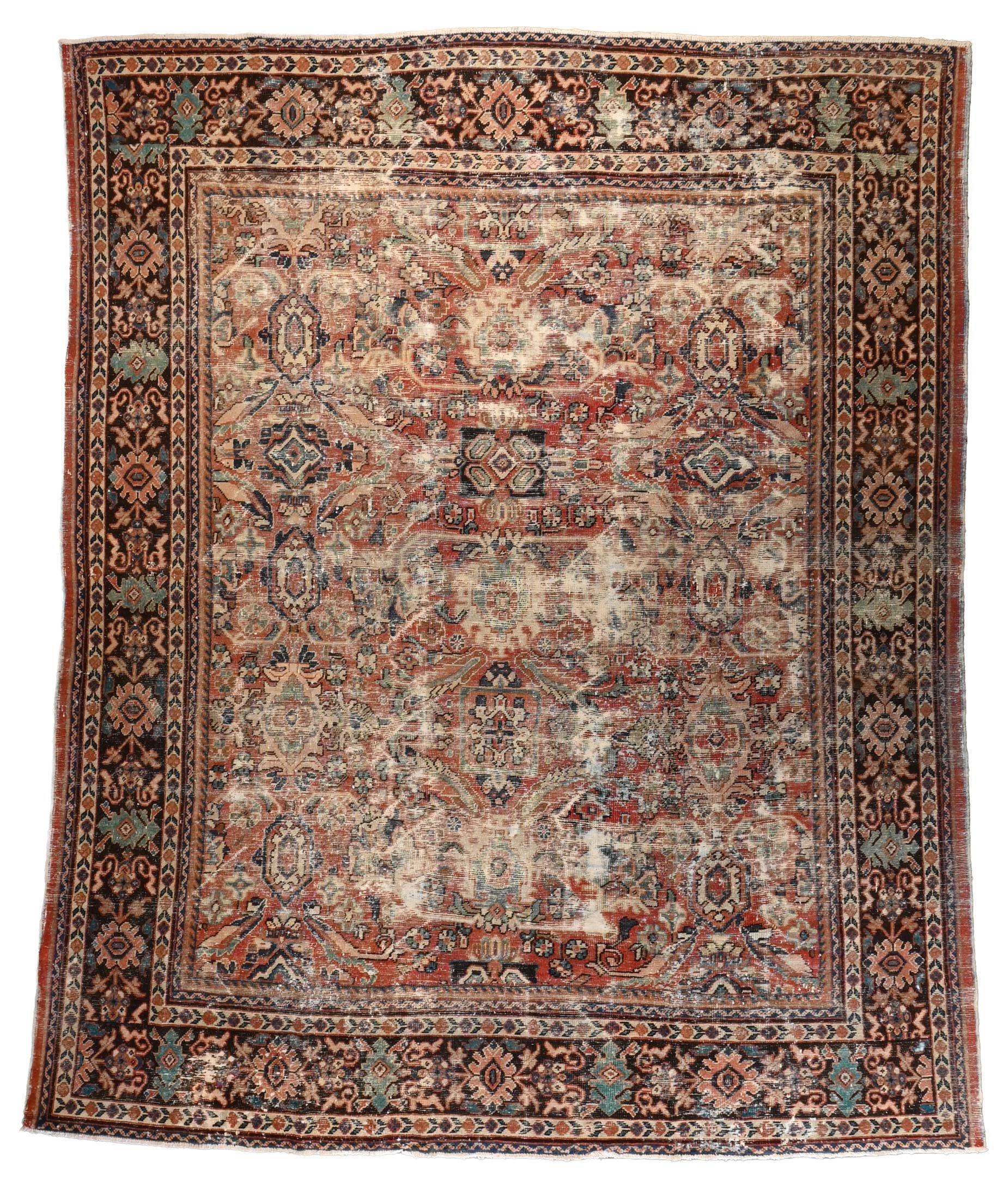
This beautiful antique Sultanabad is a wonderful example. Large stylised flowers, palmettes and branching vines spread freely across the field rather than being confined within a rigid central composition. The design has a natural rhythm, while the strong dark border frames the softer field beautifully and gives structure to the whole carpet.
What makes this particular piece especially attractive today is what time has done to it. More than a century of use has softened what was once a bold design into an almost painterly surface. The reds have mellowed into beautiful terracotta and rust tones, while soft greens, blues, ivory and earthy shades appear and disappear through the aged pile. The darker border remains stronger, creating a wonderful contrast with the faded field.
The quality of the old wool is equally important. Hand-spun wool and natural dyes have aged together, producing variations in colour, texture and lustre that cannot be artificially reproduced. The wear is now part of the character of the carpet, recording its long life while giving it the relaxed elegance for which antique Sultanabads are so admired.
These carpets were created at a fascinating moment when traditional Persian craftsmanship encountered a growing international market. Yet the best examples never lost their Persian identity. Local weavers continued to work with the materials, colours and visual language inherited from generations before them, while designers opened the compositions and enlarged the motifs to create something new.
Today, antique Sultanabad carpets of this character are particularly sought after because they bridge traditional and contemporary interiors so effortlessly. This is a carpet that has already lived for generations, and its beauty today lies as much in its magnificent age and patina as in the original design.
Time has softened the pattern, settled the colours and transformed the surface into something that no new carpet could reproduce.
Material: Hand-spun wool, naturally dyed, hand-knotted.
Sultanabad, known today as Arak, became one of the important carpet-weaving centres of central Iran during the nineteenth century. The town and the surrounding villages already possessed a rich weaving tradition, but increasing demand for Persian carpets in Europe and America brought a new chapter to the region. Foreign companies, most famously Ziegler & Co., began working with local designers and weavers, adapting traditional Persian patterns to suit the emerging Western market.
The result was a distinctive group of carpets with larger, more open patterns, generous floral forms and particularly harmonious colours. Interestingly, the very qualities that made Sultanabad carpets so desirable in Western interiors more than a century ago are precisely what make them so appealing in contemporary spaces today.
This beautiful antique Sultanabad is a wonderful example. Large stylised flowers, palmettes and branching vines spread freely across the field rather than being confined within a rigid central composition. The design has a natural rhythm, while the strong dark border frames the softer field beautifully and gives structure to the whole carpet.
What makes this particular piece especially attractive today is what time has done to it. More than a century of use has softened what was once a bold design into an almost painterly surface. The reds have mellowed into beautiful terracotta and rust tones, while soft greens, blues, ivory and earthy shades appear and disappear through the aged pile. The darker border remains stronger, creating a wonderful contrast with the faded field.
The quality of the old wool is equally important. Hand-spun wool and natural dyes have aged together, producing variations in colour, texture and lustre that cannot be artificially reproduced. The wear is now part of the character of the carpet, recording its long life while giving it the relaxed elegance for which antique Sultanabads are so admired.
These carpets were created at a fascinating moment when traditional Persian craftsmanship encountered a growing international market. Yet the best examples never lost their Persian identity. Local weavers continued to work with the materials, colours and visual language inherited from generations before them, while designers opened the compositions and enlarged the motifs to create something new.
Today, antique Sultanabad carpets of this character are particularly sought after because they bridge traditional and contemporary interiors so effortlessly. This is a carpet that has already lived for generations, and its beauty today lies as much in its magnificent age and patina as in the original design.
Time has softened the pattern, settled the colours and transformed the surface into something that no new carpet could reproduce.
Material: Hand-spun wool, naturally dyed, hand-knotted.
