
 Image 1 of 1
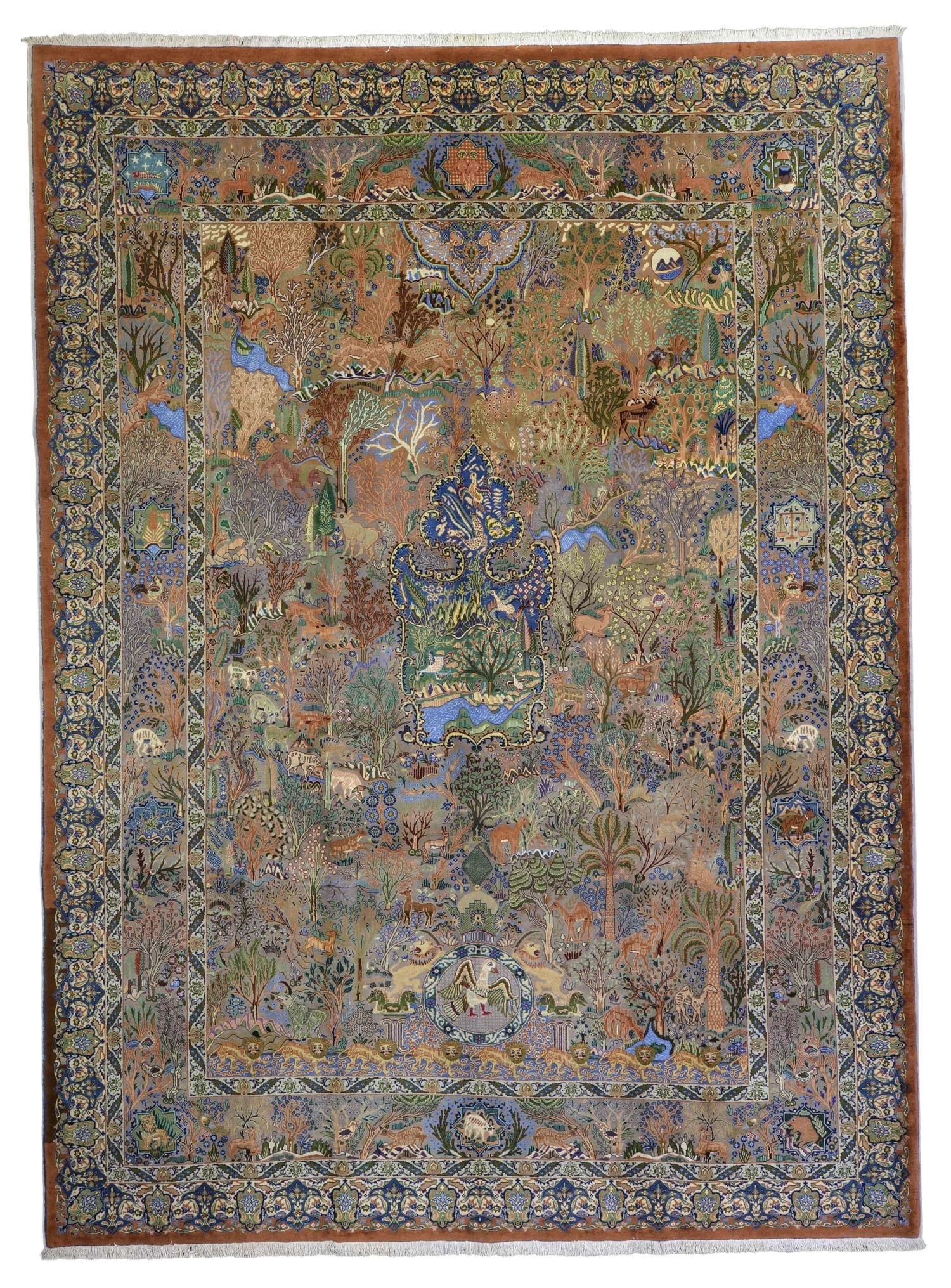
71275-385 x 294 cm | Kashmar pictorial carpet, Circa 1940s
The historic city of Kashmar, in northeastern Iran, has occupied a special place in the cultural memory of the Iranian world for more than two thousand years. Ancient Persian tradition associates the city with Zarathustra, who, according to the Shahnameh and earlier Zoroastrian sources, planted there the legendary Sarv-e Kashmar, the sacred cypress brought from heaven. For centuries, the tree became one of the greatest symbols of Iran, admired as an emblem of eternal life, steadfastness, and spiritual elevation until its famous destruction during the Abbasid period. Whether regarded as history or legend, the story reflects the profound spiritual significance that Kashmar has held throughout Persian civilisation.
This extraordinary carpet, woven in Kashmar during the 1940s from hand-spun wool and coloured entirely with natural dyes, reflects that same world of myth, symbolism, and imagination. Unlike conventional Persian carpets, it refuses to present a single narrative. Instead, it offers an intricate universe populated with animals, birds, trees, rivers, flowers, and celestial symbols that invite contemplation rather than immediate understanding.
One of the most intriguing features of the carpet is its apparent depiction of only eleven zodiac signs. Whether one sign was intentionally omitted or simply replaced can never be known with certainty. Yet the omission itself provokes thought. One is tempted to relate it to the ancient mystical symbolism of duality, of the visible and the invisible, of presence and absence, suggesting that what is left unseen may sometimes be as meaningful as what is shown.
Another mysterious feature is a small landscape enclosed within a circular frame. Rather than resembling a city, it appears almost like a solitary island surrounded by an endless sea. A philosopher friend suggested that this scene may be understood through the visionary philosophy of the great Persian sage Shahab al-Din Suhrawardi. In his writings, Suhrawardi describes symbolic lands such as Nā-Kojā-Ābād, the Land of No-Where, and the imaginal realm that exists between the material and the spiritual worlds. These are not geographical places but landscapes of illumination and inner perception. Whether the designer consciously intended such a reference can never be established. Yet the image of an isolated land surrounded by an infinite sea naturally invites such contemplation.
Perhaps this is the true mission of great art. Masterpieces do not merely answer questions; they create them. They invite us to return, to look again, and to discover new meanings with every encounter. Their mystery is not a weakness but their greatest strength.
Nearly a century has mellowed the colours into remarkable harmony and given the wool a lustre and texture that only time can create. The hand-spun wool has retained its natural character, while the vegetable dyes have softened into a rich and luminous palette impossible to imitate with modern materials.
This is far more than a decorative carpet. It is a museum-quality work of imagination, craftsmanship, and symbolism. Whether one approaches it through Persian mythology, Jungian archetypes, Suhrawardi's philosophy of illumination, or simply through the eyes of a lover of beauty, it remains a carpet that continues to ask questions long after it has ceased to answer them.
Material: Hand-spun wool on a cotton foundation, coloured entirely with natural vegetable dyes.
The historic city of Kashmar, in northeastern Iran, has occupied a special place in the cultural memory of the Iranian world for more than two thousand years. Ancient Persian tradition associates the city with Zarathustra, who, according to the Shahnameh and earlier Zoroastrian sources, planted there the legendary Sarv-e Kashmar, the sacred cypress brought from heaven. For centuries, the tree became one of the greatest symbols of Iran, admired as an emblem of eternal life, steadfastness, and spiritual elevation until its famous destruction during the Abbasid period. Whether regarded as history or legend, the story reflects the profound spiritual significance that Kashmar has held throughout Persian civilisation.
This extraordinary carpet, woven in Kashmar during the 1940s from hand-spun wool and coloured entirely with natural dyes, reflects that same world of myth, symbolism, and imagination. Unlike conventional Persian carpets, it refuses to present a single narrative. Instead, it offers an intricate universe populated with animals, birds, trees, rivers, flowers, and celestial symbols that invite contemplation rather than immediate understanding.
One of the most intriguing features of the carpet is its apparent depiction of only eleven zodiac signs. Whether one sign was intentionally omitted or simply replaced can never be known with certainty. Yet the omission itself provokes thought. One is tempted to relate it to the ancient mystical symbolism of duality, of the visible and the invisible, of presence and absence, suggesting that what is left unseen may sometimes be as meaningful as what is shown.
Another mysterious feature is a small landscape enclosed within a circular frame. Rather than resembling a city, it appears almost like a solitary island surrounded by an endless sea. A philosopher friend suggested that this scene may be understood through the visionary philosophy of the great Persian sage Shahab al-Din Suhrawardi. In his writings, Suhrawardi describes symbolic lands such as Nā-Kojā-Ābād, the Land of No-Where, and the imaginal realm that exists between the material and the spiritual worlds. These are not geographical places but landscapes of illumination and inner perception. Whether the designer consciously intended such a reference can never be established. Yet the image of an isolated land surrounded by an infinite sea naturally invites such contemplation.
Perhaps this is the true mission of great art. Masterpieces do not merely answer questions; they create them. They invite us to return, to look again, and to discover new meanings with every encounter. Their mystery is not a weakness but their greatest strength.
Nearly a century has mellowed the colours into remarkable harmony and given the wool a lustre and texture that only time can create. The hand-spun wool has retained its natural character, while the vegetable dyes have softened into a rich and luminous palette impossible to imitate with modern materials.
This is far more than a decorative carpet. It is a museum-quality work of imagination, craftsmanship, and symbolism. Whether one approaches it through Persian mythology, Jungian archetypes, Suhrawardi's philosophy of illumination, or simply through the eyes of a lover of beauty, it remains a carpet that continues to ask questions long after it has ceased to answer them.
Material: Hand-spun wool on a cotton foundation, coloured entirely with natural vegetable dyes.
