
 Image 1 of 1
Tabriz is one of the great historic cities of Iran. Situated in the northwest, between the Iranian plateau, Anatolia and the Caucasus, it has for centuries been a crossroads of cultures, trade and ideas. At different periods, it served as a capital of Iran, attracting poets, painters, calligraphers, merchants and craftsmen. This extraordinary cultural environment helped create one of the richest and most diverse traditions of Persian carpet weaving.
Unlike some of the other great weaving centres of Iran, where designers often concentrated on intricacy and perfect symmetry, Tabriz designers have always been remarkable storytellers. They borrowed freely from nature, architecture, literature and the decorative arts, constantly interpreting old patterns in new ways. This design freedom and variety of weaving techniques are why antique Tabriz carpets can differ so much from one another while remaining unmistakably Tabriz.
This beautiful old carpet is a wonderful example of another quality that makes Persian rugs so fascinating: their ability to become more beautiful with age.
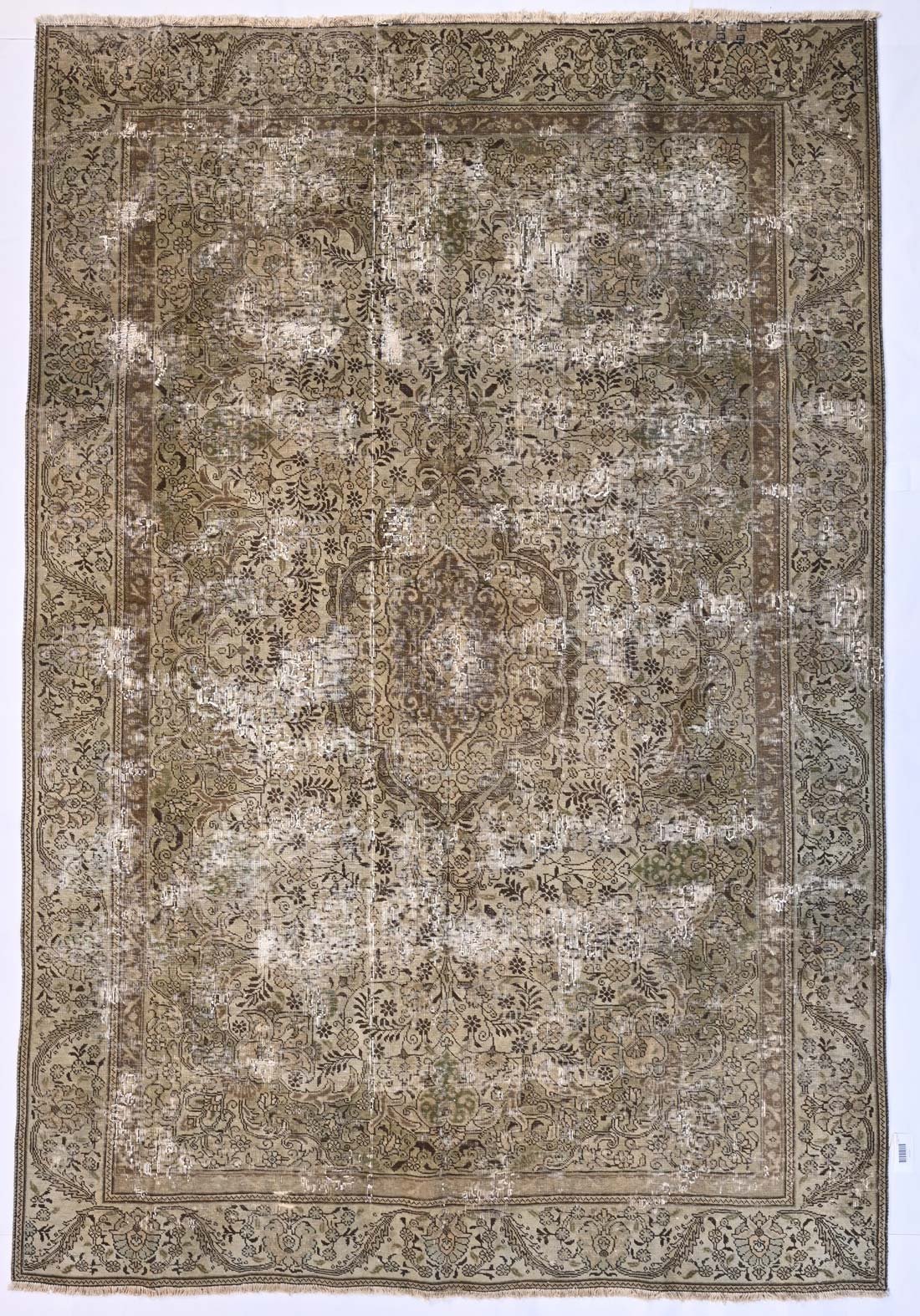
Decades of use have gradually worn down the original pile, softened the colours and blurred the precision of the design. Yet rather than diminishing the carpet, time has transformed it. What was once a strong and elaborate floral composition has become subtle and almost painterly. The reds have settled into soft terracotta and rust, while traces of blue, green, ivory and brown emerge through the aged surface.
The original design is still there, but it no longer demands attention. Flowers, palmettes, vines and geometric forms seem to appear and disappear through the patina, almost like memories emerging from the past. The darker border has retained more of its original strength and beautifully frames the softer, more weathered field.
There is something amazing about a carpet in this state. Most objects exposed to decades of heavy use lose their appeal and eventually their usefulness. A good Persian carpet can do precisely the opposite. The colours settle, the wool softens and the marks of use become part of its character. Like an old, wise friend, its beauty becomes quieter but somehow deeper.
The wear here should therefore not be seen simply as deterioration. It is part of the history of the piece. Every faded area and variation in texture records something of the life the carpet has already lived.
Today, this old Tabriz has a character that could never be recreated deliberately in a new rug. Its subdued colours and beautifully distressed surface make it particularly suitable for contemporary interiors, where it can bring history and sophistication without dominating the space.
Material: Wool pile on a cotton foundation, hand-knotted.
Tabriz is one of the great historic cities of Iran. Situated in the northwest, between the Iranian plateau, Anatolia and the Caucasus, it has for centuries been a crossroads of cultures, trade and ideas. At different periods, it served as a capital of Iran, attracting poets, painters, calligraphers, merchants and craftsmen. This extraordinary cultural environment helped create one of the richest and most diverse traditions of Persian carpet weaving.
Unlike some of the other great weaving centres of Iran, where designers often concentrated on intricacy and perfect symmetry, Tabriz designers have always been remarkable storytellers. They borrowed freely from nature, architecture, literature and the decorative arts, constantly interpreting old patterns in new ways. This design freedom and variety of weaving techniques are why antique Tabriz carpets can differ so much from one another while remaining unmistakably Tabriz.
This beautiful old carpet is a wonderful example of another quality that makes Persian rugs so fascinating: their ability to become more beautiful with age.
Decades of use have gradually worn down the original pile, softened the colours and blurred the precision of the design. Yet rather than diminishing the carpet, time has transformed it. What was once a strong and elaborate floral composition has become subtle and almost painterly. The reds have settled into soft terracotta and rust, while traces of blue, green, ivory and brown emerge through the aged surface.
The original design is still there, but it no longer demands attention. Flowers, palmettes, vines and geometric forms seem to appear and disappear through the patina, almost like memories emerging from the past. The darker border has retained more of its original strength and beautifully frames the softer, more weathered field.
There is something amazing about a carpet in this state. Most objects exposed to decades of heavy use lose their appeal and eventually their usefulness. A good Persian carpet can do precisely the opposite. The colours settle, the wool softens and the marks of use become part of its character. Like an old, wise friend, its beauty becomes quieter but somehow deeper.
The wear here should therefore not be seen simply as deterioration. It is part of the history of the piece. Every faded area and variation in texture records something of the life the carpet has already lived.
Today, this old Tabriz has a character that could never be recreated deliberately in a new rug. Its subdued colours and beautifully distressed surface make it particularly suitable for contemporary interiors, where it can bring history and sophistication without dominating the space.
Material: Wool pile on a cotton foundation, hand-knotted.
