
 Image 1 of 1
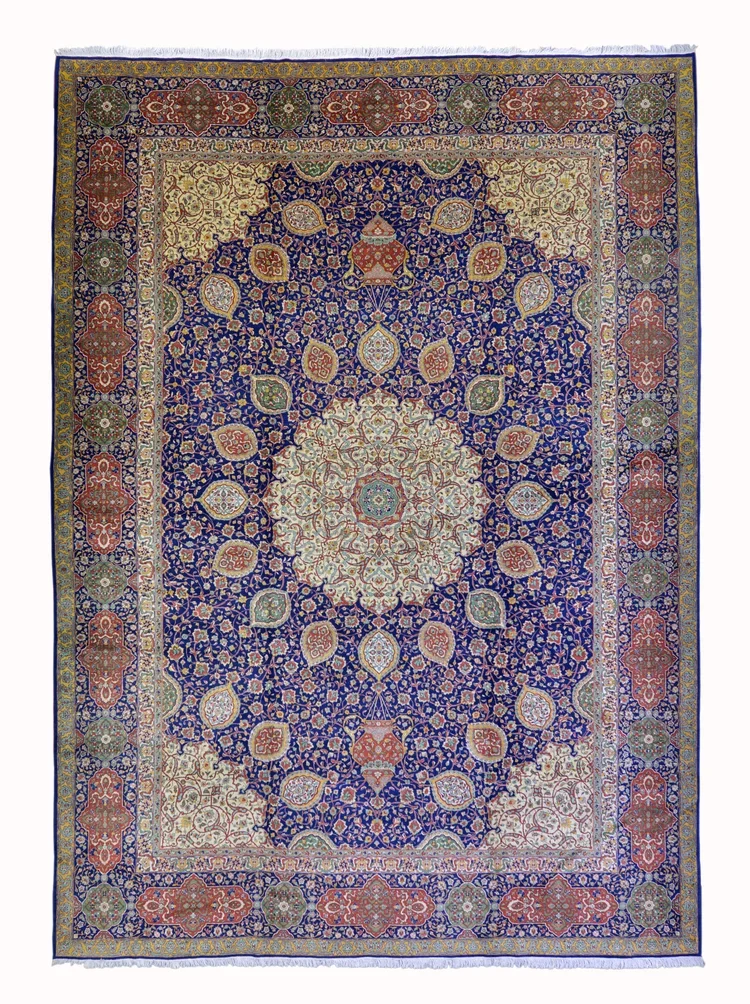
58679-415 x 304 cm | Tabriz, Ardabil design, Circa 1940s
Among the greatest achievements of Persian carpet weaving stands the legendary Ardabil Carpet, woven during the Safavid period for the shrine of Shah Safi in Ardabil. Today, one of the pair is preserved in the Victoria and Albert Museum in London and is universally regarded as one of the masterpieces of world art. Its extraordinary harmony of proportion, colour, and design has inspired generations of Persian designers, yet very few reproductions have approached the elegance of the original.
The carpet presented here is one of the finest interpretations of that celebrated design. Woven in Tabriz around the 1940s, it demonstrates the remarkable skill for which the city's master weavers are renowned. Every element—from the grand central medallion to the delicate arabesques and floral scrolls—has been executed with astonishing precision.
The quality of this piece is immediately evident in its density. With approximately 81 knots per square centimetre, this carpet contains nearly 9.7 million individual knots.
Pause for a moment and imagine what that number truly means.
A highly skilled weaver can tie around 6,000 knots a day on a carpet of this complexity. Even if three master weavers worked side by side from beginning to end, they would require approximately 540 working days, or about one and a half years, simply to complete the knotting.
Yet weaving is only the final stage.
Before a single knot could be tied, several months of preparation were required. The wool first had to be carefully selected and hand-spun into yarn. The yarn then had to be dyed using natural materials such as indigo, madder root, walnut husks, and other vegetable dyes. Most importantly, the entire design had to be drafted in meticulous detail and converted into a full weaving cartoon—a complex graph that the weavers could follow knot by knot. Together, these preparations easily required another three months or more.
In total, the creation of a masterpiece like this demanded close to two years of continuous work.
What is perhaps even more astonishing is not merely the number of knots, but their consistency. Every one of the nearly ten million knots had to be tied with almost identical size, tension, and placement. A slight inconsistency repeated thousands of times would distort the entire composition. The mathematical harmony that you see before you is therefore the result of extraordinary discipline, patience, and craftsmanship.
Such carpets remind us that Persian weaving is not simply the art of knotting wool. It is equally the art of spinning fine yarn by hand, mastering natural dyes, designing harmonious compositions, and translating an intricate drawing into millions of perfectly placed knots. It is the culmination of centuries of accumulated knowledge.
Today this magnificent carpet remains in exceptional, almost mint condition. Its hand-spun wool has retained its natural lustre, while the vegetable dyes have mellowed gracefully with age into a rich and harmonious palette that modern synthetic colours can rarely achieve.
This is far more than a decorative object. It is a museum-quality masterpiece, representing one of the highest achievements of Persian carpet weaving. A carpet of this calibre does not merely decorate a room; it transforms it, carrying with it centuries of artistic tradition, extraordinary human skill, and an elegance that few works of art can rival.
Material: Hand-spun wool on a cotton foundation, coloured entirely with natural vegetable dyes.
Among the greatest achievements of Persian carpet weaving stands the legendary Ardabil Carpet, woven during the Safavid period for the shrine of Shah Safi in Ardabil. Today, one of the pair is preserved in the Victoria and Albert Museum in London and is universally regarded as one of the masterpieces of world art. Its extraordinary harmony of proportion, colour, and design has inspired generations of Persian designers, yet very few reproductions have approached the elegance of the original.
The carpet presented here is one of the finest interpretations of that celebrated design. Woven in Tabriz around the 1940s, it demonstrates the remarkable skill for which the city's master weavers are renowned. Every element—from the grand central medallion to the delicate arabesques and floral scrolls—has been executed with astonishing precision.
The quality of this piece is immediately evident in its density. With approximately 81 knots per square centimetre, this carpet contains nearly 9.7 million individual knots.
Pause for a moment and imagine what that number truly means.
A highly skilled weaver can tie around 6,000 knots a day on a carpet of this complexity. Even if three master weavers worked side by side from beginning to end, they would require approximately 540 working days, or about one and a half years, simply to complete the knotting.
Yet weaving is only the final stage.
Before a single knot could be tied, several months of preparation were required. The wool first had to be carefully selected and hand-spun into yarn. The yarn then had to be dyed using natural materials such as indigo, madder root, walnut husks, and other vegetable dyes. Most importantly, the entire design had to be drafted in meticulous detail and converted into a full weaving cartoon—a complex graph that the weavers could follow knot by knot. Together, these preparations easily required another three months or more.
In total, the creation of a masterpiece like this demanded close to two years of continuous work.
What is perhaps even more astonishing is not merely the number of knots, but their consistency. Every one of the nearly ten million knots had to be tied with almost identical size, tension, and placement. A slight inconsistency repeated thousands of times would distort the entire composition. The mathematical harmony that you see before you is therefore the result of extraordinary discipline, patience, and craftsmanship.
Such carpets remind us that Persian weaving is not simply the art of knotting wool. It is equally the art of spinning fine yarn by hand, mastering natural dyes, designing harmonious compositions, and translating an intricate drawing into millions of perfectly placed knots. It is the culmination of centuries of accumulated knowledge.
Today this magnificent carpet remains in exceptional, almost mint condition. Its hand-spun wool has retained its natural lustre, while the vegetable dyes have mellowed gracefully with age into a rich and harmonious palette that modern synthetic colours can rarely achieve.
This is far more than a decorative object. It is a museum-quality masterpiece, representing one of the highest achievements of Persian carpet weaving. A carpet of this calibre does not merely decorate a room; it transforms it, carrying with it centuries of artistic tradition, extraordinary human skill, and an elegance that few works of art can rival.
Material: Hand-spun wool on a cotton foundation, coloured entirely with natural vegetable dyes.
