
 Image 1 of 1
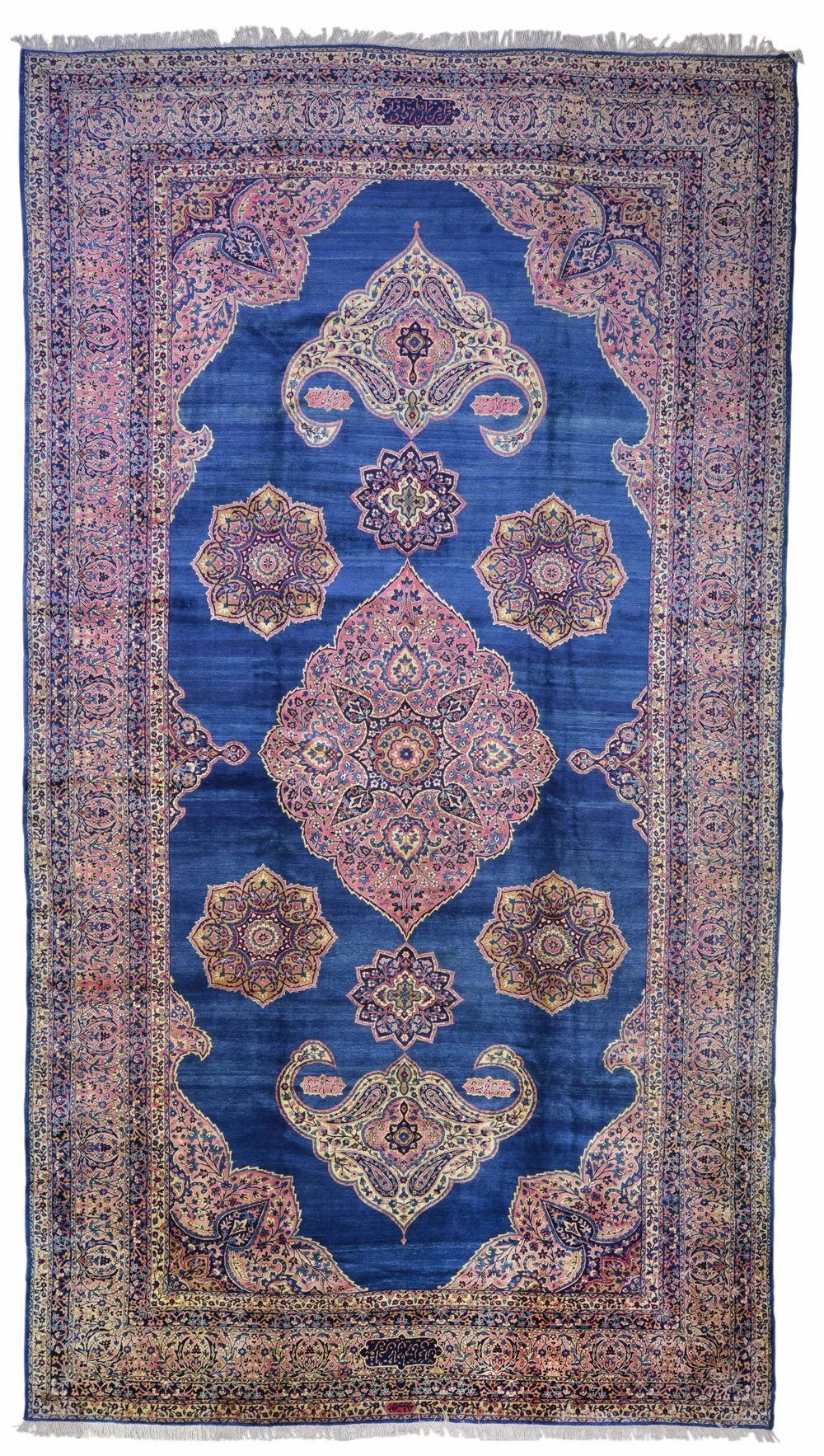
163555-555 x 305 cm | An antique OCM Mashad, Circa 1920
The first decades of the twentieth century marked a remarkable chapter in the history of Persian carpet weaving. As the demand for Persian carpets grew throughout Europe and North America, a number of international companies established workshops across Iran, working closely with local master weavers to produce carpets of exceptional quality while preserving traditional Persian craftsmanship. Among the most influential of these companies was the Overseas Carpet Manufacturers (OCM), founded in London in 1907.
One of the central figures behind OCM was Cecil A. Edwards, widely regarded as one of the foremost authorities on Persian carpets. His monumental work, The Persian Carpet, remains one of the most important references on the subject. Although parts of the book inevitably reflect the colonial attitudes of its time, it remains an invaluable historical record of Persian weaving during the early twentieth century. Edwards travelled extensively throughout Iran, documenting regional traditions while supervising the production of carpets that are today considered among the finest commercial weavings ever produced.
This magnificent carpet is signed OCM (اسیم) and is documented by Edwards himself as a Mashad carpet of the 1920s, inspired by an earlier nineteenth-century Farahan design. It therefore represents not merely an outstanding carpet, but a documented piece of Persian carpet history whose provenance is firmly established in one of the field's most respected publications.
The design reflects the remarkable ability of Persian designers to reinterpret classical compositions rather than simply reproduce them. The spacious cobalt-blue field provides a dramatic stage upon which the elegant medallion and pendants seem almost to float. Four beautifully balanced floral rosettes reinforce the composition without disturbing its extraordinary sense of harmony. The restrained use of space gives the carpet a quiet grandeur seldom encountered in later productions.
The colour combination is equally exceptional. Rich blues, soft ivory, delicate rose, and subtle reds are perfectly balanced, creating an atmosphere of refinement rather than extravagance. Every colour is derived from natural dyes, whose gentle ageing has produced a luminous patina that only time can bestow.
Equally remarkable is the quality of the materials. The carpet is woven from exceptionally fine wool on a strong cotton foundation. The wool possesses the softness, lustre, and resilience characteristic of the finest Persian fleeces, while the weaving itself demonstrates the extraordinary technical standards maintained by the OCM workshops under the supervision of experienced Persian master weavers.
Perhaps most astonishing is its state of preservation. Nearly a century after it was woven, the carpet remains in outstanding condition. Such examples are becoming increasingly difficult to find, particularly in this size and quality. It is a carpet that has preserved not only its structure but also its dignity, elegance, and artistic presence.
This is a piece that beautifully illustrates how commerce, when guided by genuine respect for tradition and uncompromising standards of craftsmanship, can produce works of lasting artistic value. It occupies a unique place in the history of Persian carpets, standing at the meeting point of traditional Iranian craftsmanship and one of the most thoroughly documented periods of twentieth-century carpet production.
Today it remains a magnificent collector's piece—equally at home in a private collection, an important interior, or a museum devoted to the history of Persian art.
Material: Fine wool on a cotton foundation, coloured entirely with natural vegetable dyes.
The first decades of the twentieth century marked a remarkable chapter in the history of Persian carpet weaving. As the demand for Persian carpets grew throughout Europe and North America, a number of international companies established workshops across Iran, working closely with local master weavers to produce carpets of exceptional quality while preserving traditional Persian craftsmanship. Among the most influential of these companies was the Overseas Carpet Manufacturers (OCM), founded in London in 1907.
One of the central figures behind OCM was Cecil A. Edwards, widely regarded as one of the foremost authorities on Persian carpets. His monumental work, The Persian Carpet, remains one of the most important references on the subject. Although parts of the book inevitably reflect the colonial attitudes of its time, it remains an invaluable historical record of Persian weaving during the early twentieth century. Edwards travelled extensively throughout Iran, documenting regional traditions while supervising the production of carpets that are today considered among the finest commercial weavings ever produced.
This magnificent carpet is signed OCM (اسیم) and is documented by Edwards himself as a Mashad carpet of the 1920s, inspired by an earlier nineteenth-century Farahan design. It therefore represents not merely an outstanding carpet, but a documented piece of Persian carpet history whose provenance is firmly established in one of the field's most respected publications.
The design reflects the remarkable ability of Persian designers to reinterpret classical compositions rather than simply reproduce them. The spacious cobalt-blue field provides a dramatic stage upon which the elegant medallion and pendants seem almost to float. Four beautifully balanced floral rosettes reinforce the composition without disturbing its extraordinary sense of harmony. The restrained use of space gives the carpet a quiet grandeur seldom encountered in later productions.
The colour combination is equally exceptional. Rich blues, soft ivory, delicate rose, and subtle reds are perfectly balanced, creating an atmosphere of refinement rather than extravagance. Every colour is derived from natural dyes, whose gentle ageing has produced a luminous patina that only time can bestow.
Equally remarkable is the quality of the materials. The carpet is woven from exceptionally fine wool on a strong cotton foundation. The wool possesses the softness, lustre, and resilience characteristic of the finest Persian fleeces, while the weaving itself demonstrates the extraordinary technical standards maintained by the OCM workshops under the supervision of experienced Persian master weavers.
Perhaps most astonishing is its state of preservation. Nearly a century after it was woven, the carpet remains in outstanding condition. Such examples are becoming increasingly difficult to find, particularly in this size and quality. It is a carpet that has preserved not only its structure but also its dignity, elegance, and artistic presence.
This is a piece that beautifully illustrates how commerce, when guided by genuine respect for tradition and uncompromising standards of craftsmanship, can produce works of lasting artistic value. It occupies a unique place in the history of Persian carpets, standing at the meeting point of traditional Iranian craftsmanship and one of the most thoroughly documented periods of twentieth-century carpet production.
Today it remains a magnificent collector's piece—equally at home in a private collection, an important interior, or a museum devoted to the history of Persian art.
Material: Fine wool on a cotton foundation, coloured entirely with natural vegetable dyes.
