
 Image 1 of 1
The town of Mud, also spelt Moud, in eastern Persia belongs, alongside Birjand and Dorokhsh, to the rich weaving tradition of southern Khorasan. The rugs from this area are woven in an amazing array of styles, among which the Herati pattern, represented in this rug, is one of the most celebrated.
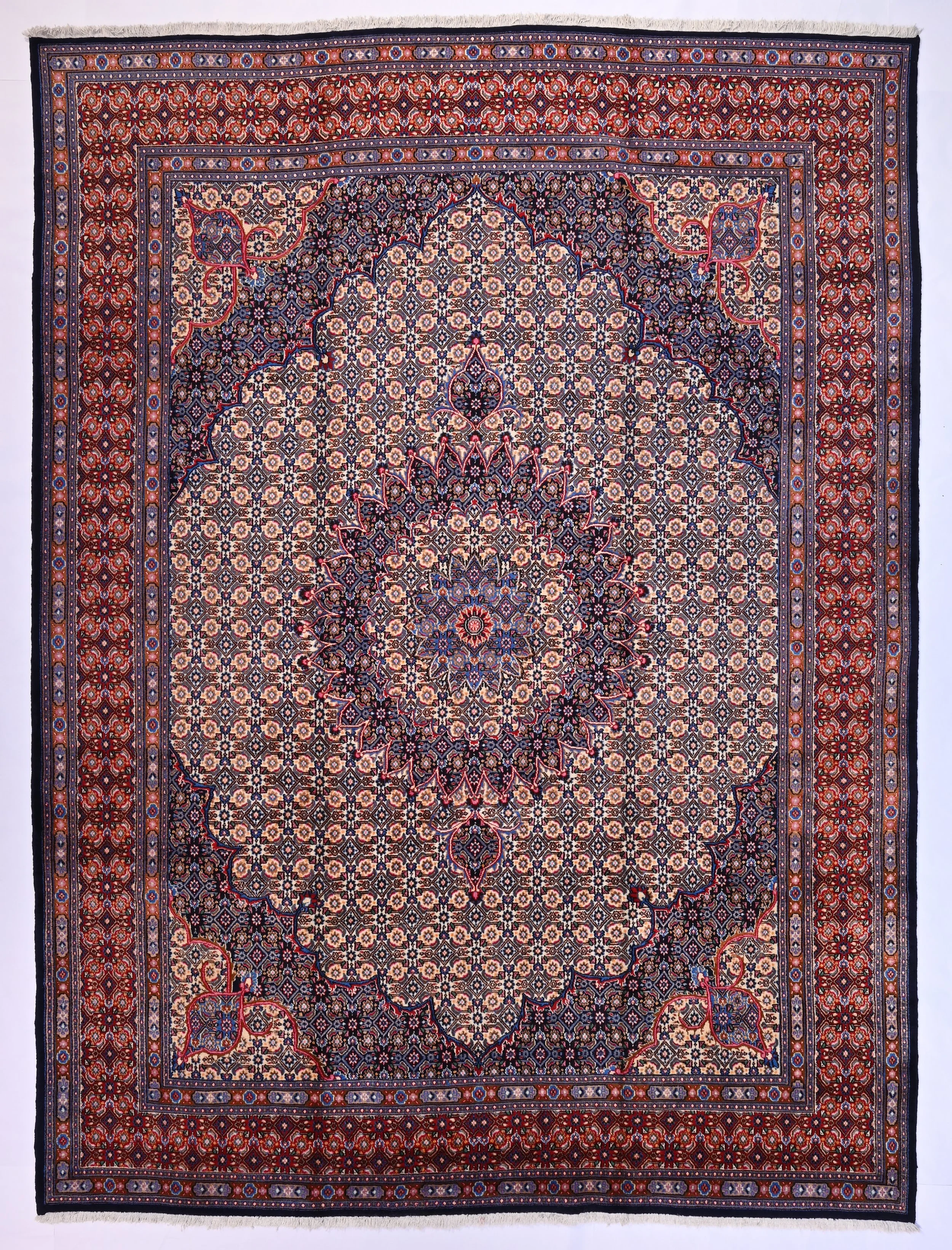
The pattern consists of a small floral rosette set within a diamond and surrounded by four curved leaves resembling fish. This resemblance gives the design its other Persian name, mahi, meaning fish. Repeated across the carpet, these little forms create a fascinating sense of movement, as though the fish were circling the flowers.
These forms invite a beautiful symbolic reading. Fish naturally suggest water, the essence of life, and have a protective role in ancient Iranian mythology. In the Bundahishn, the sacred haoma plant is guarded by fish, an evocative parallel to the idea of fish surrounding a flower. Reading the flower as a lotus also brings to mind purity, a meaning particularly prominent in Buddhist tradition, where the blossom rises above the water unstained. These associations offer a poetic way of looking at the pattern, although they do not establish its original meaning.
This carpet is woven using quality wool on a cotton foundation, with a splendid medallion design and beautiful colour combinations. Its ivory field contrasts with the deep navy medallion and corners, while a rich red border frames the intricate pattern. The repetition gives it rhythm, and the medallion gives it a centre, creating an elegant piece that can bring beauty and character to an interior.
Size: 375 × 282 cm
Origin: Mud, Persia
Material: Wool on a cotton foundation
Palette: P105
The town of Mud, also spelt Moud, in eastern Persia belongs, alongside Birjand and Dorokhsh, to the rich weaving tradition of southern Khorasan. The rugs from this area are woven in an amazing array of styles, among which the Herati pattern, represented in this rug, is one of the most celebrated.
The pattern consists of a small floral rosette set within a diamond and surrounded by four curved leaves resembling fish. This resemblance gives the design its other Persian name, mahi, meaning fish. Repeated across the carpet, these little forms create a fascinating sense of movement, as though the fish were circling the flowers.
These forms invite a beautiful symbolic reading. Fish naturally suggest water, the essence of life, and have a protective role in ancient Iranian mythology. In the Bundahishn, the sacred haoma plant is guarded by fish, an evocative parallel to the idea of fish surrounding a flower. Reading the flower as a lotus also brings to mind purity, a meaning particularly prominent in Buddhist tradition, where the blossom rises above the water unstained. These associations offer a poetic way of looking at the pattern, although they do not establish its original meaning.
This carpet is woven using quality wool on a cotton foundation, with a splendid medallion design and beautiful colour combinations. Its ivory field contrasts with the deep navy medallion and corners, while a rich red border frames the intricate pattern. The repetition gives it rhythm, and the medallion gives it a centre, creating an elegant piece that can bring beauty and character to an interior.
Size: 375 × 282 cm
Origin: Mud, Persia
Material: Wool on a cotton foundation
Palette: P105
