
 Image 1 of 1
Dowry pieces are among the most personal and fascinating of tribal weavings. They go beyond objects of everyday utility and often carry the sentiments of the young women who made them, woven with love, imagination and the skills inherited from their mothers and grandmothers.
This remarkable piece dates from the third quarter of the nineteenth century. It was intended as a decorative hanging within the weaver's black tent, but such pieces could also accompany the wedding procession, decorating the camel that carried the bride and her belongings to her new home.
Unlike commercially produced carpets, dowry weavings were made for the weaver herself and her future household. They therefore offered an opportunity to demonstrate her skill while expressing her own taste through the choice of patterns, colours and composition. In that sense, every such piece becomes something deeply personal, carrying a little of the character and aspirations of the young woman who created it.
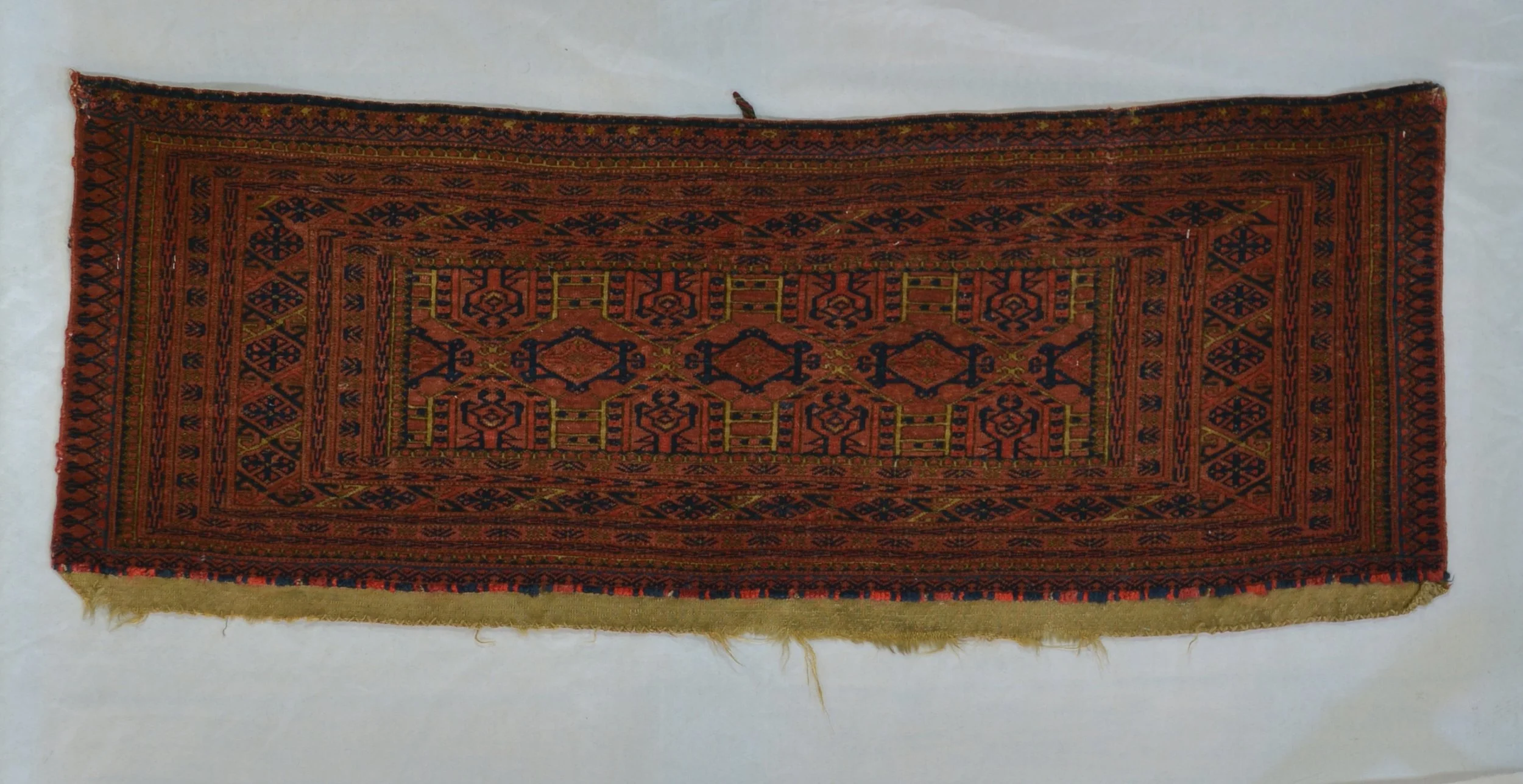
The design here is beautifully geometric, surrounded by numerous narrow borders and woven in a restrained palette of deep reds, indigo and earthy tones. The exceptional quality of the wool and natural dyes has allowed these colours to retain their remarkable depth after more than 150 years.
What survives today is therefore much more than an old tribal textile. It is a fragment of a young woman's life, created for one of the most important passages of her life and preserved for us more than a century and a half later.
Material: Wool, handwoven with natural dyes.
Dowry pieces are among the most personal and fascinating of tribal weavings. They go beyond objects of everyday utility and often carry the sentiments of the young women who made them, woven with love, imagination and the skills inherited from their mothers and grandmothers.
This remarkable piece dates from the third quarter of the nineteenth century. It was intended as a decorative hanging within the weaver's black tent, but such pieces could also accompany the wedding procession, decorating the camel that carried the bride and her belongings to her new home.
Unlike commercially produced carpets, dowry weavings were made for the weaver herself and her future household. They therefore offered an opportunity to demonstrate her skill while expressing her own taste through the choice of patterns, colours and composition. In that sense, every such piece becomes something deeply personal, carrying a little of the character and aspirations of the young woman who created it.
The design here is beautifully geometric, surrounded by numerous narrow borders and woven in a restrained palette of deep reds, indigo and earthy tones. The exceptional quality of the wool and natural dyes has allowed these colours to retain their remarkable depth after more than 150 years.
What survives today is therefore much more than an old tribal textile. It is a fragment of a young woman's life, created for one of the most important passages of her life and preserved for us more than a century and a half later.
Material: Wool, handwoven with natural dyes.
