
 Image 1 of 1
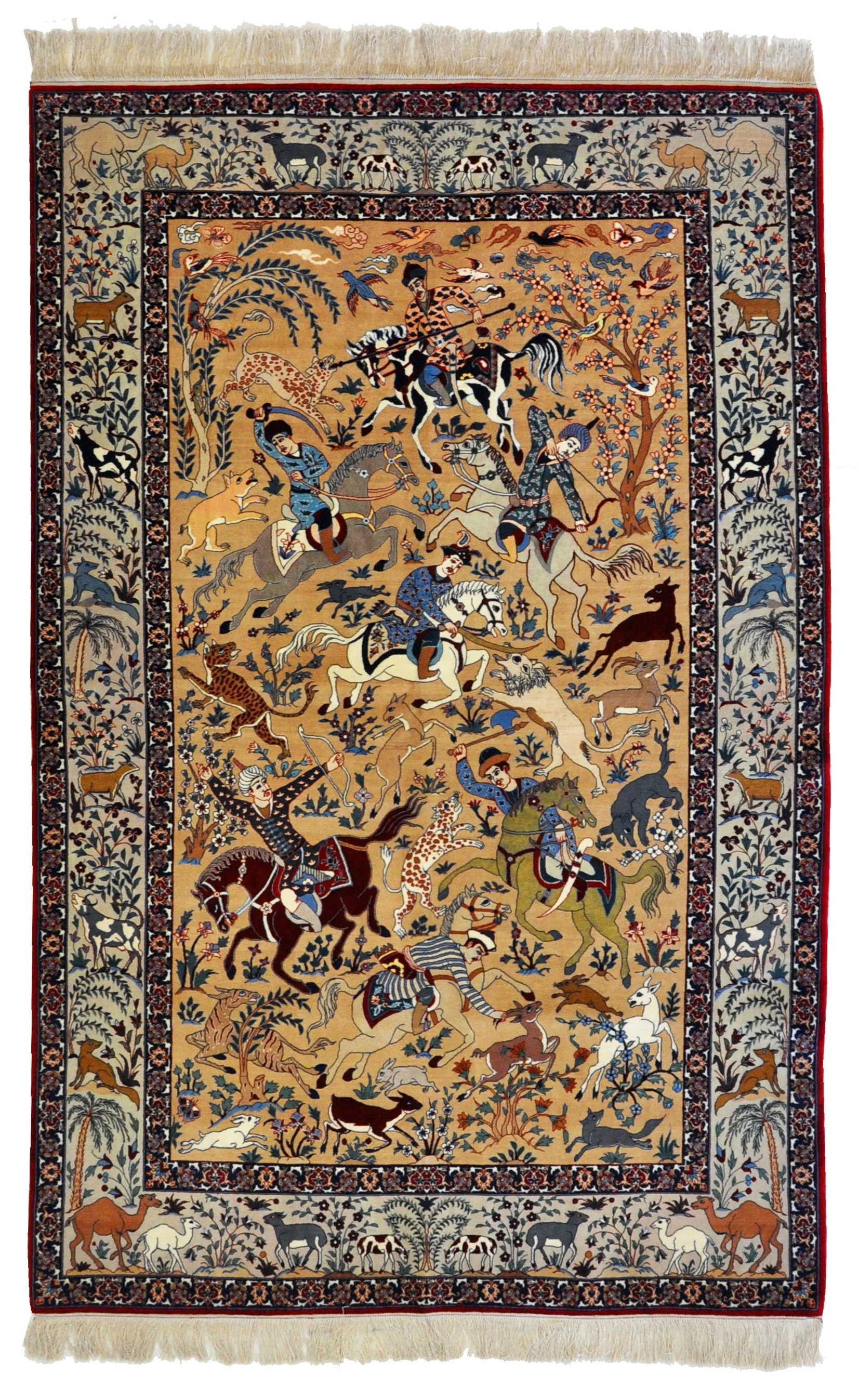
Isfahan Hunting Scene Rug, Circa 1950s
Possibly Attributed to the Seyrafian Workshop
Among the finest carpets ever woven in Iran, the rugs of the Seyrafian family occupy a special place in the history of Persian carpet weaving. Established in Isfahan during the early 1940s, the Seyrafian workshops became renowned for their exceptional craftsmanship, artistic innovation, and uncompromising standards. Their designs were often developed by the celebrated master designer Archang and produced under the close supervision of Master Mohammad Reza Seyrafian and his brother Sadeq Seyrafian.
Although this carpet does not bear a Seyrafian signature, its extraordinary workmanship, refined drawing, and overall character strongly suggest a connection to this celebrated family of master weavers. Every element reflects the precision and elegance for which Seyrafian carpets became famous.
One of the distinguishing features of Seyrafian rugs was the use of exceptionally fine wool imported from Manchester, England, combined with the finest silk foundations and carefully selected natural dyes. These superior materials contributed to the remarkable clarity, durability, and luminous quality of their carpets.
The design belongs to the celebrated hunting scene tradition, one of the most prestigious themes in Persian carpet art. Inspired by royal hunting expeditions of the ancient Persian kings, such compositions symbolise courage, skill, leadership, and the pursuit of excellence. Richly detailed landscapes are populated with animals, trees, and mounted hunters engaged in dramatic pursuits. In this example, the central hunter confronts a lion, while members of the royal entourage pursue other animals throughout the composition.
Containing more than four million knots and requiring over two years of meticulous work, this carpet represents the highest level of Persian craftsmanship. It is both a magnificent work of art and a testament to one of the greatest weaving traditions of Isfahan.
Material: Fine Manchester wool on a silk foundation.
Isfahan Hunting Scene Rug, Circa 1950s
Possibly Attributed to the Seyrafian Workshop
Among the finest carpets ever woven in Iran, the rugs of the Seyrafian family occupy a special place in the history of Persian carpet weaving. Established in Isfahan during the early 1940s, the Seyrafian workshops became renowned for their exceptional craftsmanship, artistic innovation, and uncompromising standards. Their designs were often developed by the celebrated master designer Archang and produced under the close supervision of Master Mohammad Reza Seyrafian and his brother Sadeq Seyrafian.
Although this carpet does not bear a Seyrafian signature, its extraordinary workmanship, refined drawing, and overall character strongly suggest a connection to this celebrated family of master weavers. Every element reflects the precision and elegance for which Seyrafian carpets became famous.
One of the distinguishing features of Seyrafian rugs was the use of exceptionally fine wool imported from Manchester, England, combined with the finest silk foundations and carefully selected natural dyes. These superior materials contributed to the remarkable clarity, durability, and luminous quality of their carpets.
The design belongs to the celebrated hunting scene tradition, one of the most prestigious themes in Persian carpet art. Inspired by royal hunting expeditions of the ancient Persian kings, such compositions symbolise courage, skill, leadership, and the pursuit of excellence. Richly detailed landscapes are populated with animals, trees, and mounted hunters engaged in dramatic pursuits. In this example, the central hunter confronts a lion, while members of the royal entourage pursue other animals throughout the composition.
Containing more than four million knots and requiring over two years of meticulous work, this carpet represents the highest level of Persian craftsmanship. It is both a magnificent work of art and a testament to one of the greatest weaving traditions of Isfahan.
Material: Fine Manchester wool on a silk foundation.
