
 Image 1 of 1
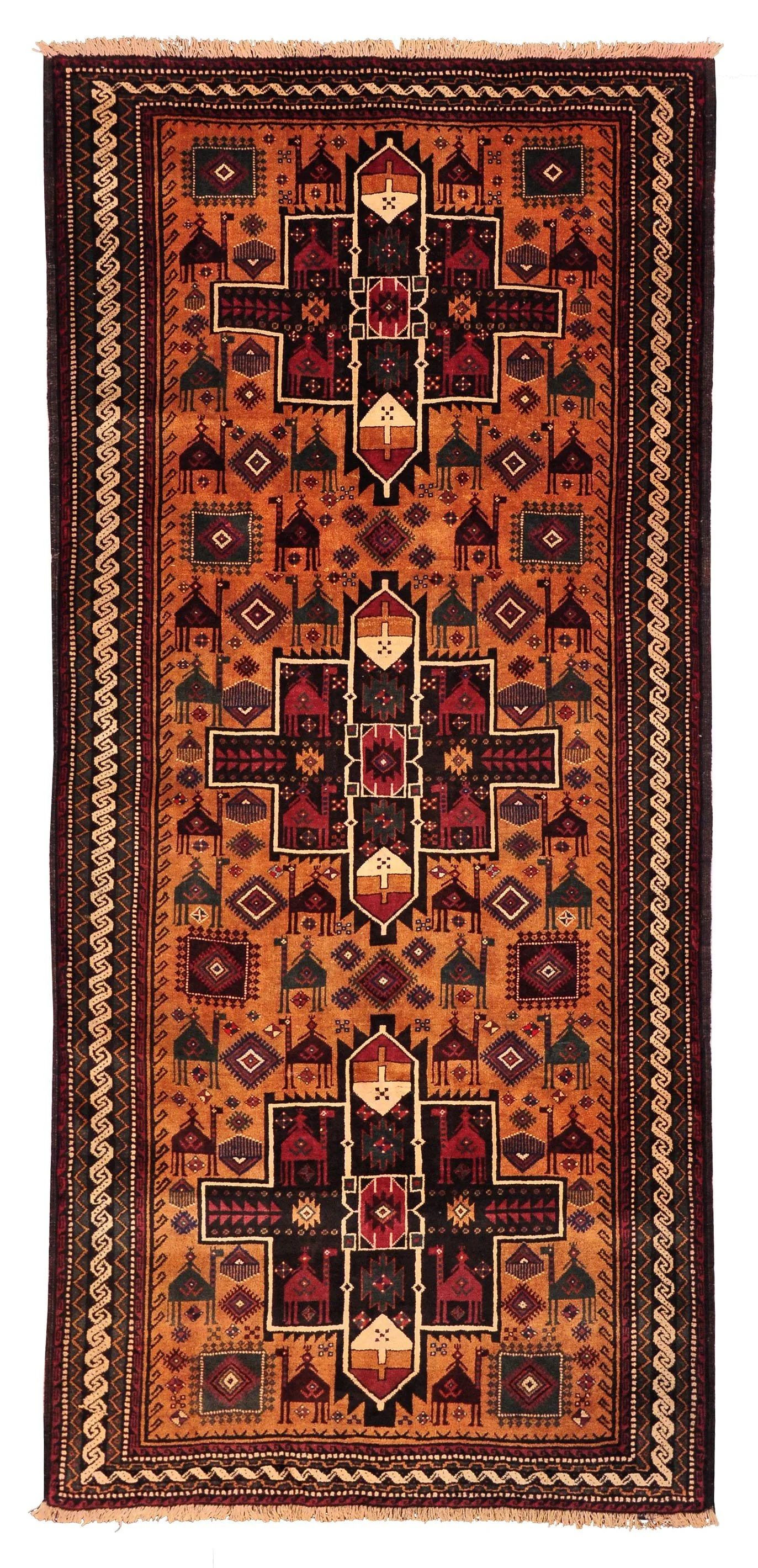
Some rugs are reservoirs of archetypal symbols, carrying forward stories, beliefs, and memories inherited over countless generations. This remarkable Baluch rug from the Zabol region of eastern Iran is one such piece. Woven entirely from memory, it reflects not only the skill of its maker but also a rich visual language shaped by centuries of nomadic life.
Among the most prominent motifs are stylised camels, animals that were inseparable from the nomadic world. Often associated with travel, longing, and reunion, they may express the thoughts of a weaver whose loved ones were away on distant journeys. Equally important are the stylised tents scattered throughout the field, symbols of home, family, and belonging in a constantly moving world.
The rug is filled with other traditional motifs, including combs associated with marriage and courtship, geometric emblems of protection, and forms whose meanings have gradually faded into the collective memory of the tribe. Together they create a composition that feels almost like a coded narrative, rich with emotion and symbolism.
Woven from hand-spun wool and natural dyes, this antique rug possesses both aesthetic beauty and cultural depth. More than a decorative object, it is a document of tribal life, a materialisation of memory, and a work that continues to reveal new details and meanings the longer one lives with it.
Like the finest tribal weavings, it is a rug that always seems to have another story to tell.
Some rugs are reservoirs of archetypal symbols, carrying forward stories, beliefs, and memories inherited over countless generations. This remarkable Baluch rug from the Zabol region of eastern Iran is one such piece. Woven entirely from memory, it reflects not only the skill of its maker but also a rich visual language shaped by centuries of nomadic life.
Among the most prominent motifs are stylised camels, animals that were inseparable from the nomadic world. Often associated with travel, longing, and reunion, they may express the thoughts of a weaver whose loved ones were away on distant journeys. Equally important are the stylised tents scattered throughout the field, symbols of home, family, and belonging in a constantly moving world.
The rug is filled with other traditional motifs, including combs associated with marriage and courtship, geometric emblems of protection, and forms whose meanings have gradually faded into the collective memory of the tribe. Together they create a composition that feels almost like a coded narrative, rich with emotion and symbolism.
Woven from hand-spun wool and natural dyes, this antique rug possesses both aesthetic beauty and cultural depth. More than a decorative object, it is a document of tribal life, a materialisation of memory, and a work that continues to reveal new details and meanings the longer one lives with it.
Like the finest tribal weavings, it is a rug that always seems to have another story to tell.
