
 Image 1 of 1
Among the countless symbols that humanity has carried through the ages, few have travelled as deeply through cultures and civilisations as the Tree of Life. In Persian mythology, perhaps the closest parallel is the Tree of All Seeds mentioned in the Bundahishn, the mythical mother of all vegetation in the world, standing beside the sacred Haoma tree in the middle of the cosmic sea of Farakhkart. From there, the idea travelled and transformed across cultures, reappearing in different forms throughout history.
For centuries, Persian weavers have interpreted this symbol in endless ways. Some depicted paradise, others eternity, fertility, renewal, or spiritual ascendance. Yet every interpretation ultimately became a reflection of the weaver’s own understanding of existence.
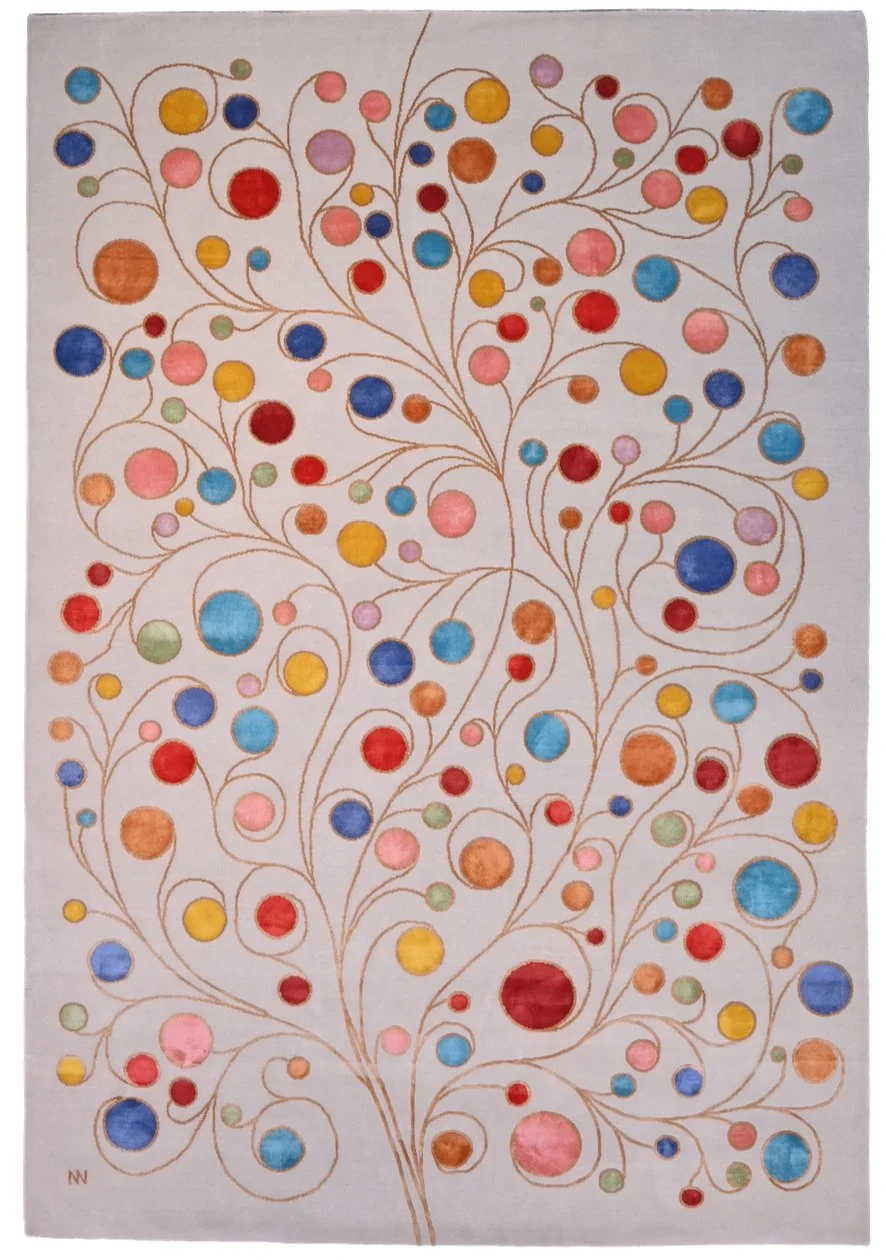
This carpet is my own interpretation, something I chose to call The Tree of My Life.
My tree does not begin within the borders of the rug, nor does it end there. Like existence itself, it arrives from an unknown infinity and disappears into another beyond my understanding. The branches twist, scroll, and wander freely, much like life itself, unpredictable, imperfect, and alive.
The fruits scattered across the tree are intentionally different in colour and size. Some appear vibrant, others quieter, some larger, some barely visible. Together, they represent moments, experiences, people, emotions, successes, losses, memories, and traces left behind through a lifetime.
There are exactly 184 fruits on the tree. The number was not accidental. Through the old Abjad system of assigning numerical values to letters, 184 corresponds to the word Vahed, meaning “One.” Many fruits, many colours, many experiences, yet ultimately one origin and one existence.
What fascinates me most about the ancient Tree of Life symbol is that, despite all cultural differences, it almost always points toward the same mystery, the relationship between multiplicity and unity, between the visible and invisible, between the temporary and the eternal.
The carpet itself was woven in Nepal by three sisters from the Tamang clan, Shanti, Kamala, and Sunita, whose patience and care became part of the piece's soul. Their contribution reminds me that even deeply personal ideas can only come into existence through human connection and shared effort.
Natural wool, silk, and cotton were used throughout the carpet, while the yarn was prepared and dyed traditionally in small quantities with minimal undesirable environmental impact. The materials were chosen to age gently and honestly, allowing the piece to mature over time, much like the life it seeks to portray.
This carpet is not meant merely to decorate a space. It is a meditation on existence, an attempt to translate thoughts that cannot easily be expressed in words into form, colour, and movement.
Wool and silk on a cotton base.
Among the countless symbols that humanity has carried through the ages, few have travelled as deeply through cultures and civilisations as the Tree of Life. In Persian mythology, perhaps the closest parallel is the Tree of All Seeds mentioned in the Bundahishn, the mythical mother of all vegetation in the world, standing beside the sacred Haoma tree in the middle of the cosmic sea of Farakhkart. From there, the idea travelled and transformed across cultures, reappearing in different forms throughout history.
For centuries, Persian weavers have interpreted this symbol in endless ways. Some depicted paradise, others eternity, fertility, renewal, or spiritual ascendance. Yet every interpretation ultimately became a reflection of the weaver’s own understanding of existence.
This carpet is my own interpretation, something I chose to call The Tree of My Life.
My tree does not begin within the borders of the rug, nor does it end there. Like existence itself, it arrives from an unknown infinity and disappears into another beyond my understanding. The branches twist, scroll, and wander freely, much like life itself, unpredictable, imperfect, and alive.
The fruits scattered across the tree are intentionally different in colour and size. Some appear vibrant, others quieter, some larger, some barely visible. Together, they represent moments, experiences, people, emotions, successes, losses, memories, and traces left behind through a lifetime.
There are exactly 184 fruits on the tree. The number was not accidental. Through the old Abjad system of assigning numerical values to letters, 184 corresponds to the word Vahed, meaning “One.” Many fruits, many colours, many experiences, yet ultimately one origin and one existence.
What fascinates me most about the ancient Tree of Life symbol is that, despite all cultural differences, it almost always points toward the same mystery, the relationship between multiplicity and unity, between the visible and invisible, between the temporary and the eternal.
The carpet itself was woven in Nepal by three sisters from the Tamang clan, Shanti, Kamala, and Sunita, whose patience and care became part of the piece's soul. Their contribution reminds me that even deeply personal ideas can only come into existence through human connection and shared effort.
Natural wool, silk, and cotton were used throughout the carpet, while the yarn was prepared and dyed traditionally in small quantities with minimal undesirable environmental impact. The materials were chosen to age gently and honestly, allowing the piece to mature over time, much like the life it seeks to portray.
This carpet is not meant merely to decorate a space. It is a meditation on existence, an attempt to translate thoughts that cannot easily be expressed in words into form, colour, and movement.
Wool and silk on a cotton base.